Question: Problem #7: Let f(x) = 2, 0.7 Limn+1 (x - 2)12 n=0 7=0 7=0 00 (D) (-1) (n+ 1) OO (-1) (n+ 1) (-1) (n+
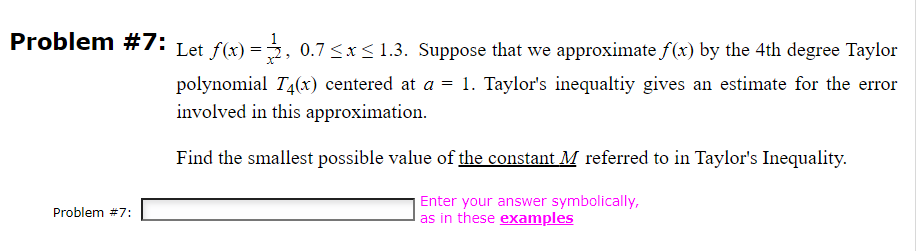
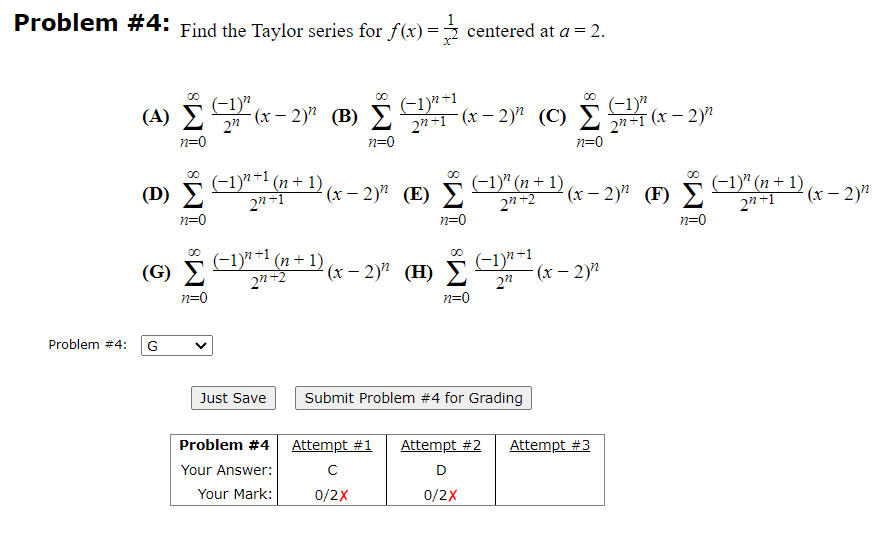
 Problem #7: Let f(x) = 2, 0.7 Limn+1 (x - 2)12n=0 7=0 7=0 00 (D) (-1)" (n+ 1) OO (-1)" (n+ 1)(-1)" (n+ 1 ) 2n+1 (x - 2)" (E) > 2n+2 (x- 2)" ( F) 2n+1 (x - 2)32 1=0 1=0 00 00(G) (-1)" (n + 1) 2n +2 (x - 2)"2 (H) (x- 2)12 1=0 Problem #4: G V Just Save Submit Problem #4

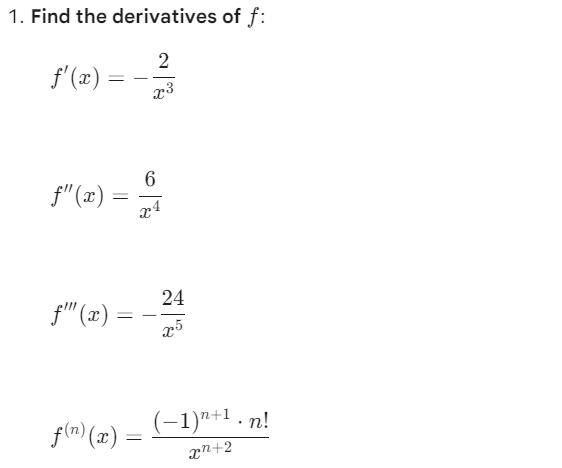
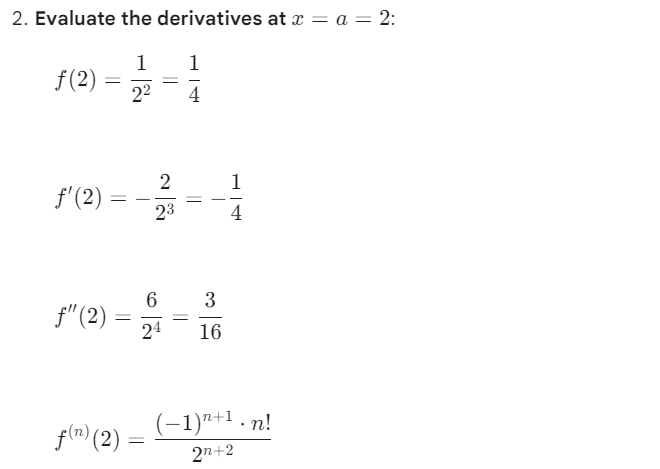
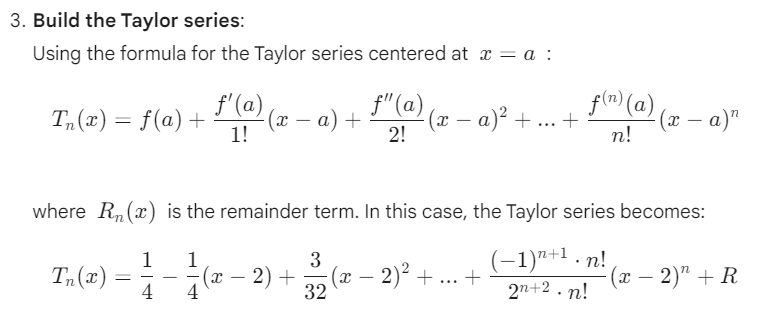
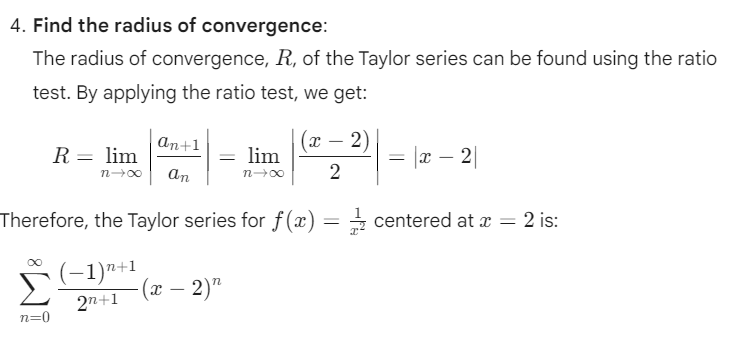
Problem #7: Let f(x) = 2, 0.7 Limn+1 (x - 2)12 n=0 7=0 7=0 00 (D) (-1)" (n+ 1) OO (-1)" (n+ 1) (-1)" (n+ 1 ) 2n+1 (x - 2)" (E) > 2n+2 (x - 2)" ( F) 2n+1 (x - 2)32 1=0 1=0 00 00 (G) (-1)" (n + 1) 2n +2 (x - 2)"2 (H) (x - 2)12 1=0 Problem #4: G V Just Save Submit Problem #4 for Grading Problem #4 Attempt #1 Attempt #2 Attempt #3 Your Answer: C D Your Mark: 0/2X 0/2X1. Find the derivatives of f: f ( x) =- f" (2) = 24 f" (20 ) = - 25 f (n) (a) = (-1)n+1 . n! zn+2\f3. Build the Taylor series: Using the formula for the Taylor series centered at x = a : In (2) = f(a) + f' la f"(a) f (n) (a) (ex - a) + ( ac - a)2 +... + (ac - a)" 1! 2! n! where Rn (@) is the remainder term. In this case, the Taylor series becomes: 3 In(a) = (Ex - 2) 2 +... + (-1)n+1 . n! (ac - 2) + (Ex - 2)" + R 32 2n+2 . n!4. Find the radius of convergence: The radius of convergence, R, of the Taylor series can be found using the ratio test. By applying the ratio test, we get: an+1 2 R = lim = lim = |2 - 2 an n->00 2 Therefore, the Taylor series for f (x) = centered at x = 2 is: (-1)n+1 2n+1 (x - 2) " 7=0

Step by Step Solution

There are 3 Steps involved in it

1 Expert Approved Answer
Step: 1 Unlock blur-text-image
Question Has Been Solved by an Expert!

Get step-by-step solutions from verified subject matter experts

Step: 2 Unlock
Step: 3 Unlock

Students Have Also Explored These Related Mathematics Questions!