







Question: Problem 7. This question is adapted from our textbook. The table below describes a two-person, two-commodity economy. The utility functions, endowments and demand functions
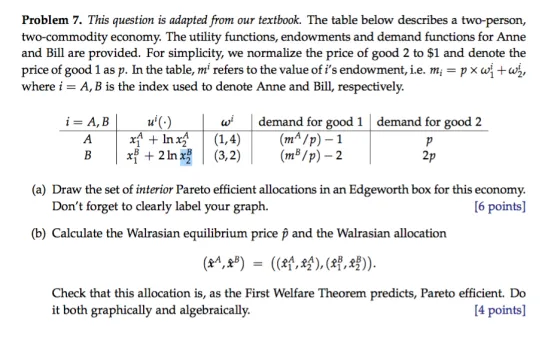
Problem 7. This question is adapted from our textbook. The table below describes a two-person, two-commodity economy. The utility functions, endowments and demand functions for Anne and Bill are provided. For simplicity, we normalize the price of good 2 to $1 and denote the price of good 1 as p. In the table, mi refers to the value of i's endowment, i.e. m; - p xw +w, where i = A, B is the index used to denote Anne and Bill, respectively. i = A,B A B u(.) x + In x x + 2 ln x wi (1,4) (3,2) demand for good 1 demand for good 2 (m^/p)-1 (m/p)-2 P 2p (a) Draw the set of interior Pareto efficient allocations in an Edgeworth box for this economy. Don't forget to clearly label your graph. [6 points] (b) Calculate the Walrasian equilibrium price and the Walrasian allocation (x^, *) = ((x, x2), (x, x)). Check that this allocation is, as the First Welfare Theorem predicts, Pareto efficient. Do it both graphically and algebraically. [4 points]
Step by Step Solution
3.49 Rating (152 Votes )
There are 3 Steps involved in it
a To draw the set of interior Pareto efficient allocations in an Edgeworth box we need to plot the i... View full answer

Get step-by-step solutions from verified subject matter experts
 Study Help