







Question: Problem 7-11 (Algorithmic) Hart Manufacturing makes three products. Each product requires manufacturing operations in three departments: A, B, and C. The labor-hour requirements, by department,
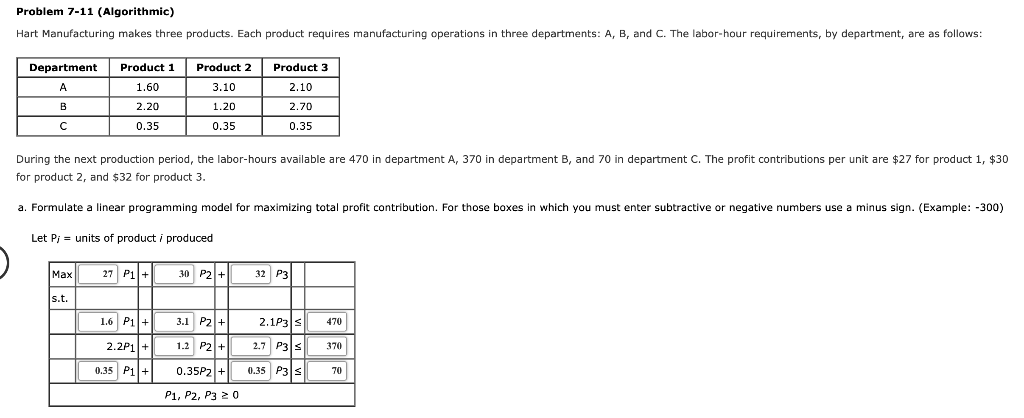
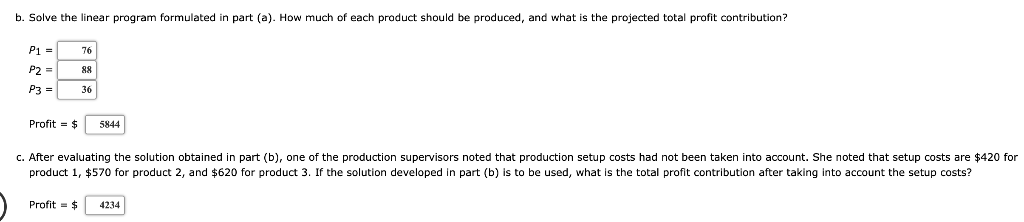
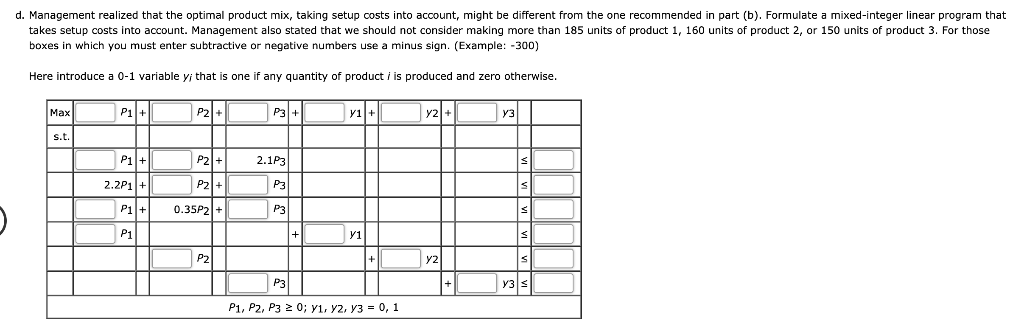
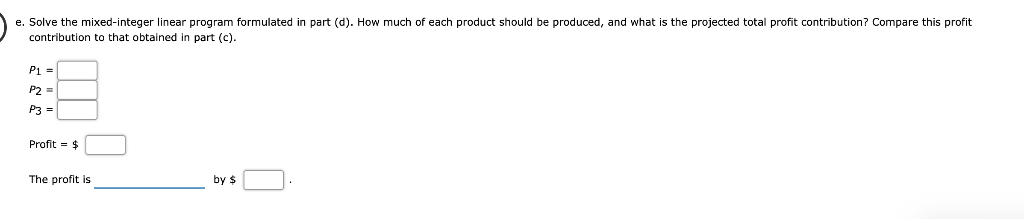
Problem 7-11 (Algorithmic) Hart Manufacturing makes three products. Each product requires manufacturing operations in three departments: A, B, and C. The labor-hour requirements, by department, are as follows: Department Product 1 Product 2 Product 3 3.10 A 1.60 2.10 1.20 2.70 2.20 0.35 0.35 C 0.35 During the next production period, the labor-hours available are 470 in department A, 370 in department B, and 70 in department C. The profit contributions per unit are $27 for product 1, $30 for product 2, and $32 for product 3 a. Formulate a linear programming model for maximizing total profit contribution. For those boxes in which you must enter subtractive or negative numbers use a minus sign. (Example: -300) units of product i produced Let Pi 27 P1 30 P2+ Max 32 P3 s.t 3.1 P2 + 16 P1 2.1P3 S 470 1.2 P2+ 2.7 P3 S 2.2P1 370 0.35 P3 0.35 P1 0.35P2 70 P1, P2, P3 0 the projected total profit contribution? b. Solve the linear program formulated in part (a). How much of each product should be produced, and what P1 76 P2 88 P3 36 Profit $ 5844 c. After evaluating the solution obtained in part (b), one of the production supervisorss noted that production setup costs had not been taken into account. She noted that setup costs are $420 for product 1, $570 for product 2, and $620 for product 3. If the solution developed in part (b) is to be used, what is the total profit contribution after taking into account the setup costs? Profit $ 4234 d. Management realized that the optimal product mix, taking setup costs into account, might be different from the one recommended takes setup costs into account. Management also stated that we should not consider making more than 185 units of product 1, 160 units of product 2, or 150 units of product 3. For those boxes in which you must enter subtractive or negative numbers use a minus sign. (Example: -300) part (b). Formulate a mixed-integer linear program that Here introduce a 0-1 variable i that is one if any quantity of product i is produced and zero otherwise. P1+ P2+ P3 |x y1 y2 y3 s.t P2+ P1 + 2.1P3 P2+ P3 2.2P1 P1+ 0.35P2 P Pt y1 y2 P2 + P3 s P1, P2, 3 2 0%3B 1, 2, %3D 0, 1 e. Solve the mixed-integer linear program formulated in part (d). How much of each product should be produced, and what contribution to that obtained in part (c) the projected total profit contribution? Compare this profit Pi= P2= P3= Profit $ The profit is by $
Step by Step Solution
There are 3 Steps involved in it

Get step-by-step solutions from verified subject matter experts
 Study Help