



Question: Problem 7.31 As part of a diabetes prevention program, a clinic is considering setting up a screening service in a local mall. They are considering
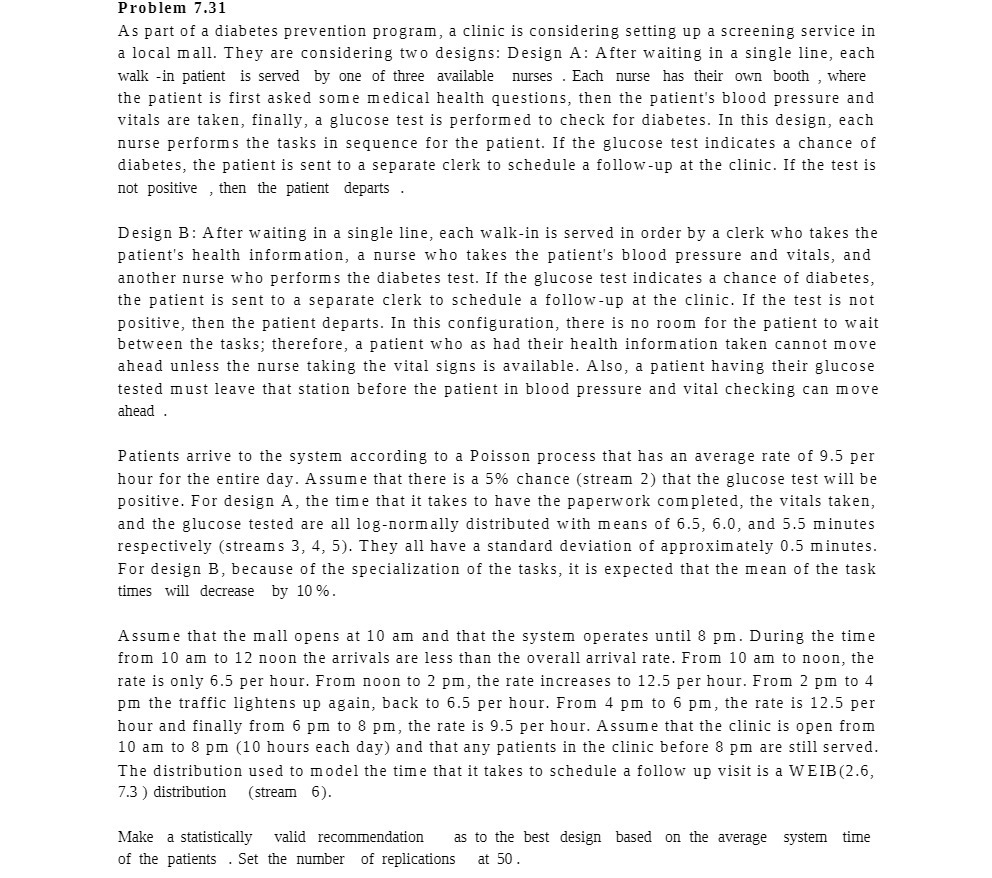
Problem 7.31 As part of a diabetes prevention program, a clinic is considering setting up a screening service in a local mall. They are considering two designs: Design A: After waiting in a single line, each walk -i.n patient is served by one of three available nurses .Each nurse has their own booth , where the patient is first asked some medical health questions, then the patient's blood pressure and vitals are taken, finally, a glucose test is performed to check for diabetes. In this design, each nurse performs the tasks in sequence for the patient. If the glucose test indicates a chance of diabetes, the patient is sent to a separate clerk to schedule a followup at the clinic. If the test is not positive ,then the patient departs . Design B: After waiting in a single line, each walk-in is served in order by a clerk who takes the patient's health information, a nurse who takes the patient's blood pressure and vitals, and another nurse who performs the diabetes test. If the glucose test indicates a chance of diabetes, the patient is sent to a separate clerk to schedule a followup at the clinic. If the test is not positive, then the patient departs. In this configuration, there is no room for the patient to wait between the tasks; therefore, a patient who as had their health information taken cannot move ahead unless the nurse taking the vital signs is available. Also, a patient having their glucose tested must leave that station before the patient in blood pressure and vital checking can move ahead . Patients arrive to the system according to a Poisson process that has an average rate of 9.5 per hour for the entire day. Assume that there is a 5% chance (stream 2} that the glucose test will be positive. For design A, the time that it takes to have the paperwork completed, the vitals taken, and the glucose tested are all log-normally distributed with means of 6.5, 6.0, and 5.5 minutes respectively (streams 3, 4, 5). They all have a standard deviation of approximately 0.5 minutes. For design B, because of the specialization of the tasks, it is expected that the mean of the task times will decrease by 10%. Assume that the mall opens at ll] am and that the system operates until 8 pm. During the time from 1|] am to 12 noon the arrivals are less than the overall arrival rate. From 1|] am to noon, the rate is only 6.5 per hour. From noon to 2 pm, the rate increases to 12.5 per hour. From 2 pm to 4 pm the traffic lightens up again, back to 6.5 per hour. From 4 pm to 6 pm, the rate is 12.5 per hour and finally from 6 pm to 8 pm, the rate is 9.5 per hour. Assume that the clinic is open from 1|] am to 8 pm (10 hours each day] and that any patients in the clinic before 3 pm are still served. The distribution used to model the time that it takes to schedule a follow up visit is a WEIBE, 7.3)distribution [stream 6). Make a statistically valid recommendation as to the best design based on the average system time of the patients .Set the number of replications at 5|]
Step by Step Solution
There are 3 Steps involved in it

Get step-by-step solutions from verified subject matter experts