







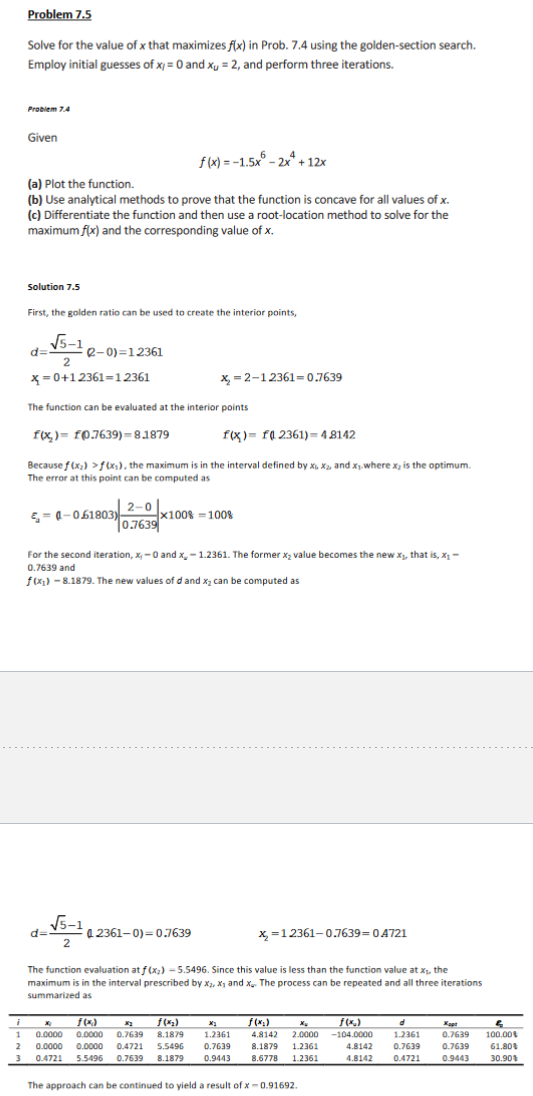
Question: Problem 7.5 Solve for the value of x that maximizes f(x) in Prob. 7.4 using the golden-section search. Employ initial guesses of x_(l)=0 and x_(U)=2
Problem 7.5\ Solve for the value of
xthat maximizes
f(x)in Prob. 7.4 using the golden-section search.\ Employ initial guesses of
x_(l)=0and
x_(U)=2, and perform three iterations.\ Problem 7.4\ Given\
f(x)=-1.5x^(6)-2x^(4)+12x\ (a) Plot the function.\ (b) Use analytical methods to prove that the function is concave for all values of
x.\ (c) Differentiate the function and then use a root-location method to solve for the\ maximum
f(x)and the corresponding value of
x.\ Solution 7.5\ First, the golden ratio can be used to create the interior points,\
d=(\\\\sqrt(5)-1)/(2)(2-0)=1.2361\ x_(1)=0+1.2361=1.2361,x_(2)=2-1.2361=0.7639\ The function can be evaluated at the interior points\
f(x_(2))=f(0.7639)=8.1879,f(x_(1))=f(1.2361)=4.8142\ Because
f(x_(2))>f(x_(1)), the maximum is in the interval defined by
x_(6)x_(2)and
x_(1), where
x_(2)is the optimum.\ The error at this point can be computed as\
\\\\epsi _(a)=(1-0.61803)|(2-0)/(0.7639)|\\\\times 1008=1008\ For the second iteration,
x_(1)-0and
x_(w)-1.2361. The former
x_(2)value becomes the new
x_(1), that is,
x_(1)-\ 0.7639 and\
f(x_(1))-8.1879. The new values of
dand
x_(2)can be computed as\
d=(\\\\sqrt(5)-1)/(2)(1.2361-0)=0.7639,x_(2)=1.2361-0.7639=0.4721\ The function evaluation at
f(x_(2))-5.5496. Since this value is less than the function value at
x_(1), the\ maximum is in the interval prescribed by
x_(2),x_(1)and
x_(0). The process can be repeated and all three iterations\ summarized as\ The approach can be continued to yield a result of
x=0.91692.\ \ \ \ \ \ \ \ \ \ \ SOLVE THE 4TH ITERATION!!!
Solve for the value of x that maximizes f(x) in Prob. 7.4 using the golden-section search. Employ initial guesses of xl=0 and xu=2, and perform three iterations. Probiem 7.4 Given f(x)=1.5x62x4+12x (a) Plot the function. (b) Use analytical methods to prove that the function is concave for all values of x. (c) Differentiate the function and then use a root-location method to solve for the maximum f(x) and the corresponding value of x. Solution 7.5 First, the golden ratio can be used to create the interior points, d=251(20)=1.2361x1=0+12361=1.2361x2=21.2361=0.7639 The function can be evaluated at the interior points f(x2)=f(0.7639)=8.1879f(x1)=f(1.2361)=48142 Because f(x2)>f(x1), the maximum is in the interval defined by x6x2 and x1, where x2 is the optimum. The error at this point can be computed as a=(10.51803)0.7639201008=1008 For the second iteration, x10 and xw1.2361. The former x2 value becomes the new x1, that is, x1 0.7639 and f(x1)8.1879. The new values of d and x2 can be computed as d=251(2.23610)=0.7639x2=1.23610.7639=0.4721 The function evaluation at f(x2)5.5496. Since this value is less than the function value at x1, the maximum is in the interval prescribed by x2,x1 and x6. The process can be repeated and all three iterations summarized as The approach can be continued to yield a result of x=0.91692
Step by Step Solution
There are 3 Steps involved in it

Get step-by-step solutions from verified subject matter experts
 Study Help