







Question: Problem 8. Write a function called unequal4_expression that takes one four- element vector as an input argument (the function does not have to check the
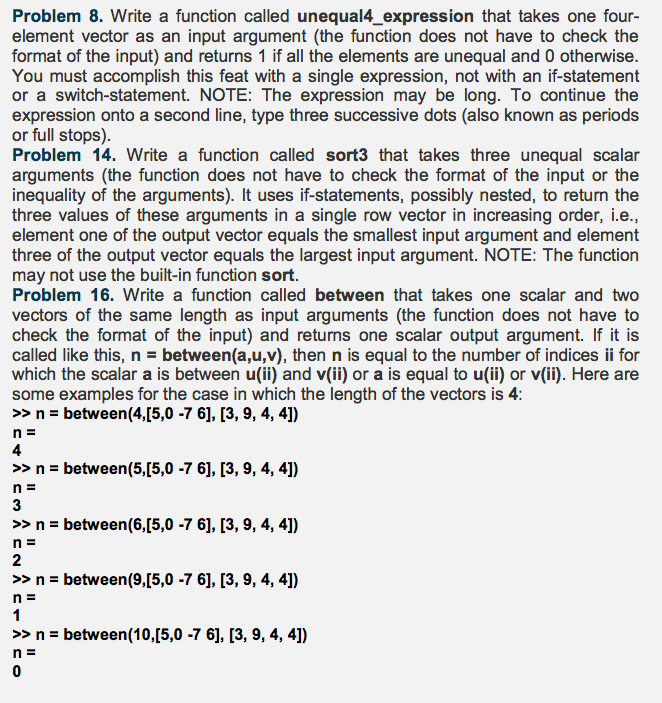
Problem 8. Write a function called unequal4_expression that takes one four- element vector as an input argument (the function does not have to check the format of the input) and returns 1 if all the elements are unequal and 0 otherwise You must accomplish this feat with a single expression, not with an if-statement or a switch-statement. NOTE: The expression may be long. To continue the expression onto a second line, type three successive dots (also known as periods or full stops) Problem 14. Write a function called sort3 that takes three unequal scalar arguments (the function does not have to check the format of the input or the inequality of the arguments). It uses if-statements, possibly nested, to return the three values of these arguments in a single row vector in increasing order, i.e element one of the output vector equals the smallest input argument and element three of the output vector equals the largest input argument. NOTE: The function may not use the built-in function sort. Problem 16. Write a function called betweenthat takes one scalar andtwo vectors of the same length as input arguments (the function does not have to check the format of the input) and returns one scalar output argument. If it is called like this, n -between(a,u,v), then n is equal to the number of indices ii for which the scalar a is between u(ii) and v(ii) or a is equal to u(ii) or v(ii). Here are some examples for the case in which the length of the vectors is 4 >> n = between(4,5,0-7 6], [3, 9, 4, 4]) 4 >> n = between(5,[5,0-7 6], [3, 9, 4, 41) >> n = between(6,[5,0-7 6], [3, 9, 4, 41) 2 >> n = between(9.[5,0-7 6], [3, 9, 4, 41) >> n = between(10.[5,0-7 6], [3, 9, 4, 41) Problem 8. Write a function called unequal4_expression that takes one four- element vector as an input argument (the function does not have to check the format of the input) and returns 1 if all the elements are unequal and 0 otherwise You must accomplish this feat with a single expression, not with an if-statement or a switch-statement. NOTE: The expression may be long. To continue the expression onto a second line, type three successive dots (also known as periods or full stops) Problem 14. Write a function called sort3 that takes three unequal scalar arguments (the function does not have to check the format of the input or the inequality of the arguments). It uses if-statements, possibly nested, to return the three values of these arguments in a single row vector in increasing order, i.e element one of the output vector equals the smallest input argument and element three of the output vector equals the largest input argument. NOTE: The function may not use the built-in function sort. Problem 16. Write a function called betweenthat takes one scalar andtwo vectors of the same length as input arguments (the function does not have to check the format of the input) and returns one scalar output argument. If it is called like this, n -between(a,u,v), then n is equal to the number of indices ii for which the scalar a is between u(ii) and v(ii) or a is equal to u(ii) or v(ii). Here are some examples for the case in which the length of the vectors is 4 >> n = between(4,5,0-7 6], [3, 9, 4, 4]) 4 >> n = between(5,[5,0-7 6], [3, 9, 4, 41) >> n = between(6,[5,0-7 6], [3, 9, 4, 41) 2 >> n = between(9.[5,0-7 6], [3, 9, 4, 41) >> n = between(10.[5,0-7 6], [3, 9, 4, 41)
Step by Step Solution
There are 3 Steps involved in it

Get step-by-step solutions from verified subject matter experts
 Study Help