







Question: Problem 9 Designing an undirected graphical model In this question we design a very simple undirected graphical model for denoising the output of a black-andwhite
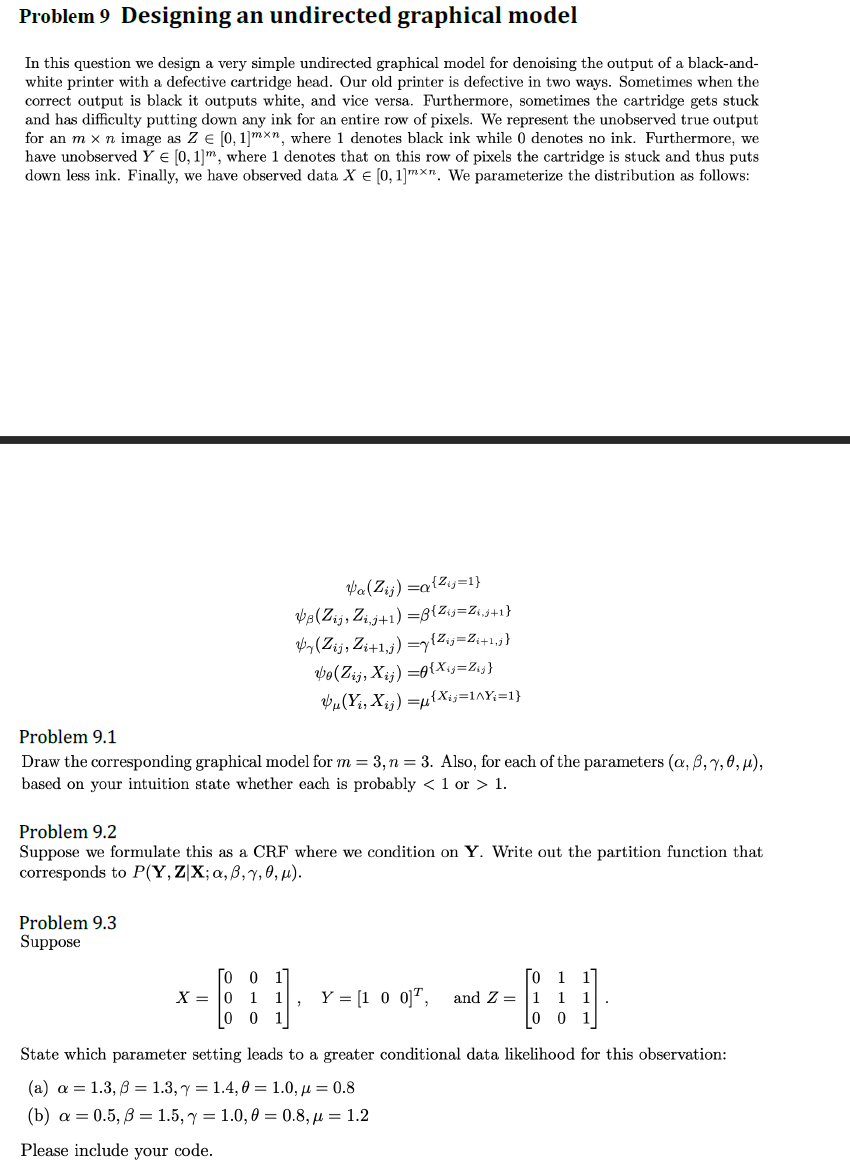
Problem 9 Designing an undirected graphical model In this question we design a very simple undirected graphical model for denoising the output of a black-andwhite printer with a defective cartridge head. Our old printer is defective in two ways. Sometimes when the correct output is black it outputs white, and vice versa. Furthermore, sometimes the cartridge gets stuck and has difficulty putting down any ink for an entire row of pixels. We represent the unobserved true output for an mn image as Z[0,1]mn, where 1 denotes black ink while 0 denotes no ink. Furthermore, we have unobserved Y[0,1]m, where 1 denotes that on this row of pixels the cartridge is stuck and thus puts down less ink. Finally, we have observed data X[0,1]mn. We parameterize the distribution as follows: (Zij)(Zij,Zi,j+1)(Zij,Zi+1,j)(Zij,Xij)(Yi,Xij)={Zij=1}={Zij=Zi,j+1}={Zij=Zi+1,j}={Xij=Zij}={Xij=1Yi=1} Problem 9.1 Draw the corresponding graphical model for m=3,n=3. Also, for each of the parameters (,,,,), based on your intuition state whether each is probably 1. Problem 9.2 Suppose we formulate this as a CRF where we condition on Y. Write out the partition function that corresponds to P(Y,ZX;,,,,). Problem 9.3 Suppose X=000010111,Y=[100]T,andZ=010110111. State which parameter setting leads to a greater conditional data likelihood for this observation: (a) =1.3,=1.3,=1.4,=1.0,=0.8 (b) =0.5,=1.5,=1.0,=0.8,=1.2 Please include your code
Step by Step Solution
There are 3 Steps involved in it

Get step-by-step solutions from verified subject matter experts
 Study Help