







Question: Problem 9 The maximum seismic base shear demand for a steel building structure during its expected lifetime has an expected value of 14,000 kips, a
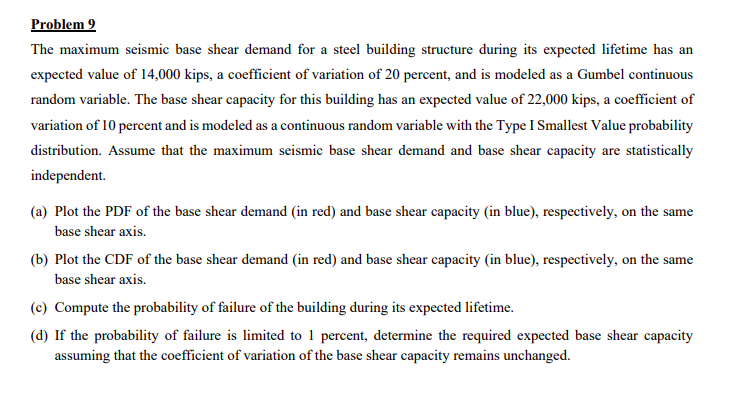
Problem 9 The maximum seismic base shear demand for a steel building structure during its expected lifetime has an expected value of 14,000 kips, a coefficient of variation of 20 percent, and is modeled as a Gumbel continuous random variable. The base shear capacity for this building has an expected value of 22,000 kips, a coefficient of variation of 10 percent and is modeled as a continuous random variable with the Type I Smallest Value probability distribution. Assume that the maximum seismic base shear demand and base shear capacity are statistically independent. (a) Plot the PDF of the base shear demand (in red) and base shear capacity (in blue), respectively, on the same base shear axis. (b) Plot the CDF of the base shear demand (in red) and base shear capacity (in blue), respectively, on the same base shear axis. (c) Compute the probability of failure of the building during its expected lifetime. (d) If the probability of failure is limited to 1 percent, determine the required expected base shear capacity assuming that the coefficient of variation of the base shear capacity remains unchanged
Step by Step Solution
There are 3 Steps involved in it

Get step-by-step solutions from verified subject matter experts
 Study Help