







Question: Problem 9.2 Predicting Delayed Flights. The le FlightDelays.csv contains information on all commercial flights departing the Washington, DC area and arriving at New York during
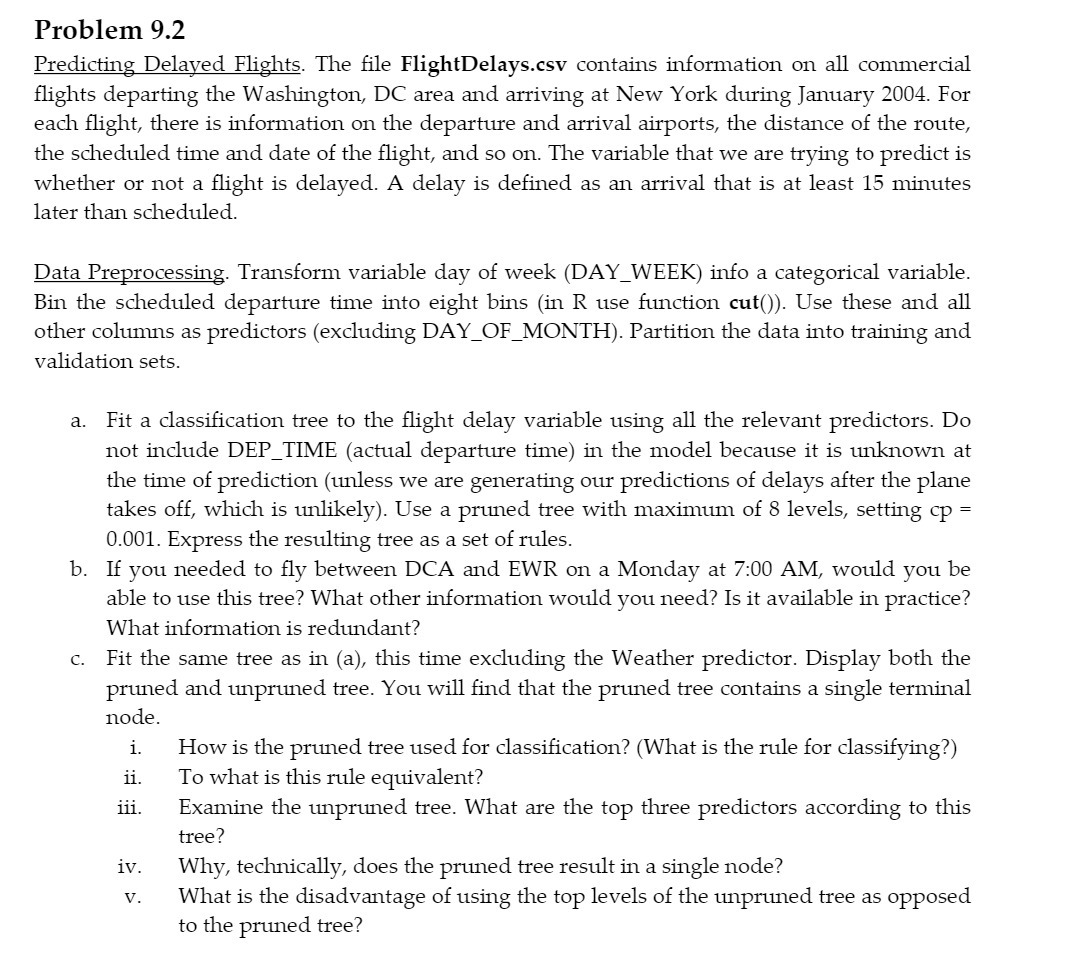
Problem 9.2 Predicting Delayed Flights. The le FlightDelays.csv contains information on all commercial flights departing the Washington, DC area and arriving at New York during January 2004. For each flight, there is information on the departure and arrival airports, the distance of the route, the scheduled time and date of the flight, and so on. The variable that we are trying to predict is whether or not a flight is delayed. A delay is defined as an arrival that is at least 15 minutes later than scheduled. Data ngrocessing. Transform variable day of week (DAY_WEEK) info a categorical variable. Bin the scheduled departure time into eight bins (in R use function cut()). Use these and all other columns as predictors (excluding DAY_OF_MONTH). Partition the data into training and. validation sets. a. Fit a classification tree to the ight delay variable using all the relevant predictors. Do not include DEP_TIME (actual departure time) in the model because it is unknown at the time of prediction (unless we are generating our predictions of delays after the plane takes off, which is unlikely). Use a pruned tree with maximum of 8 levels, setting cp = 0.001. Express the resulting tree as a set of rules. b. If you needed to fly between DCA and EWR on a Monday at 7:00 AM, would you be able to use this tree? What other information would you need? Is it available in practice? What information is redundant? c. Fit the same tree as in (a), this tinre excluding the Weather predictor. Display both the pruned and unpruned tree. You will find that the pruned tree contains a single terminal node. i. How is the pruned tree used for classication? (What is the rule for classifying?) ii To what is this rule equivalent? iii. Examine the unpruned tree. What are the top three predictors according to this tree? iv. Why, technically, does the pruned tree result in a single node? v. What is the disadvantage of using the top levels of the unpruned tree as opposed to the pruned tree
Step by Step Solution
There are 3 Steps involved in it

Get step-by-step solutions from verified subject matter experts
 Study Help