







Question: Problem A4) Problem A5) a) Is 51 a prime number? Explain briefly. b) List the first 15 prime numbers (Remember that 1 is not
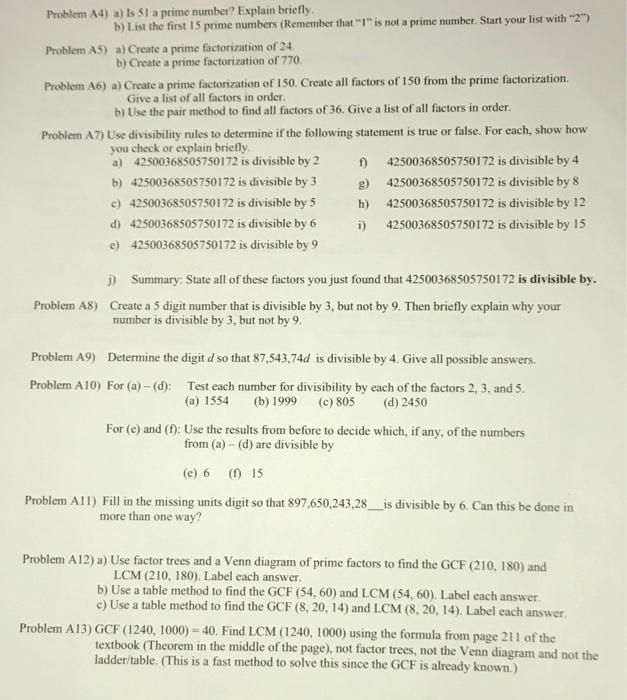
Problem A4) Problem A5) a) Is 51 a prime number? Explain briefly. b) List the first 15 prime numbers (Remember that "1" is not a prime number. Start your list with "2") a) Create a prime factorization of 24. b) Create a prime factorization of 770. Problem A6) a) Create a prime factorization of 150. Create all factors of 150 from the prime factorization. Give a list of all factors in order. b) Use the pair method to find all factors of 36. Give a list of all factors in order. Problem A7) Use divisibility rules to determine if the following statement is true or false. For each, show how you check or explain briefly. a) 42500368505750172 is divisible by 2 b) 42500368505750172 is divisible by 3 c) 42500368505750172 is divisible by 5. d) 42500368505750172 is divisible by 6 e) 42500368505750172 is divisible by 9 f) g) 42500368505750172 is divisible by 4 42500368505750172 is divisible by 8 h) 42500368505750172 is divisible by 12 i) 42500368505750172 is divisible by 15 j) Summary: State all of these factors you just found that 42500368505750172 is divisible by. Problem A8) Create a 5 digit number that is divisible by 3, but not by 9. Then briefly explain why your number is divisible by 3, but not by 9. Problem A9) Determine the digit d so that 87,543,74d is divisible by 4. Give all possible answers. Problem A10) For (a)-(d): Test each number for divisibility by each of the factors 2, 3, and 5. (a) 1554 (b) 1999 (c) 805 (d) 2450 For (e) and (f): Use the results from before to decide which, if any, of the numbers from (a)-(d) are divisible by (e) 6 (f) 15 Problem A11) Fill in the missing units digit so that 897,650,243,28 is divisible by 6. Can this be done in more than one way? Problem A12) a) Use factor trees and a Venn diagram of prime factors to find the GCF (210, 180) and LCM (210, 180). Label each answer. b) Use a table method to find the GCF (54, 60) and LCM (54, 60). Label each answer. c) Use a table method to find the GCF (8, 20, 14) and LCM (8, 20, 14). Label each answer. Problem A13) GCF (1240, 1000)-40. Find LCM (1240, 1000) using the formula from page 211 of the textbook (Theorem in the middle of the page), not factor trees, not the Venn diagram and not the ladder/table. (This is a fast method to solve this since the GCF is already known.)
Step by Step Solution
3.38 Rating (151 Votes )
There are 3 Steps involved in it
Problem A4 a No 51 is not a prime number because it is divisible by 3 3 x 17 b The first 15 prime numbers are 2 3 5 7 11 13 17 19 23 29 31 37 41 43 47 ... View full answer

Get step-by-step solutions from verified subject matter experts
 Study Help