







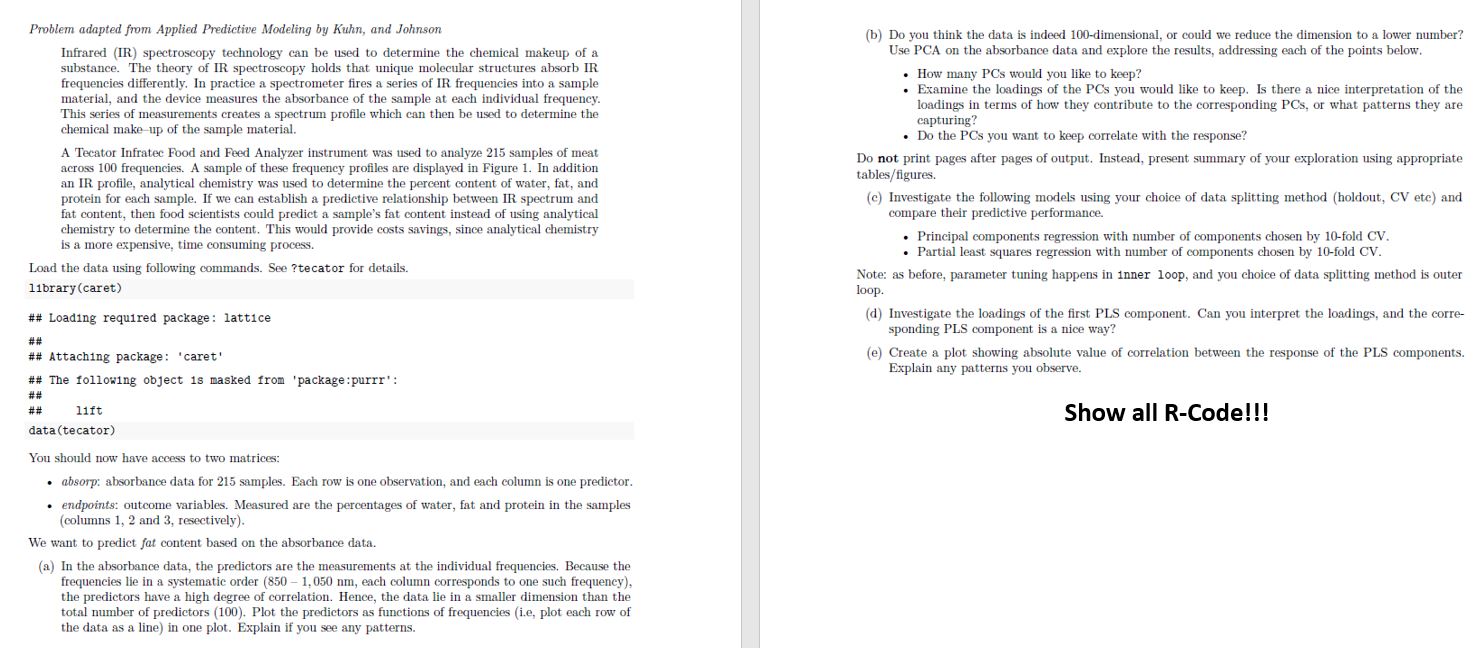
Question: Problem adapted from Applied Predictive Modeling by Kuhn, and Johnson Infrared ( IR ) spectroscopy technology can be used to determine the chemical makeup of
Problem adapted from Applied Predictive Modeling by Kuhn, and Johnson
Infrared IR spectroscopy technology can be used to determine the chemical makeup of a
substance. The theory of IR spectroscopy holds that unique molecular structures absorb IR
frequencies differently. In practice a spectrometer fires a series of IR frequencies into a sample
material, and the device measures the absorbance of the sample at each individual frequency.
This series of measurements creates a spectrum profile which can then be used to determine the
chemical makeup of the sample material.
A Tecator Infratec Food and Feed Analyzer instrument was used to analyze samples of meat
across frequencies. A sample of these frequency profiles are displayed in Figure In addition
an IR profile, analytical chemistry was used to determine the percent content of water, fat, and
protein for each sample. If we can establish a predictive relationship between IR spectrum and
fat content, then food scientists could predict a samples fat content instead of using analytical
chemistry to determine the content. This would provide costs savings, since analytical chemistry
is a more expensive, time consuming process.
Load the data using following commands. See tecator for details.
librarycaret
## Loading required package: lattice
##
## Attaching package: 'caret'
## The following object is masked from 'package:purrr':
##
## lift
datatecator
You should now have access to two matrices:
absorp: absorbance data for samples. Each row is one observation, and each column is one predictor.
endpoints: outcome variables. Measured are the percentages of water, fat and protein in the samples
columns and resectively
We want to predict fat content based on the absorbance data.
a In the absorbance data, the predictors are the measurements at the individual frequencies. Because the
frequencies lie in a systematic order nm each column corresponds to one such frequency
the predictors have a high degree of correlation. Hence, the data lie in a smaller dimension than the
total number of predictors Plot the predictors as functions of frequencies ie plot each row of
the data as a line in one plot. Explain if you see any patterns.
b Do you think the data is indeed dimensional, or could we reduce the dimension to a lower number?
Use PCA on the absorbance data and explore the results, addressing each of the points below.
How many PCs would you like to keep?
Examine the loadings of the PCs you would like to keep. Is there a nice interpretation of the
loadings in terms of how they contribute to the corresponding PCs or what patterns they are
capturing?
Do the PCs you want to keep correlate with the response?
Do not print pages after pages of output. Instead, present summary of your exploration using appropriate
tablesfigures
c Investigate the following models using your choice of data splitting method holdout CV etc and
compare their predictive performance.
Principal components regression with number of components chosen by fold CV
Partial least squares regression with number of components chosen by fold CV
Note: as before, parameter tuning happens in nner loop, and you choice of data splitting method is outer
loop.
d Investigate the loadings of the first PLS component. Can you interpret the loadings, and the corre
sponding PLS component is a nice way?
e Create a plot showing absolute value of correlation between the response of the PLS components.
Explain any patterns you observe.
b Do you think the data is indeed dimensional, or could we reduce the dimension to a lower number?
Use PCA on the absorbance data and explore the results, addressing each of the points below.
How many PCs would you like to keep?
Examine the loadings of the PCs you would like to keep. Is there a nice interpretation of the
loadings in terms of how they contribute to the corresponding PCs or what patterns they are
capturing?
Do the PCs you want to keep correlate with the response?
Do not print pages after pages of output. Instead, present summary of your exploration using appropriate
tablesfigures
c Investigate the following models using your choice of data splitting method holdout CV etc and
compare their predictive performance.
Principal components regression with number of components chosen by fold CV
Partial least squares regression with number of components chosen by fold CV
Note: as before, parameter tuning happens in inner loop, and you choice of data splitting method is outer
loop.
d Investigate the loadings of the first PLS component. Can you interpret the loadings, and the corre
sponding PLS component is a nice way?
e Create a plot showing absolute value of correlation between the response of the PLS components.
Explain any patterns you observe.
SHOW ALL RCODE!!!
Step by Step Solution
There are 3 Steps involved in it
1 Expert Approved Answer
Step: 1 Unlock

Question Has Been Solved by an Expert!
Get step-by-step solutions from verified subject matter experts
Step: 2 Unlock
Step: 3 Unlock
 Study Help