Question: Problem: and compound | or compound -2 0 or - 2x 2 4OneVariable Compound Inequalities I compound inequality I and I or I intersection I

  • Problem:
  • and compound | or compound
Problem: and compound | or compound -2 < 26 +7xProblem: and compound | or compound -2 < 26 +7xProblem: and compound | or compound -2 < 26 +7xProblem: and compound | or compound -2 < 26 +7x
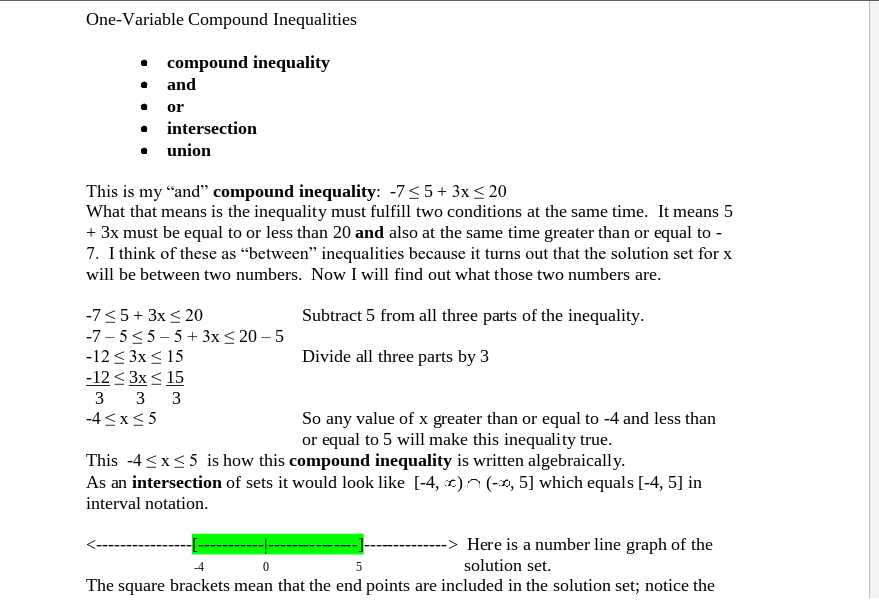
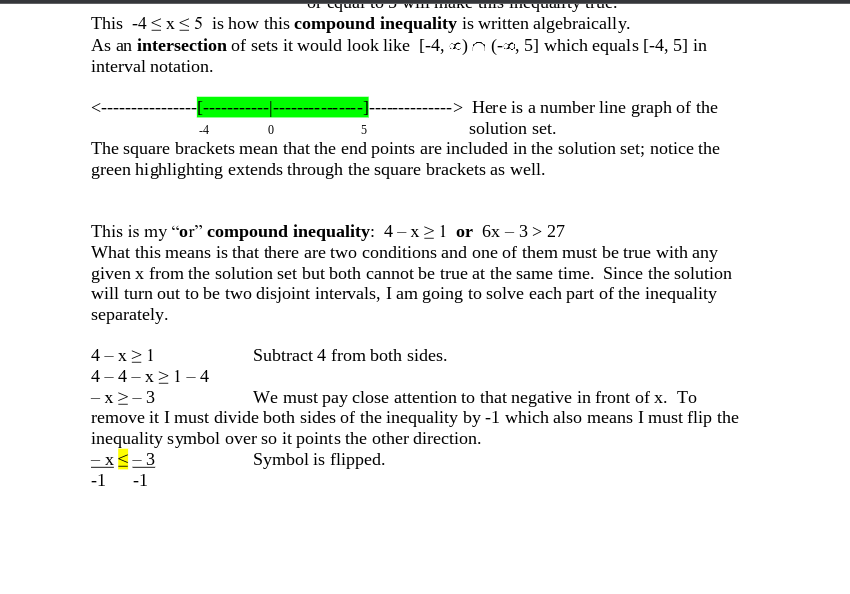
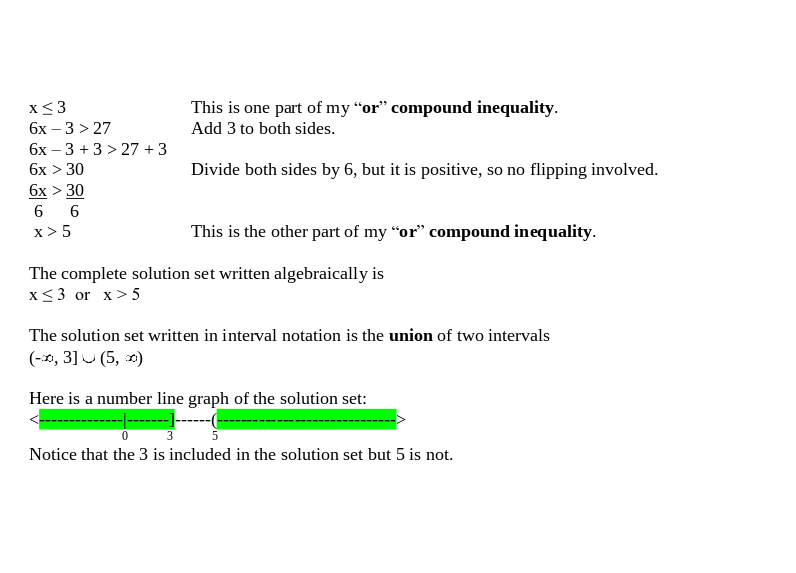
-2 0 or - 2x 2 4OneVariable Compound Inequalities I compound inequality I and I or I intersection I union This is my \"and" compound inequality: -? E S + 3x 5 20 What that means is the inequality must fulfill two conditions at the same time. It means 5 + 3): must be equal to or less than 20 and also at the same time greater than or equal to - T. Ithink of these as \"between" inequalities because it turns out that the solution set for x will be between two numbers. Now I will find out what those two numbers are. ? E 5 + 3x :1 2|} Subtract 5 from all three parts of the inequality. -7'555+3x205 12 :3 3x :1 15 Divide all three parts by 3 E 5 Q i E 3 3 3 4 E x E 5 So any value of x greater than or equal to 4 and less than or equal to 5 will make this inequality true. This -4 E x E 5 is how this compound inequality is written algebraically. As an intersection of sets it would look like [-4, 3:] n [-n, S] which equals [-4, 5] in interval notation. Here is a number line graph of the 4 0 5 solution set. The square brackets mean that the end points are included in the solution set; notice the W This -4 i x E 5 is how this compound inequality is written algebraically. As an intersection of sets it would look like [-4, as] c\" [-20, S] which equals [-4, S] in interval notation. Here is a number line graph of the 4 1} 5 solution set. The square brackets mean that the end points are included in the solution set; notice the green highlighting extends through the square brackets as well. This is my \"or" compound inequality: 4 x 3 l or Ex 3 3' 2? 'What this means is that there are two conditions and one of them must be true with any given it from the solution set but both cannot be true at the same time. Since the solution will turn out to be two disjoint intervals, I am going to solve each part ofthe inequality separately. 4 x 3 1 Subtract 4 from both sides. 44x>l4 x 3 3 We must pay close attention to that negative in front of x. To remove it I must divide both sides of the inequality by -1 which also means I must flip the inequality symbol over so it points the other direction. 1 :1 _3 Symbol is flipped. -1 -1 x 27 Add 3 to both sides. 6x - 3 + 3 > 27 + 3 6x > 30 Divide both sides by 6, but it is positive, so no flipping involved. 6x > 30 6 6 x > 5 This is the other part of my "or" compound inequality. The complete solution set written algebraically is x 3 or x > 5 The solution set written in interval notation is the union of two intervals (-1, 3] (5, x) Here is a number line graph of the solution set: 0 Notice that the 3 is included in the solution set but 5 is not

Step by Step Solution

There are 3 Steps involved in it

1 Expert Approved Answer
Step: 1 Unlock blur-text-image

Question Has Been Solved by an Expert!

Get step-by-step solutions from verified subject matter experts

Step: 2 Unlock
Step: 3 Unlock

Students Have Also Explored These Related Mathematics Questions!