







Question: Problem : Answer the questions in Part A and Part B. Show your work. Part A : Consider the following grammar: S > At A
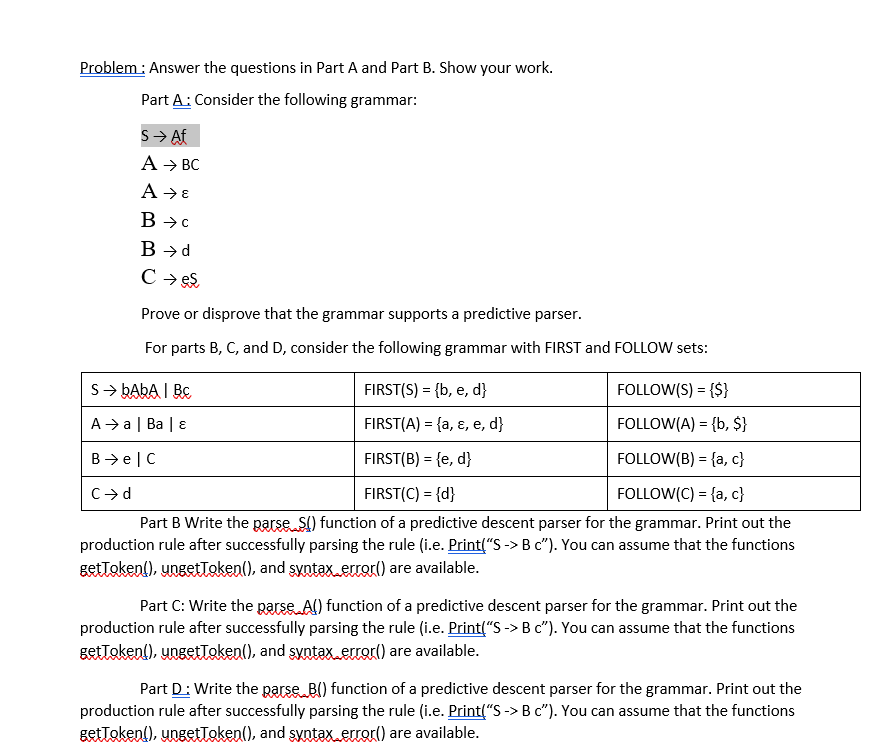
Problem : Answer the questions in Part A and Part B. Show your work. Part A : Consider the following grammar: S > At A > BC A - E B - c B -d Czes Prove or disprove that the grammar supports a predictive parser. For parts B, C, and D, consider the following grammar with FIRST and FOLLOW sets: S -> bAbA I BE FIRST(S) = {b, e, d} FOLLOW(S) = ($} A - a | Ba | E FIRST(A) = {a, &, e, d} FOLLOW(A) = {b, $} FIRST(B) = {e, d'} FOLLOW(B) = {a, c} c-d FIRST(C) = {d} FOLLOW(C) = {a, c} Part B Write the parse_S() function of a predictive descent parser for the grammar. Print out the production rule after successfully parsing the rule (i.e. Print("S -> B c"). You can assume that the functions getToken!), ungetToken(), and syntax error() are available. Part C: Write the parse_A() function of a predictive descent parser for the grammar. Print out the production rule after successfully parsing the rule (i.e. Print("S -> B c"). You can assume that the functions getToken(), ungetToken(), and syntax error() are available. Part D : Write the parse_B() function of a predictive descent parser for the grammar. Print out the production rule after successfully parsing the rule (i.e. Print("S -> Bc"). You can assume that the functions getToken(), unsetToken(), and syntax_error() are available
Step by Step Solution
There are 3 Steps involved in it

Get step-by-step solutions from verified subject matter experts
 Study Help