







Question: Problem: Convert a C program to a Goto-C program. Read the following for information on how Goto-C works and for examples: Goto-C refers to a
Problem: Convert a C program to a "Goto-C" program.
Read the following for information on how "Goto-C" works and for examples:
"Goto-C refers to a programming language that is C with the following modifications: The only kind of if statement allowed in Goto-C is the following: if (expression) goto label ; Goto-C does not have the following keywords and operators: else while for do switch && || Goto-C does not have ?: the conditional operator.

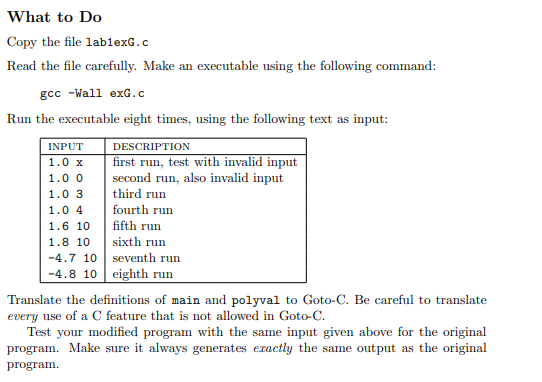
MAKE SURE TO TRANSLATE ANY EXPRESSIONS THAT USE else, for, while, do, switch &&, ||. THESE ARE ILLEGAL KEYWORDS AND MUST BE REMOVED. CONFIRM THAT THE ORGINAL C CODE AND "Go-to C" CODE PRODUCE THE SAME OUTPUT! PLEASE PROVIDE THE "Go-to C" CODE AND SCREENSHOTS OF THE OUTPUTS WITH THE TEST INPUTS PROVIDED ABOVE.
The original c file is provided below
// lab1exG.c
#include
#include
#include
#define MAX_ABS_F (5.0e-10)
#define POLY_DEGREE 4
double polyval(const double *a, int n, double x);
/* Return a[0] + a[1] * x + ... + a[n] * pow(x, n). */
int main(void)
{
double f[] = {1.45, 0.72, -3.07, -1.15, 1.00};
double dfdx[POLY_DEGREE];
double guess;
int max_updates;
int update_count;
int n_scanned;
int i;
double current_x, current_f, current_dfdx;
printf("This program demonstrates use of Newton's Method to find "
"approximate roots of the polynomial f(x) = ");
printf("%.2f", f[0]);
for (i = 1; i
if (f[i] >= 0)
printf(" + %.2f*pow(x,%d)", f[i], i);
else
printf(" - %.2f*pow(x,%d)", -f[i], i);
printf(" Please enter a guess at a root, and a maximum number of "
"updates to do, separated by a space. ");
n_scanned = scanf("%lf%d", &guess, &max_updates);
if (n_scanned != 2)
{
printf("Sorry, I couldn't understand the input. ");
exit(1);
}
if (max_updates
{
printf("Sorry, I must be allowed do at least one update. ");
exit(1);
}
printf("Running with initial guess %f. ", guess);
for (i = POLY_DEGREE - 1; i >= 0; i--)
dfdx[i] = (i + 1) * f[i + 1]; // Calculus!
current_x = guess;
update_count = 0;
while (1)
{
current_f = polyval(f, POLY_DEGREE, current_x);
printf("%d update(s) done; x is %.15f; f(x) is %.15e ",
update_count, current_x, current_f);
if (fabs(current_f)
break;
if (update_count == max_updates)
break;
current_dfdx = polyval(dfdx, POLY_DEGREE - 1, current_x);
current_x -= current_f / current_dfdx;
update_count++;
}
if (fabs(current_f) >= MAX_ABS_F)
printf("%d updates performed, |f(x)| still >= %g. ",
update_count, MAX_ABS_F);
else
printf("Stopped with approximate solution of %.10f. ",
current_x);
return 0;
}
double polyval(const double *a, int n, double x)
{
double result = 0.0;
int i = n;
while (1)
{
result += a[i];
if (i == 0)
break;
result *= x;
i--;
}
return result;
}
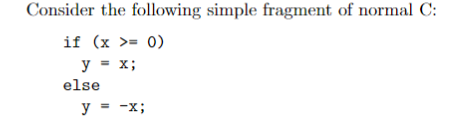
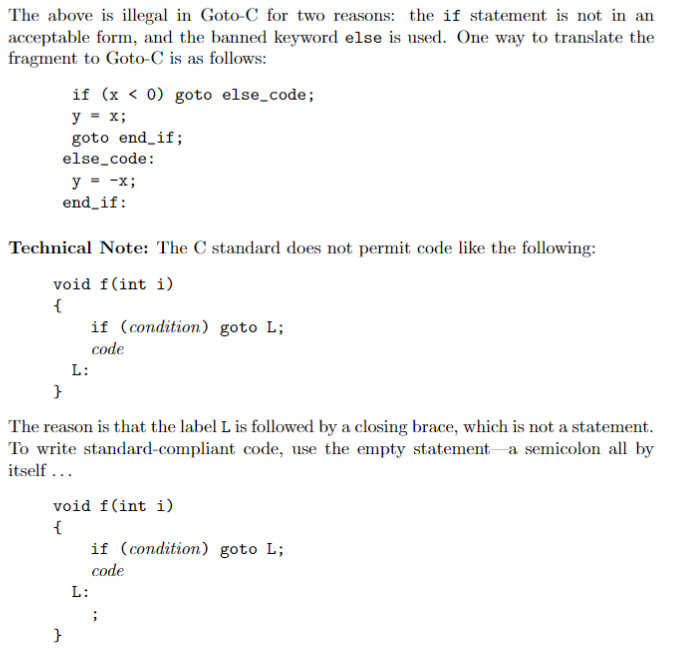
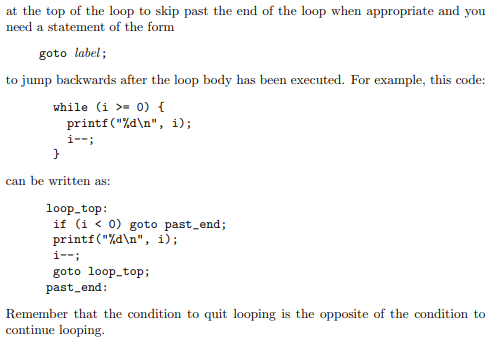
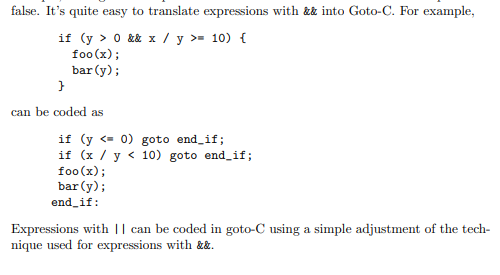
Consider the following simple fragment of normal C: if (x >= 0) y = x; else y = -x; The above is illegal in Goto-C for two reasons: the if statement is not in an acceptable form, and the banned keyword else is used. One way to translate the fragment to Goto-C is as follows: if (x = 0){ printf("%d ", i); i--; } can be written as: loop-top: if (i 0 && x / y >- 10) { foo(x); bar(y); } can be coded as if (y
Step by Step Solution
There are 3 Steps involved in it

Get step-by-step solutions from verified subject matter experts
 Study Help