







Question: . . Problem: Create a Nave Bayesian Classifier for the iris dataset. Given: The iris data set contains 150 samples of data, 50 for each
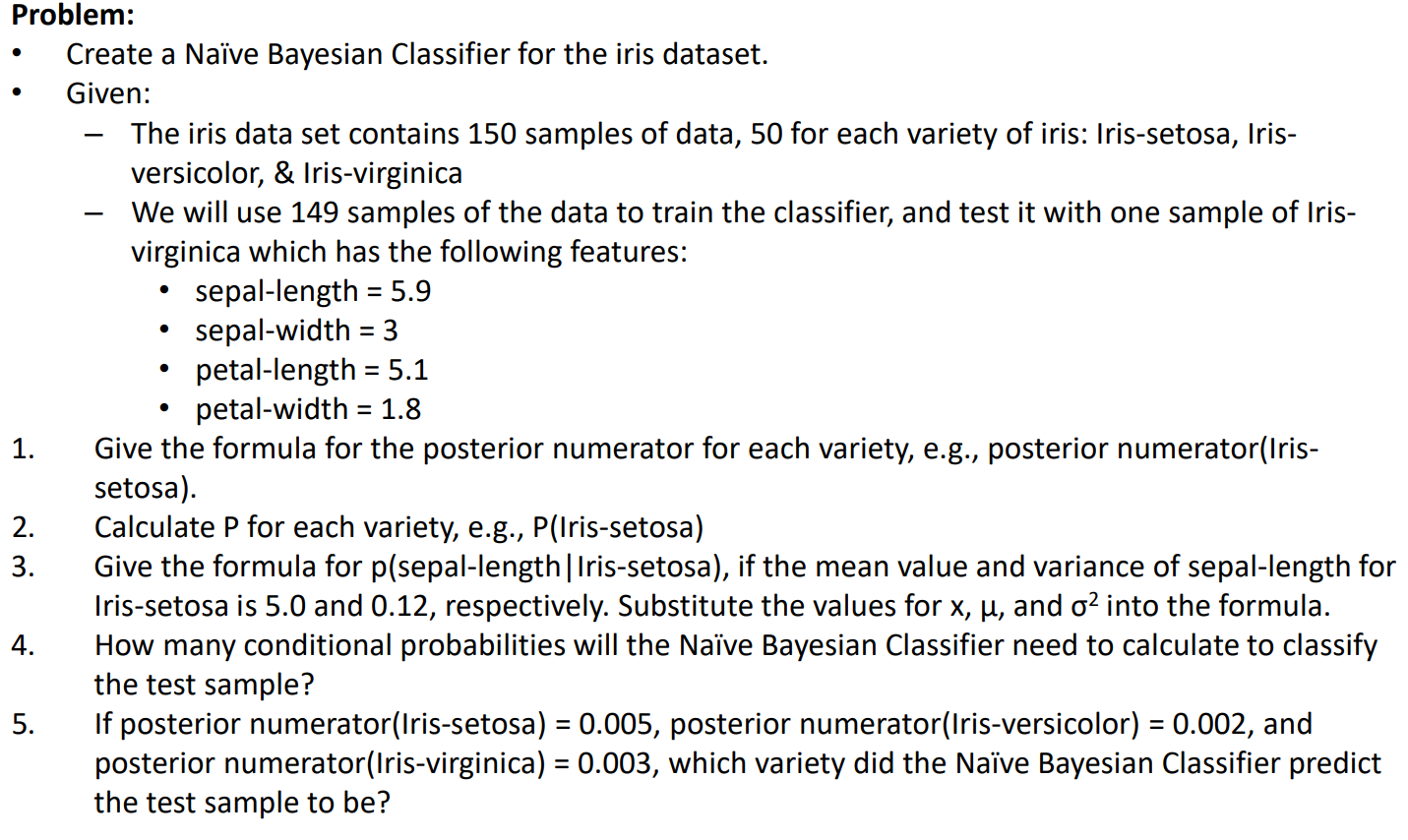
. . Problem: Create a Nave Bayesian Classifier for the iris dataset. Given: The iris data set contains 150 samples of data, 50 for each variety of iris: Iris-setosa, Iris- versicolor, & Iris-virginica We will use 149 samples of the data to train the classifier, and test it with one sample of Iris- virginica which has the following features: sepal-length = 5.9 sepal-width = 3 petal-length = 5.1 petal-width = 1.8 1. Give the formula for the posterior numerator for each variety, e.g., posterior numerator(Iris- setosa). 2. Calculate P for each variety, e.g., P(Iris-setosa) 3. Give the formula for p(sepal-length|Iris-setosa), if the mean value and variance of sepal-length for Iris-setosa is 5.0 and 0.12, respectively. Substitute the values for x, y, and o2 into the formula. 4. How many conditional probabilities will the Nave Bayesian Classifier need to calculate to classify the test sample? 5. If posterior numerator(Iris-setosa) = 0.005, posterior numerator(Iris-versicolor) = 0.002, and posterior numerator(Iris-virginica) = 0.003, which variety did the Nave Bayesian Classifier predict the test sample to be? . . Problem: Create a Nave Bayesian Classifier for the iris dataset. Given: The iris data set contains 150 samples of data, 50 for each variety of iris: Iris-setosa, Iris- versicolor, & Iris-virginica We will use 149 samples of the data to train the classifier, and test it with one sample of Iris- virginica which has the following features: sepal-length = 5.9 sepal-width = 3 petal-length = 5.1 petal-width = 1.8 1. Give the formula for the posterior numerator for each variety, e.g., posterior numerator(Iris- setosa). 2. Calculate P for each variety, e.g., P(Iris-setosa) 3. Give the formula for p(sepal-length|Iris-setosa), if the mean value and variance of sepal-length for Iris-setosa is 5.0 and 0.12, respectively. Substitute the values for x, y, and o2 into the formula. 4. How many conditional probabilities will the Nave Bayesian Classifier need to calculate to classify the test sample? 5. If posterior numerator(Iris-setosa) = 0.005, posterior numerator(Iris-versicolor) = 0.002, and posterior numerator(Iris-virginica) = 0.003, which variety did the Nave Bayesian Classifier predict the test sample to be
Step by Step Solution
There are 3 Steps involved in it

Get step-by-step solutions from verified subject matter experts
 Study Help