







Question: Problem D. Consider the exponential average formula used to predict the length of the next CPU burst. Associate the following implications a) through e) with
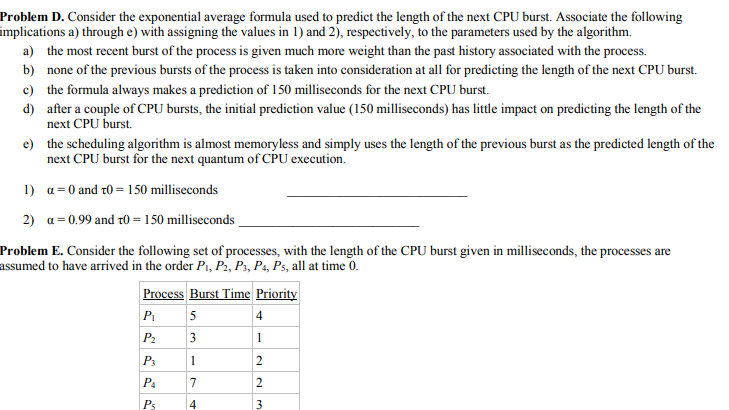
Problem D. Consider the exponential average formula used to predict the length of the next CPU burst. Associate the following implications a) through e) with assigning the values in 1) and 2), respectively, to the parameters used by the algorithm. a) the most recent burst of the process is given much more weight than the past history associated with the process. b) none of the previous bursts of the process is taken into consideration at all for predicting the length of the next CPU burst. c) the formula always makes a prediction of 150 milliseconds for the next CPU burst. d) after a couple of CPU bursts, the initial prediction value (150 milliseconds) has little impact on predicting the length of the next CPU burst. e) the scheduling algorithm is almost memoryless and simply uses the length of the previous burst as the predicted length of the next CPU burst for the next quantum of CPU execution. 1) = 0 and 0 = 150 milliseconds 2) 0.99 and 0-150 milliseconds Problem E. Consider the following set of processes, with the length of the CPU burst given in milliseconds, the processes are assumed to have arrived in the order Pl, P2, Ps, Ps, Ps, all at time 0. Process Burst Time Priority Ps 1 Ps Ps 4
Step by Step Solution
There are 3 Steps involved in it

Get step-by-step solutions from verified subject matter experts
 Study Help