





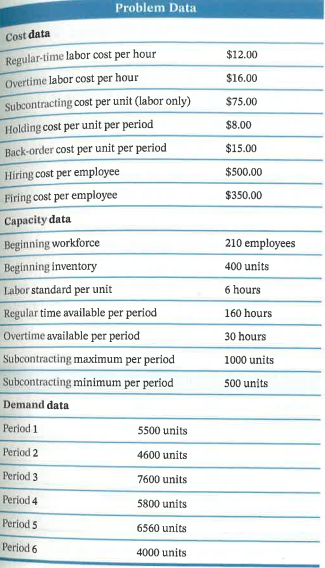
Question: Problem Data Cost data $12.00 $16.00 $75.00 $8.00 $15.00 $500.00 $350.00 Regular-time labor cost per hour Overtime labor cost per hour Subcontracting cost per unit
Problem Data Cost data $12.00 $16.00 $75.00 $8.00Problem Data Cost data $12.00 $16.00 $75.00 $8.00

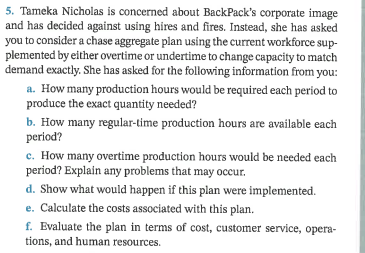
Problem Data Cost data $12.00 $16.00 $75.00 $8.00 $15.00 $500.00 $350.00 Regular-time labor cost per hour Overtime labor cost per hour Subcontracting cost per unit (labor only) Holding cost per unit per period Back-order cost per unit per period Hiring cost per employee Firing cost per employee Capacity data Beginning workforce Beginning inventory Labor standard per unit Regular time available per period Overtime available per period Subcontracting maximum per period Subcontracting minimum per period Demand data Period 1 5500 units Period 2 4600 units Period 3 7600 units 5800 units 6560 units 4000 units 210 employees 400 units 6 hours 160 hours 30 hours 1000 units 500 units Period 4 Periods Period 6 5. Tameka Nicholas is concerned about BackPack's corporate image and has decided against using hires and fires. Instead, she has asked you to consider a chase aggregate plan using the current workforce sup- plemented by either overtime or undertime to change capacity to match demand exactly. She has asked for the following information from you: a. How many production hours would be required each period to produce the exact quantity needed? b. How many regular-time production hours are available each period? c. How many overtime production hours would be needed each period? Explain any problems that may occur. d. Show what would happen if this plan were implemented e. Calculate the costs associated with this plan. f. Evaluate the plan in terms of cost, customer service, opera- tions, and human resources. Problem Data Cost data $12.00 $16.00 $75.00 $8.00 $15.00 $500.00 $350.00 Regular-time labor cost per hour Overtime labor cost per hour Subcontracting cost per unit (labor only) Holding cost per unit per period Back-order cost per unit per period Hiring cost per employee Firing cost per employee Capacity data Beginning workforce Beginning inventory Labor standard per unit Regular time available per period Overtime available per period Subcontracting maximum per period Subcontracting minimum per period Demand data Period 1 5500 units Period 2 4600 units Period 3 7600 units 5800 units 6560 units 4000 units 210 employees 400 units 6 hours 160 hours 30 hours 1000 units 500 units Period 4 Periods Period 6 5. Tameka Nicholas is concerned about BackPack's corporate image and has decided against using hires and fires. Instead, she has asked you to consider a chase aggregate plan using the current workforce sup- plemented by either overtime or undertime to change capacity to match demand exactly. She has asked for the following information from you: a. How many production hours would be required each period to produce the exact quantity needed? b. How many regular-time production hours are available each period? c. How many overtime production hours would be needed each period? Explain any problems that may occur. d. Show what would happen if this plan were implemented e. Calculate the costs associated with this plan. f. Evaluate the plan in terms of cost, customer service, opera- tions, and human resources

Step by Step Solution

There are 3 Steps involved in it

1 Expert Approved Answer
Step: 1 Unlock blur-text-image

Question Has Been Solved by an Expert!

Get step-by-step solutions from verified subject matter experts

Step: 2 Unlock
Step: 3 Unlock

Students Have Also Explored These Related General Management Questions!