







Question: Problem: Define a Turing Machine which will take a string of Os and 1s as its input, treat it like binary number, and add 1
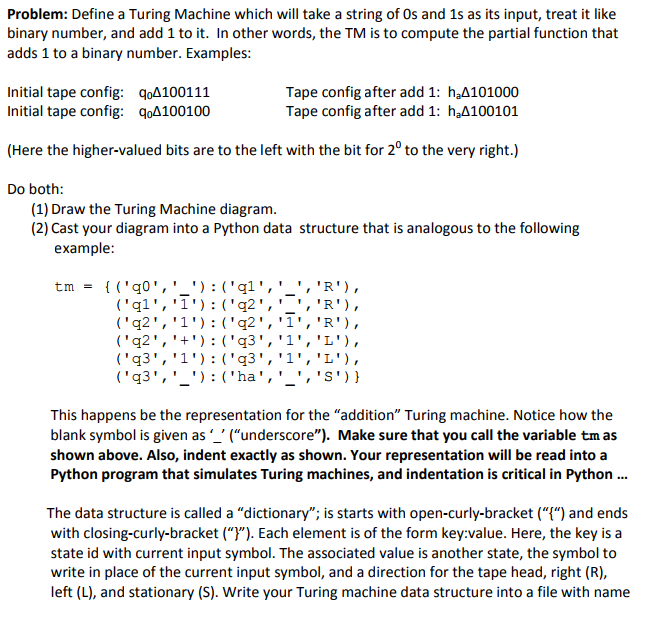
Problem: Define a Turing Machine which will take a string of Os and 1s as its input, treat it like binary number, and add 1 to it. In other words, the TM is to compute the partial function that adds 1 to a binary number. Examples Initial tape config: Initial tape config: q04100111 q04100100 Tape config after add 1: haA101000 Tape config after add 1: haA100101 (Here the higher-valued bits are to the left with the bit for 2 to the very right.) Do both (1) Draw the Turing Machine diagram (2) Cast your diagram into a Python data structure that is analogous to the following example tm= {('go',' ' ) : ( 'q1 ' , ' ', 'R'), - - This happens be the representation for the "addition" Turing machine. Notice how the blank symbol is given as -("underscore"). Make sure that you call the variable tmas shown above. Also, indent exactly as shown. Your representation will be read into a Python program that simulates Turing machines, and indentation is critical in Python The data structure is called a dictionary", is starts with open-curly-bracket ("(") and ends with closing-curly-bracket ()"). Each element is of the form key:value. Here, the key is a state id with current input symbol. The associated value is another state, the symbol to write in place of the current input symbol, and a direction for the tape head, right (R), left (L), and stationary (S). Write your Turing machine data structure into a file with name
Step by Step Solution
There are 3 Steps involved in it

Get step-by-step solutions from verified subject matter experts
 Study Help