







Question: Problem Description For this problem, you will design an inheritance hierarchy based on a rough description of the problem to solve. Grading will be based
Problem Description For this problem, you will design an inheritance hierarchy
based on a rough description of the problem to solve.
Grading will be based on your ability to demonstrate
appropriate use of classes, subclasses and interfaces to
formulate a viable solution. There is no single "correct"
answer!
This is a design exercise. YOU ARE NOT CODING! Your job is to
read details from the following description of part of an
application, and design an inheritance hierarchy as a UML Class
Diagram showing your design for the relevant classes and
interfaces.
As was the case in our HW assignment, you'll need to design
with at least two Interfaces and at least one superclass ie
related to the problem described and at least two subclasses.
Note: you will probably need more than the minimums to model
the problem!
For the purpose of this exercise, you should omit fields from your
diagram, and focus on showing methods relevant to the
specification and interface design.
Each class or interface should show some relevant methods and
access level for private, # for protected, for public Methods
should show name, parameters, and return type. Underline
abstract methods in your design.
Abstract classes, if any: names should be underlined. Create an original design for a hierarchy of Account using good
interface and abstract class design as appropriate.
For this test, design an inheritance hierarchy to represent the kind of
information described above. You can enhance a bit, based on your
knowledge of banking, but you aren't being graded on your financial
expertise!
SKETCH your hierarchy and take a pdf png or jpg to upload,
OR use Word or a diagramming tool and upload your
document
Must use arrows correctly to indicate relationships
subclass implements an interface, etc.
In your diagram, clearly show each class and
interface.
correct use of arrows should do
this
In each class or interface, identify abstract andor
concrete methods and show method headers no
code needed
could be in a "caption" of text for
each object in a separate section
You can underline any abstract
methods if you can't use italic
type.
I should be able to understand your design from the diagram and
notations!
Upload attach your solution as a pdf png jpg or Word doc. Be
sure to do this before time limit for this problem is reached!
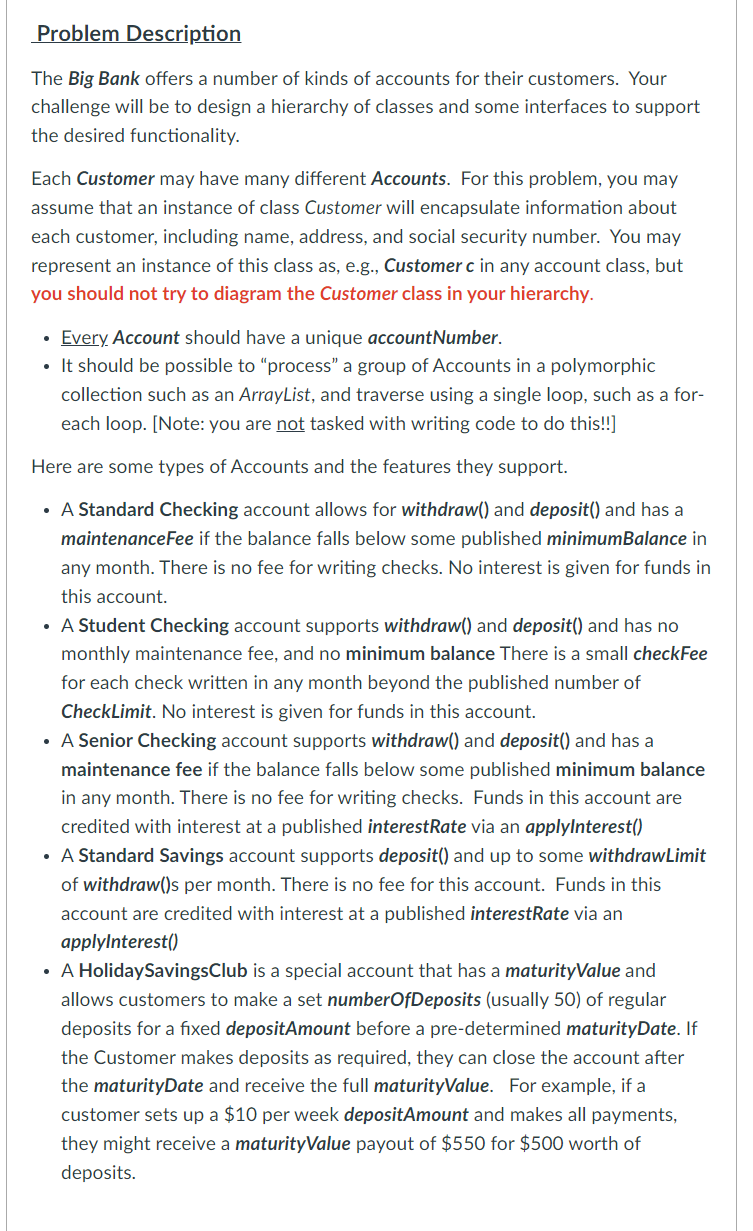
The Big Bank offers a number of kinds of accounts for their customers. Your
challenge will be to design a hierarchy of classes and some interfaces to support
the desired functionality.
Each Customer may have many different Accounts. For this problem, you may
assume that an instance of class Customer will encapsulate information about
each customer, including name, address, and social security number. You may
represent an instance of this class as eg Customer in any account class, but
you should not try to diagram the Customer class in your hierarchy.
Every Account should have a unique accountNumber.
It should be possible to "process" a group of Accounts in a polymorphic
collection such as an ArrayList, and traverse using a single loop, such as a for
each loop. Note: you are not tasked with writing code to do this!!
Here are some types of Accounts and the features they support.
A Standard Checking account allows for withdraw and deposit and has a
maintenanceFee if the balance falls below some published minimumBalance in
any month. There is no fee for writing checks. No interest is given for funds in
this account.
A Student Checking account supports withdraw and deposit and has no
monthly maintenance fee, and no minimum balance There is a small checkFee
for each check written in any month beyond the published number of
CheckLimit. No interest is given for funds in this account.
A Senior Checking account supports withdraw and deposit and has a
maintenance fee if the balance falls below some published minimum balance
in any month. There is no fee for writing checks. Funds in this account are
credited with interest at a published interestRate via an applyInterest
A Standard Savings account supports deposit and up to some withdrawLimit
of withdraws per month. There is no fee for this account. Funds in this
account are credited with interest at a published interestRate via an
applyInterest
A HolidaySavingsClub is a special account that has a maturityValue and
allows customers to make a set numberOfDeposits usually of regular
deposits for a fixed depositAmount before a predetermined maturityDate. If
the Customer makes deposits as required, they can close the account after
the maturityDate and receive the full maturityValue. For example, if a
customer sets up a $ per week depositAmount and makes all payments,
they might receive a maturityValue payout of $ for $ worth of
deposits.
Step by Step Solution
There are 3 Steps involved in it
1 Expert Approved Answer
Step: 1 Unlock

Question Has Been Solved by an Expert!
Get step-by-step solutions from verified subject matter experts
Step: 2 Unlock
Step: 3 Unlock
 Study Help