







Question: Problem Description The problem concerns implementing a hashing scheme by generating uniform random numbers in the interval (16384, 65535) and inserting them in a hash-table
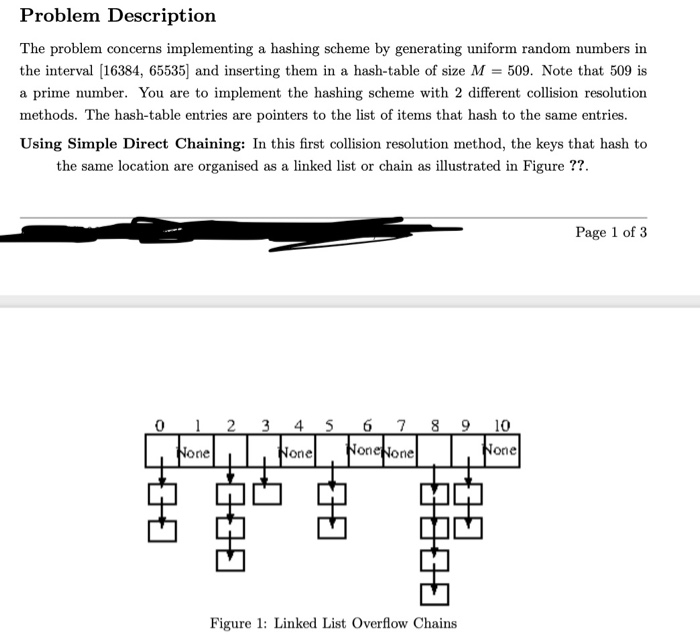
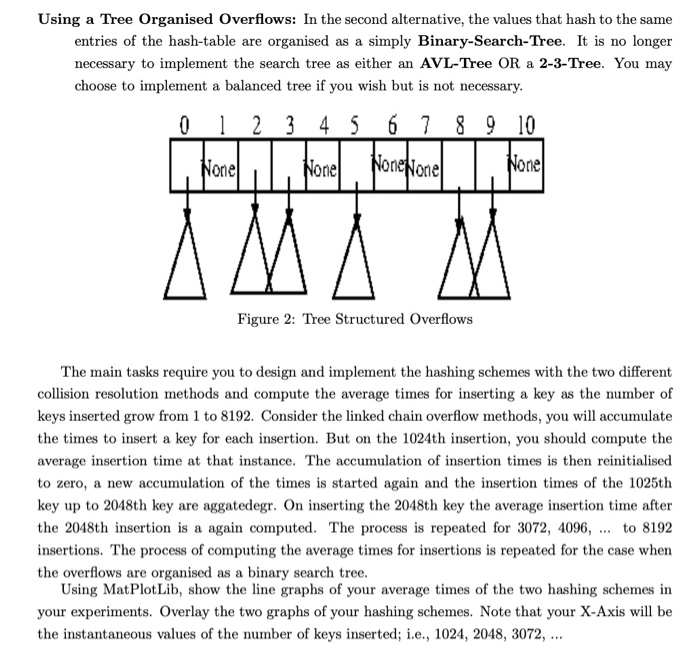
Problem Description The problem concerns implementing a hashing scheme by generating uniform random numbers in the interval (16384, 65535) and inserting them in a hash-table of size M = 509. Note that 509 is a prime number. You are to implement the hashing scheme with 2 different collision resolution methods. The hash-table entries are pointers to the list of items that hash to the same entries. Using Simple Direct Chaining: In this first collision resolution method, the keys that hash to the same location are organised as a linked list or chain as illustrated in Figure ??. Page 1 of 3 0 1 2 3 4 5 None None 6 7 8 9 10 None None Nonel H2H Figure 1: Linked List Overflow Chains Using a Tree Organised Overflows: In the second alternative, the values that hash to the same entries of the hash-table are organised as a simply Binary-Search-Tree. It is no longer necessary to implement the search tree as either an AVL-Tree OR a 2-3-Tree. You may choose to implement a balanced tree if you wish but is not necessary. 0 1 2 3 4 5 6 7 8 9 10 Nonel nel None Nonel Nonel None AM M Figure 2: Tree Structured Overflows The main tasks require you to design and implement the hashing schemes with the two different collision resolution methods and compute the average times for inserting a key as the number of keys inserted grow from 1 to 8192. Consider the linked chain overflow methods, you will accumulate the times to insert a key for each insertion. But on the 1024th insertion, you should compute the average insertion time at that instance. The accumulation of insertion times is then reinitialised to zero, a new accumulation of the times is started again and the insertion times of the 1025th key up to 2048th key are aggatedegr. On inserting the 2048th key the average insertion time after the 2048th insertion is a again computed. The process is repeated for 3072, 4096, ... to 8192 insertions. The process of computing the average times for insertions is repeated for the case when the overflows are organised as a binary search tree. Using MatPlotLib, show the line graphs of your average times of the two hashing schemes in your experiments. Overlay the two graphs of your hashing schemes. Note that your X-Axis will be the instantaneous values of the number of keys inserted; i.e., 1024, 2048, 3072, ... Input Data The hashtable size, for each simulation run of a specific scheme, is set at 509. Uniform random numbers between 16385, and 65335, are generated as keys and inserted into the hash-table using a Mid-Square hashcode function and then compressing this to lie within the hash-table size. The simulation run should go from 1 to 8192 and at the point of inserting the 1024th, 2048th, 3072th ..., keys, the average insertion times are computed. Problem Description The problem concerns implementing a hashing scheme by generating uniform random numbers in the interval (16384, 65535) and inserting them in a hash-table of size M = 509. Note that 509 is a prime number. You are to implement the hashing scheme with 2 different collision resolution methods. The hash-table entries are pointers to the list of items that hash to the same entries. Using Simple Direct Chaining: In this first collision resolution method, the keys that hash to the same location are organised as a linked list or chain as illustrated in Figure ??. Page 1 of 3 0 1 2 3 4 5 None None 6 7 8 9 10 None None Nonel H2H Figure 1: Linked List Overflow Chains Using a Tree Organised Overflows: In the second alternative, the values that hash to the same entries of the hash-table are organised as a simply Binary-Search-Tree. It is no longer necessary to implement the search tree as either an AVL-Tree OR a 2-3-Tree. You may choose to implement a balanced tree if you wish but is not necessary. 0 1 2 3 4 5 6 7 8 9 10 Nonel nel None Nonel Nonel None AM M Figure 2: Tree Structured Overflows The main tasks require you to design and implement the hashing schemes with the two different collision resolution methods and compute the average times for inserting a key as the number of keys inserted grow from 1 to 8192. Consider the linked chain overflow methods, you will accumulate the times to insert a key for each insertion. But on the 1024th insertion, you should compute the average insertion time at that instance. The accumulation of insertion times is then reinitialised to zero, a new accumulation of the times is started again and the insertion times of the 1025th key up to 2048th key are aggatedegr. On inserting the 2048th key the average insertion time after the 2048th insertion is a again computed. The process is repeated for 3072, 4096, ... to 8192 insertions. The process of computing the average times for insertions is repeated for the case when the overflows are organised as a binary search tree. Using MatPlotLib, show the line graphs of your average times of the two hashing schemes in your experiments. Overlay the two graphs of your hashing schemes. Note that your X-Axis will be the instantaneous values of the number of keys inserted; i.e., 1024, 2048, 3072, ... Input Data The hashtable size, for each simulation run of a specific scheme, is set at 509. Uniform random numbers between 16385, and 65335, are generated as keys and inserted into the hash-table using a Mid-Square hashcode function and then compressing this to lie within the hash-table size. The simulation run should go from 1 to 8192 and at the point of inserting the 1024th, 2048th, 3072th ..., keys, the average insertion times are computed
Step by Step Solution
There are 3 Steps involved in it

Get step-by-step solutions from verified subject matter experts
 Study Help