







Question: Problem I ( 1 5 pts ) . For the signal e - 3 t u ( t ) , determine the bandwidth of an
Problem I pts
For the signal determine the bandwidth of an antialiasing filter if the essential bandwidth of the signal contains of the signal energy.
Hint: use Parseval's theorem
Problem II pts
A Using only the fact that and properties of the transform, find the transform of:
a
b
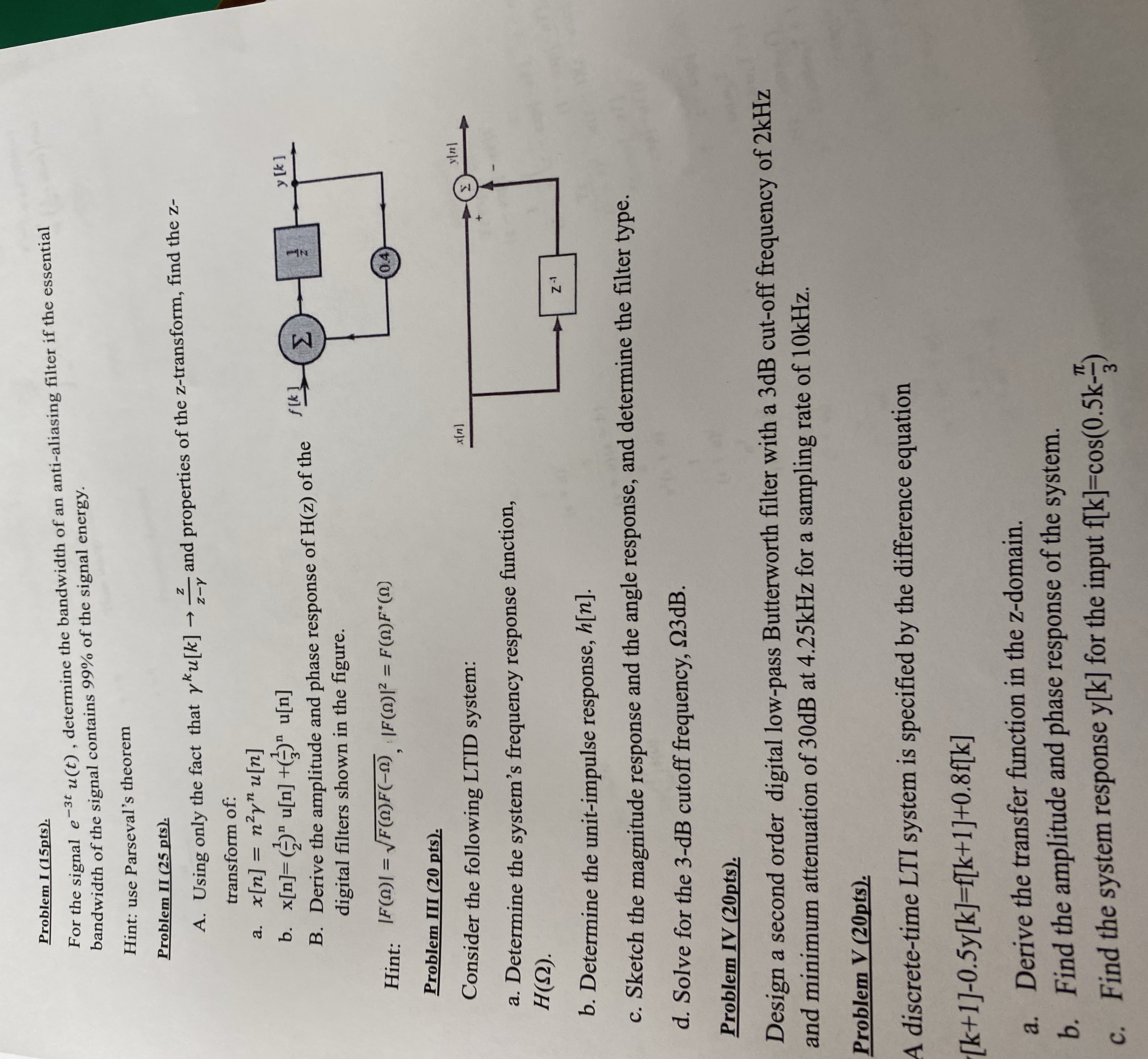
B Derive the amplitude and phase response of of the digital filters shown in the figure.
Hint:
Problem III pts
Consider the following LTID system:
a Determine the system's frequency response function,
b Determine the unitimpulse response,
c Sketch the magnitude response and the angle response, and determine the filter type.
d Solve for the cutoff frequency,
Problem IV pts
Design a second order digital lowpass Butterworth filter with a dB cutoff frequency of kHz and minimum attenuation of dB at kHz for a sampling rate of kHz
Problem V pts
A discretetime LTI system is specified by the difference equation
a Derive the transfer function in the zdomain.
b Find the amplitude and phase response of the system.
c Find the system response for the input
Step by Step Solution
There are 3 Steps involved in it
1 Expert Approved Answer
Step: 1 Unlock

Question Has Been Solved by an Expert!
Get step-by-step solutions from verified subject matter experts
Step: 2 Unlock
Step: 3 Unlock
 Study Help