







Question: Problem I (10 + 15 + 20 = 45 points Consider the single-input single-output linear system i(t) = Ar(t) + Bu(t), y(t) = Cx(t) +
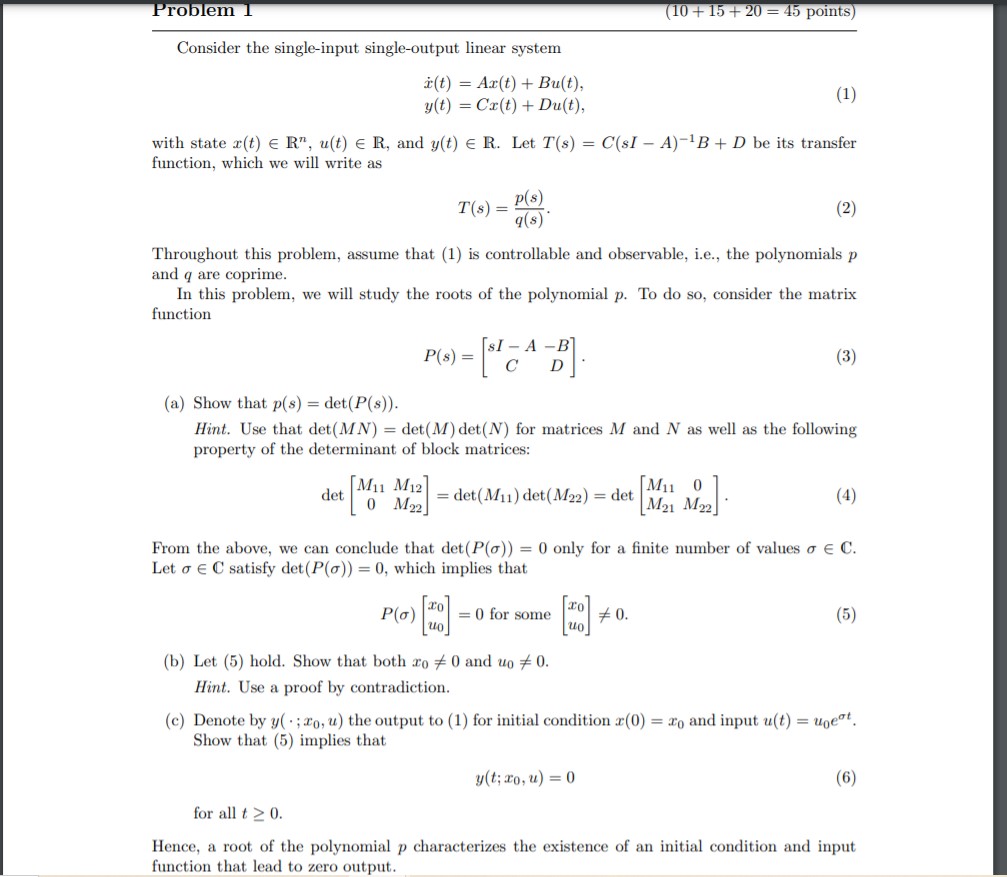
Problem I (10 + 15 + 20 = 45 points Consider the single-input single-output linear system i(t) = Ar(t) + Bu(t), y(t) = Cx(t) + Du(t), (1) with state r(t) ( R", u(t) E R, and y(t) E R. Let T(s) = C(sI - A)-1B + D be its transfer function, which we will write as T(s) = P(s) (2) q(s) Throughout this problem, assume that (1) is controllable and observable, i.e., the polynomials p and q are coprime. In this problem, we will study the roots of the polynomial p. To do so, consider the matrix function P(s) = [sI - A - B] (3) (a) Show that p(s) = det(P(s)). Hint. Use that det(MN) = det(M) det(N) for matrices M and N as well as the following property of the determinant of block matrices: det 0 M22] Mii M12 = det(Mii) det(M22) = det Mzi M22] (4) From the above, we can conclude that det(P(o)) = 0 only for a finite number of values o e C. Let o E C satisfy det(P(o)) = 0, which implies that P(a) to = 0 for some TO # 0. (5) (b) Let (5) hold. Show that both ro # 0 and uo # 0. Hint. Use a proof by contradiction. (c) Denote by y( . ; To, u) the output to (1) for initial condition a(0) = To and input u(t) = upeat. Show that (5) implies that y(t; To, u) = 0 (6) for all t 2 0. Hence, a root of the polynomial p characterizes the existence of an initial condition and input function that lead to zero output
Step by Step Solution
There are 3 Steps involved in it

Get step-by-step solutions from verified subject matter experts
 Study Help