







Question: Problem I In class we saw that for our 1 s t attempt of asymmetrical rise - fall - dwell ( RFD ) cam design
Problem I
In class we saw that for our attempt of asymmetrical risefalldwell RFD cam design Example the position value overshot see figure the desired maximum value of We reasoned on our attempt, that adding a boundary condition would fix the overshoot. It does, but causes other problems see figure In our attempt, we decided to use three segments for the cam design, with one polynomial for the rise and one for the fall as shown in the first part of Example We solved for the rise polynomial first and the fall polynomial second. We calculated the acceleration at the end of the rise and used it as the acceleration boundary condition at the start of the fall. Sadly, this result was also not desirable; it had significant undershoot and a very large acceleration magnitude. Part two of Example in the book is a attempt at asymmetrical RFD cam design. The example is described in some detail, but the work done to solve for the coefficients is not shown.
For this HW you will set up the boundary condition tables for the rise and fall segments for the th attempt using the following steps: setup and solve for the fall boundary conditions first since it has the lowiest aeleration setup and solve for the rise boundary conditions second while using the acceleration at the start of the fall as the acceleration boundary condition at the end of the rise.
Complete the following steps:
Setup and solve for the fall polynomial coefficients since it has the lowest acceleration
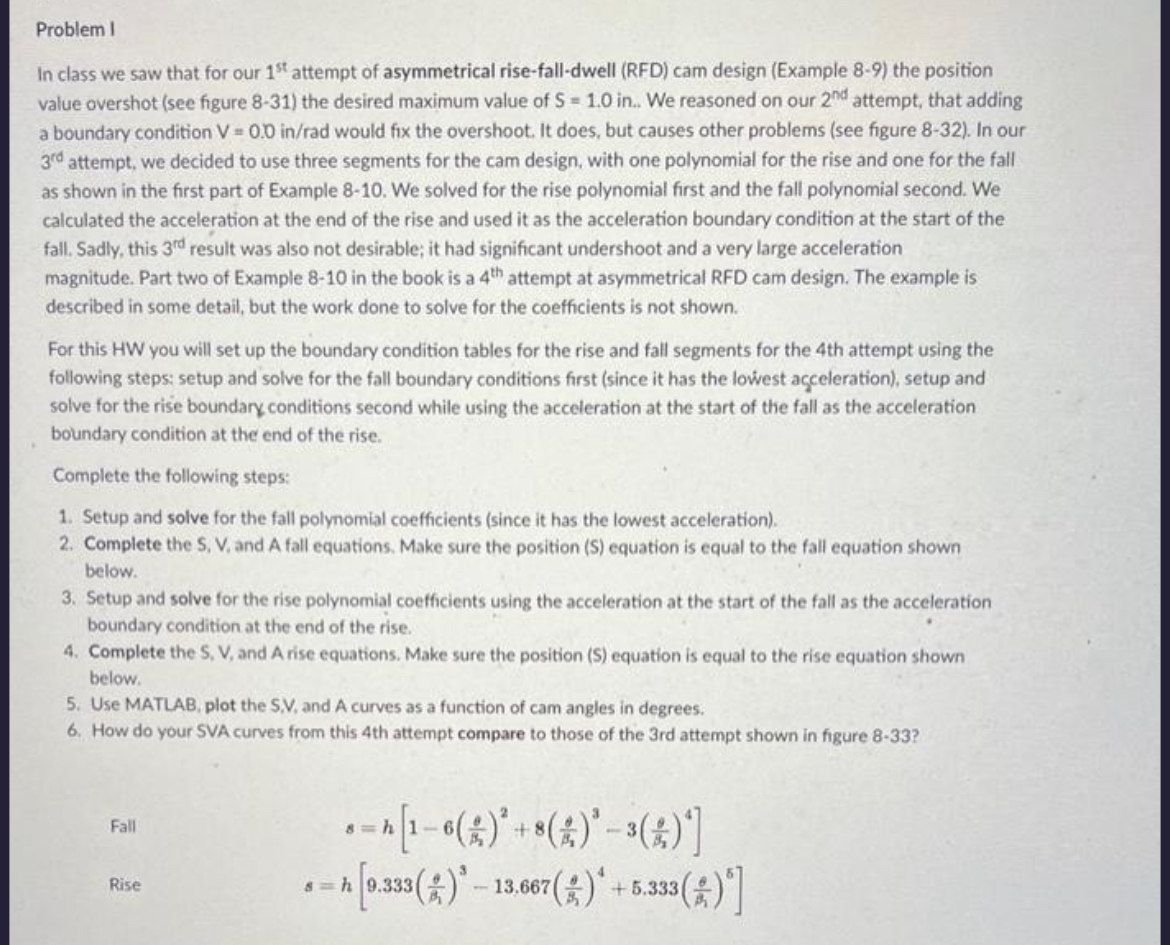
Complete the and A fall equations. Make sure the position S equation is equal to the fall equation shown below.
Setup and solve for the rise polynomial coefficients using the acceleration at the start of the fall as the acceleration boundary condition at the end of the rise.
Complete the and A rise equations. Make sure the position S equation is equal to the rise equation shown below.
Use MATLAB, plot the SV and A curves as a function of cam angles in degrees.
How do your SVA curves from this th attempt compare to those of the rd attempt shown in figure
Fall
Rise
Step by Step Solution
There are 3 Steps involved in it
1 Expert Approved Answer
Step: 1 Unlock

Question Has Been Solved by an Expert!
Get step-by-step solutions from verified subject matter experts
Step: 2 Unlock
Step: 3 Unlock
 Study Help