







Question: problem in sequential strategic settings. Suppose that the High Speed Rail consortium (HSR) is deciding whether or not to build a high-speed railway between Melbourne
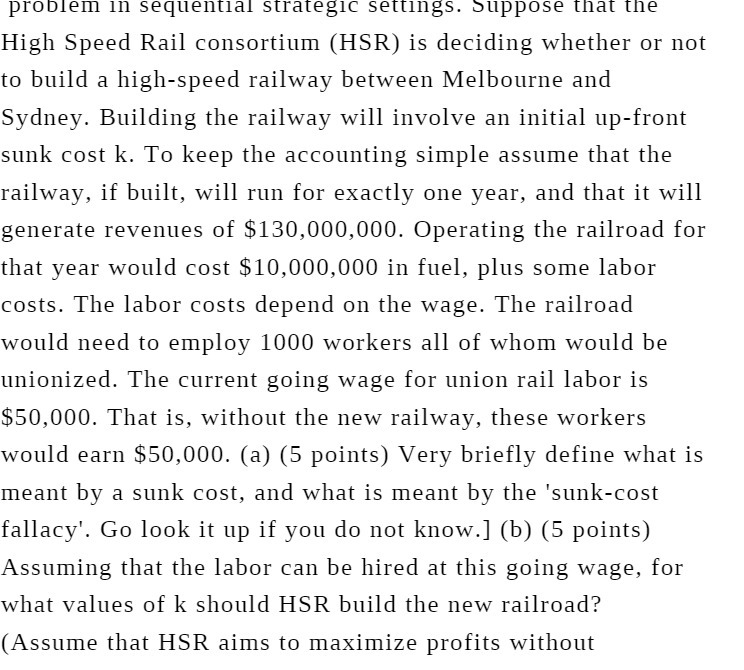
problem in sequential strategic settings. Suppose that the High Speed Rail consortium (HSR) is deciding whether or not to build a high-speed railway between Melbourne and Sydney. Building the railway will involve an initial up-front sunk cost k. To keep the accounting simple assume that the railway, if built, will run for exactly one year, and that it will generate revenues of $130,000,000. Operating the railroad for that year would cost $10,000,000 in fuel, plus some labor costs. The labor costs depend on the wage. The railroad would need to employ 1000 workers all of whom would be unionized. The current going wage for union rail labor is $50,000. That is, without the new railway, these workers would earn $50,000. (a) (5 points) Very briefly define what is meant by a sunk cost, and what is meant by the 'sunk-cost fallacy'. Go look it up if you do not know.] (b) (5 points) Assuming that the labor can be hired at this going wage, for what values of k should HSR build the new railroad? (Assume that HSR aims to maximize profits without
Step by Step Solution
There are 3 Steps involved in it

Get step-by-step solutions from verified subject matter experts
 Study Help