







Question: Problem information is given in the image. For many years, the medically accepted practice of giving aid to a person experiencing a heart at- tack
Problem information is given in the image.
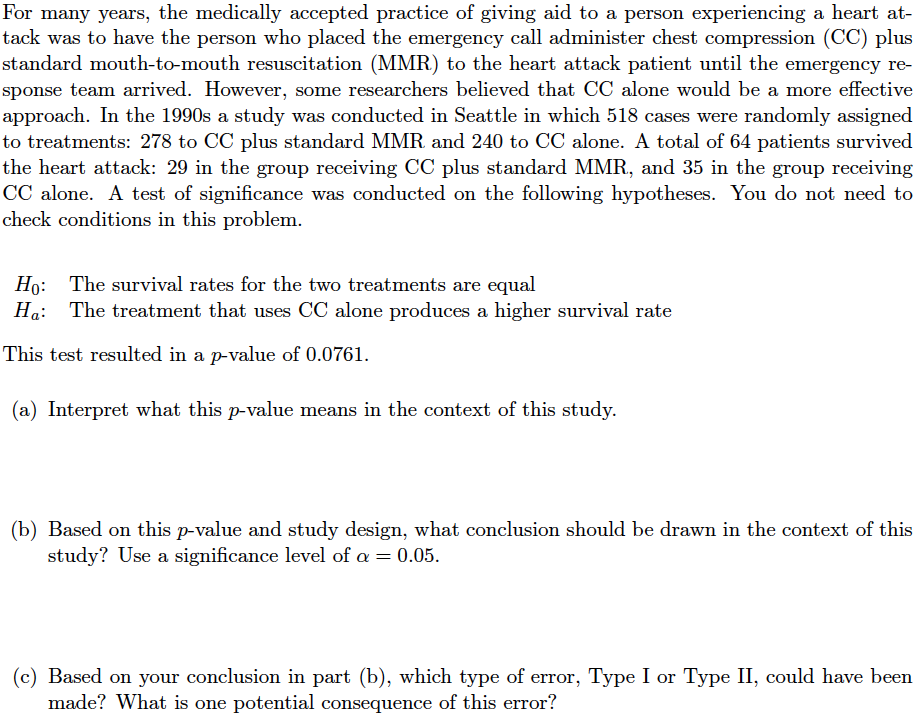
For many years, the medically accepted practice of giving aid to a person experiencing a heart at- tack was to have the person who placed the emergency call administer chest compression (CC) plus standard mouth-to-mouth resuscitation (MM) to the heart attack patient until the emergency re- sponse team arrived. However1 some researchers believed that CC alone would be a more effective approach. In the 1990s a study was conducted in Seattle in which 518 cases were randomly assigned to treatments: 278 to CC plus standard MMR and 240 to CC alone. A total of 64 patients survived the heart attack: 29 in the group receiving CC plus standard MMR, and 35 in the group receiving CC alone. A test of signicance was conducted on the following hypothenes. You do not need to check conditions in this problem. Hg: The survival rates for the two treatments are equal Hg: The treatment that uses CC alone produces a higher survival rate This test resulted in a p-value of 0.0761. (a) Interpret what this p-value means in the context of this study. (b) Based on this p-value and study design, what conclusion should be drawn in the context of this study? Use a signicance level of o: : 0.05. (c) Based on your conclusion in part (b), which type of error, Type I or Type II, could have been made? What is one potential consequence of this error
Step by Step Solution
There are 3 Steps involved in it

Get step-by-step solutions from verified subject matter experts
 Study Help