







Question: Problem IV: Given: . Full duplex (FDX) communication between nodes A and B . Full duplex (FDX) communication between nodes B and C. . Full
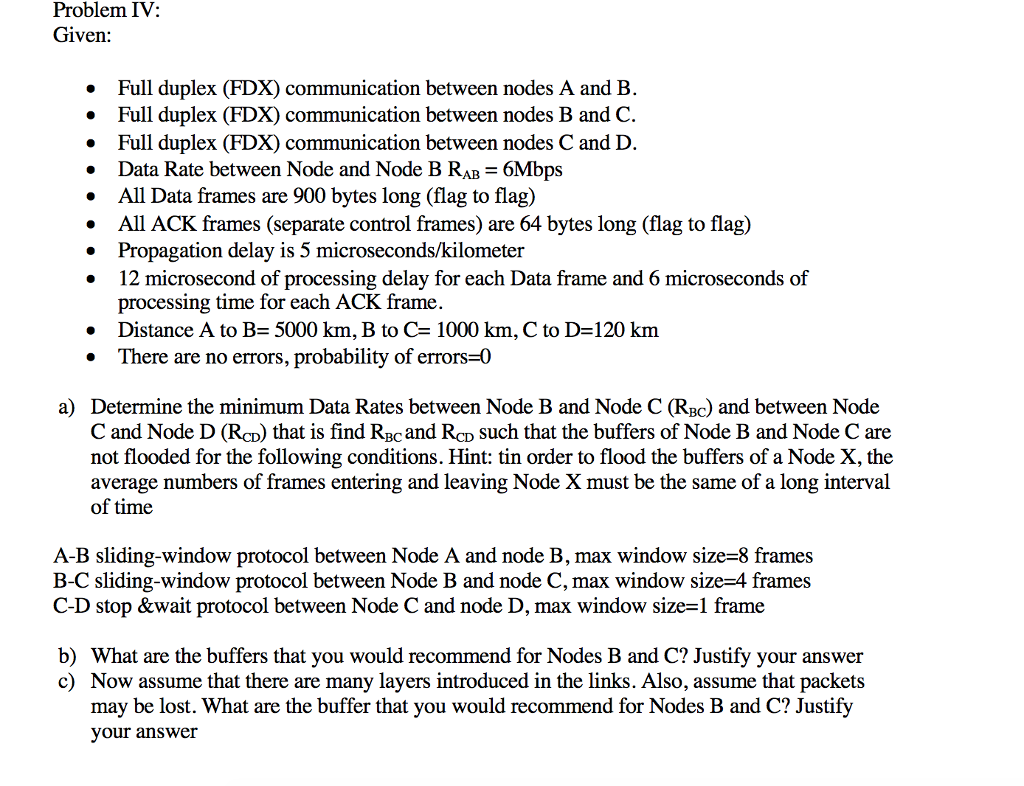
Problem IV: Given: . Full duplex (FDX) communication between nodes A and B . Full duplex (FDX) communication between nodes B and C. . Full duplex (FDX) communication between nodes C and D . Data Rate between Node and Node B RAB-6Mbps . All Data frames are 900 bytes long (flag to flag) All ACK frames (separate control frames) are 64 bytes long (flag to flag) Propagation delay is 5 microseconds/kilometer . 12 microsecond of processing delay for each Data frame and 6 microseconds of processing time for each ACK frame Distance A to B- 5000 km, B to C- 1000 km, C to D-120 km . There are no errors, probability of errors-0 Determine the minimum Data Rates between Node B and Node C (RBc) and between Node C and Node D (RcD) that is find RBcand Rco such that the buffers of Node B and Node C are not flooded for the following conditions. Hint: tin order to flood the buffers of a Node X, the average numbers of frames entering and leaving Node X must be the same of a long interval of time a) A-B sliding-window protocol between Node A and node B, max window size-8 frames B-C sliding-window protocol between Node B and node C, max window size-4 frames C-D stop &wait protocol between Node C and node D, max window size-1 frame b) What are the buffers that you would recommend for Nodes B and C? Justify your answer c) Now assume that there are many layers introduced in the links. Also, assume that packets may be lost. What are the buffer that you would recommend for Nodes B and C? Justify your answe Problem IV: Given: . Full duplex (FDX) communication between nodes A and B . Full duplex (FDX) communication between nodes B and C. . Full duplex (FDX) communication between nodes C and D . Data Rate between Node and Node B RAB-6Mbps . All Data frames are 900 bytes long (flag to flag) All ACK frames (separate control frames) are 64 bytes long (flag to flag) Propagation delay is 5 microseconds/kilometer . 12 microsecond of processing delay for each Data frame and 6 microseconds of processing time for each ACK frame Distance A to B- 5000 km, B to C- 1000 km, C to D-120 km . There are no errors, probability of errors-0 Determine the minimum Data Rates between Node B and Node C (RBc) and between Node C and Node D (RcD) that is find RBcand Rco such that the buffers of Node B and Node C are not flooded for the following conditions. Hint: tin order to flood the buffers of a Node X, the average numbers of frames entering and leaving Node X must be the same of a long interval of time a) A-B sliding-window protocol between Node A and node B, max window size-8 frames B-C sliding-window protocol between Node B and node C, max window size-4 frames C-D stop &wait protocol between Node C and node D, max window size-1 frame b) What are the buffers that you would recommend for Nodes B and C? Justify your answer c) Now assume that there are many layers introduced in the links. Also, assume that packets may be lost. What are the buffer that you would recommend for Nodes B and C? Justify your answe
Step by Step Solution
There are 3 Steps involved in it

Get step-by-step solutions from verified subject matter experts
 Study Help