







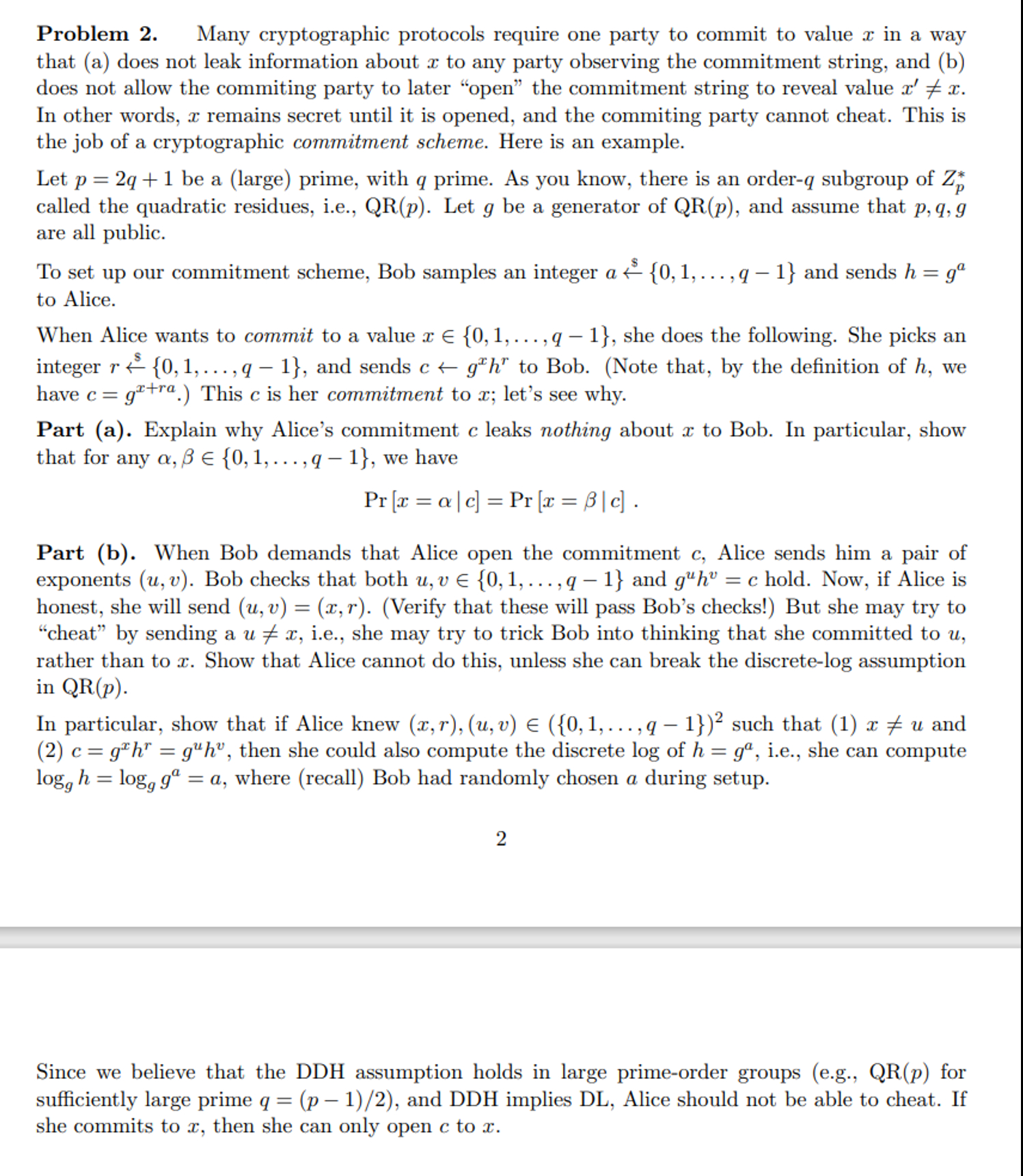
Question: Problem: Many cryptographic protocols require one party to commit to value x in a way that ( a ) does not leak information about x
Problem: Many cryptographic protocols require one party to commit to value in a way
that a does not leak information about to any party observing the commitment string, and b
does not allow the commiting party to later "open" the commitment string to reveal value
In other words, remains secret until it is opened, and the commiting party cannot cheat. This is
the job of a cryptographic commitment scheme. Here is an example.
Let be a large prime, with prime. As you know, there is an order subgroup of
called the quadratic residues, ie Let be a generator of and assume that
are all public.
To set up our commitment scheme, Bob samples an integer dots, and sends
to Alice.
When Alice wants to commit to a value xindots, she does the following. She picks an
integer dots, and sends to Bob. Note that, by the definition of we
have This is her commitment to ; let's see why.
Part a Explain why Alice's commitment leaks nothing about to Bob. In particular, show
that for any dots, we have
Part b When Bob demands that Alice open the commitment Alice sends him a pair of
exponents Bob checks that both vindots, and hold. Now, if Alice is
honest, she will send Verify that these will pass Bob's checks! But she may try to
"cheat" by sending a ie she may try to trick Bob into thinking that she committed to
rather than to Show that Alice cannot do this, unless she can break the discretelog assumption
in
In particular, show that if Alice knew dots, such that and
then she could also compute the discrete of ie she can compute
where recall Bob had randomly chosen a during setup.
Since we believe that the DDH assumption holds in large primeorder groups eg QR for
sufficiently large prime and DDH implies DL Alice should not be able to cheat. If
she commits to then she can only open to
Step by Step Solution
There are 3 Steps involved in it
1 Expert Approved Answer
Step: 1 Unlock

Question Has Been Solved by an Expert!
Get step-by-step solutions from verified subject matter experts
Step: 2 Unlock
Step: 3 Unlock
 Study Help