



Question: Problem No. 1 A retailer has two sources from whom to buy a particular product. The intended sales price is $322.50. Her records indicate sales
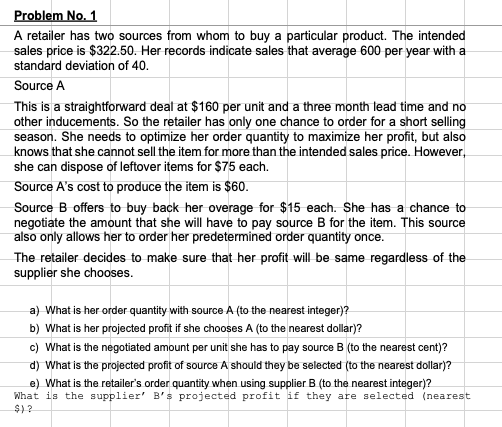
Problem No. 1 A retailer has two sources from whom to buy a particular product. The intended sales price is $322.50. Her records indicate sales that average 600 per year with a standard deviation of 40. Source A This is a straightforward deal at $160 per unit and a three month lead time and no other inducements. So the retailer has only one chance to order for a short selling season. She needs to optimize her order quantity to maximize her profit, but also knows that she cannot sell the item for more than the intended sales price. However, she can dispose of leftover items for $75 each. Source A's cost to produce the item is $60. Source B offers to buy back her overage for $15 each. She has a chance to negotiate the amount that she will have to pay source B for the item. This source also only allows her to order her predetermined order quantity once. The retailer decides to make sure that her profit will be same regardless of the supplier she chooses. a) What is her order quantity with source A (to the nearest integer)? b) What is her projected profit if she chooses A (to the nearest dollar)? c) What is the negotiated amount per unit she has to pay source B (to the nearest cent)? d) What is the projected profit of source A should they be selected to the nearest dollar)? e) What is the retailer's order quantity when using supplier B (to the nearest integer)? What is the supplier' B's projected profit if they are selected (nearest $) ? Problem No. 1 A retailer has two sources from whom to buy a particular product. The intended sales price is $322.50. Her records indicate sales that average 600 per year with a standard deviation of 40. Source A This is a straightforward deal at $160 per unit and a three month lead time and no other inducements. So the retailer has only one chance to order for a short selling season. She needs to optimize her order quantity to maximize her profit, but also knows that she cannot sell the item for more than the intended sales price. However, she can dispose of leftover items for $75 each. Source A's cost to produce the item is $60. Source B offers to buy back her overage for $15 each. She has a chance to negotiate the amount that she will have to pay source B for the item. This source also only allows her to order her predetermined order quantity once. The retailer decides to make sure that her profit will be same regardless of the supplier she chooses. a) What is her order quantity with source A (to the nearest integer)? b) What is her projected profit if she chooses A (to the nearest dollar)? c) What is the negotiated amount per unit she has to pay source B (to the nearest cent)? d) What is the projected profit of source A should they be selected to the nearest dollar)? e) What is the retailer's order quantity when using supplier B (to the nearest integer)? What is the supplier' B's projected profit if they are selected (nearest $)
Step by Step Solution
There are 3 Steps involved in it

Get step-by-step solutions from verified subject matter experts