







Question: Problem one The table below contains information on the total number of workers required to produce one metric ton of each products (cocoa and rice)
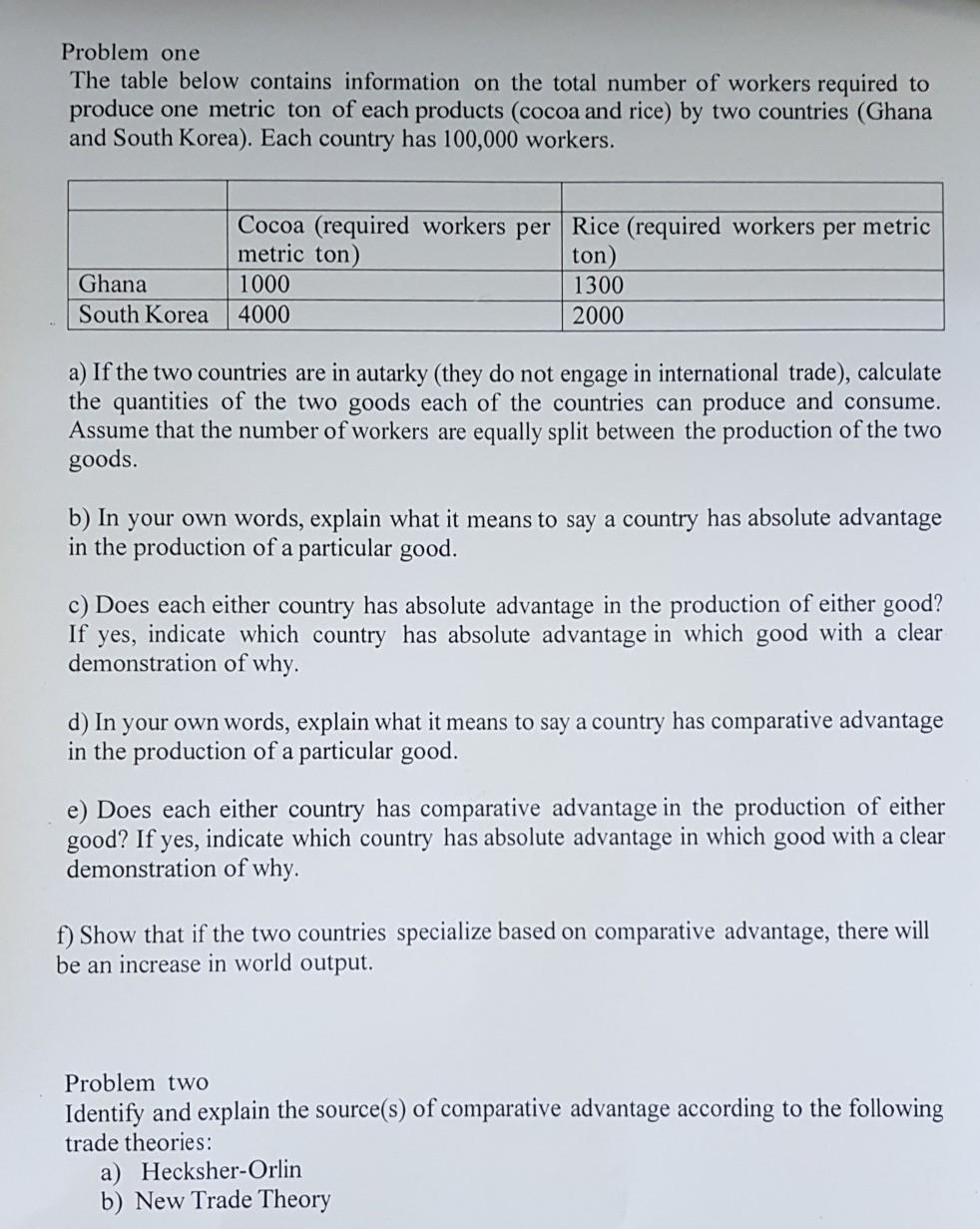
Problem one The table below contains information on the total number of workers required to produce one metric ton of each products (cocoa and rice) by two countries (Ghana and South Korea). Each country has 100,000 workers. Cocoa (required workers per Rice (required workers per metric metric ton) ton) 1000 1300 4000 2000 Ghana South Korea a) If the two countries are in autarky (they do not engage in international trade), calculate the quantities of the two goods each of the countries can produce and consume. Assume that the number of workers are equally split between the production of the two goods. b) In your own words, explain what it means to say a country has absolute advantage in the production of a particular good. c) Does each either country has absolute advantage in the production of either good? If yes, indicate which country has absolute advantage in which good with a clear demonstration of why. d) In your own words, explain what it means to say a country has comparative advantage in the production of a particular good. e) Does each either country has comparative advantage in the production of either good? If yes, indicate which country has absolute advantage in which good with a clear demonstration of why. f) Show that if the two countries specialize based on comparative advantage, there will be an increase in world output. Problem two Identify and explain the source(s) of comparative advantage according to the following trade theories: a) Hecksher-Orlin b) New Trade Theory
Step by Step Solution
There are 3 Steps involved in it

Get step-by-step solutions from verified subject matter experts
 Study Help