







Question: Problem: Round Table Seating Arrangement Clarification: You are provided with a heuristic table representing the dislike percentages between pairs of individuals, indicating the level of
Problem: Round Table Seating Arrangement
Clarification:
You are provided with a heuristic table representing the dislike percentages between
pairs of individuals, indicating the level of conflict or discomfort each person feels towards
others. The goal is to seat the individuals around a round table in the most suitable
arrangement to minimize conflict while ensuring that each person can talk to their
neighbors on the left and right.
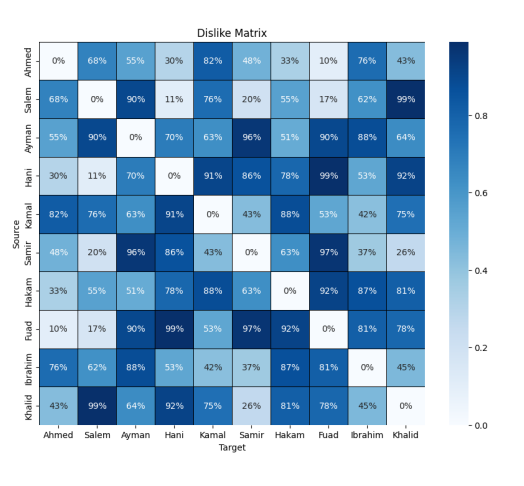
Heuristic Table Dislike Matrix:
The heuristic table provides dislike percentages between pairs of individuals, with higher
percentages indicating greater dislike or conflict. For example, a dislike percentage of
between Person A and Person B indicates a low level of conflict, while a dislike percentage
of indicates a high level of conflict.
Cost Function:
In addition to the heuristic table, a cost function is defined to incorporate the actual
cost of seating two specific individuals next to each other. Although it might be simpler
to use a constant cost eg the cost function used in this assignment is a Non
Linear Dislike Cost function. The nonlinear dislike cost function is described in the next
section.
NonLinear Dislike Cost:
Define a nonlinear function that maps dislike percentages to costs. eg
would make high dislike percentages have a quadratically higher cost.
fn
S
sumdislikepercentagesbetweenneighbors
sumfdislikepercentagesbetweenneighbors
The aim of this
funnction is to penalize highly disliked pairs more severely than just a
constant of a linear mapping.
Objective:
Your objective is to determine which algorithm among Uniform Cost Search UCS Greedy
Search, and Search can find the best seating arrangement that minimizes conflict
based on the provided heuristic table and the NonLinear Dislike Cost function.
Requirements:
Each person should be seated next to their neighbors on the left and right to
facilitate conversation.
The seating arrangement should form a closed loop, as it is a round table.
Tasks:
Implement the UCS, Greedy, and search algorithms to find the seating
arrangement.
Incorporate the NonLinear Dislike Cost function into the search algorithms'
evaluation process.
Evaluate the effectiveness of each algorithm in finding the best seating
arrangement based on the conflict minimization objective.
Compare the obtained seating arrangements and discuss the strengths and
weaknesses of each algorithm in this context.
Present your findings, including the final seating arrangements and analysis of
algorithm performance, in a report.
Submission:
Submit your report detailing the implementation, results, and analysis of the algorithms'
performance.
The following dislike matrix represents the heuristic evaluation function
Below the Dislike matrix
Step by Step Solution
There are 3 Steps involved in it
1 Expert Approved Answer
Step: 1 Unlock

Question Has Been Solved by an Expert!
Get step-by-step solutions from verified subject matter experts
Step: 2 Unlock
Step: 3 Unlock
 Study Help