Question: Problem S11.9 Question Help Consider a three-firm supply chain consisting of a retailer, manufacturer, and supplier. The retailer's demand over an 8-week period was 90
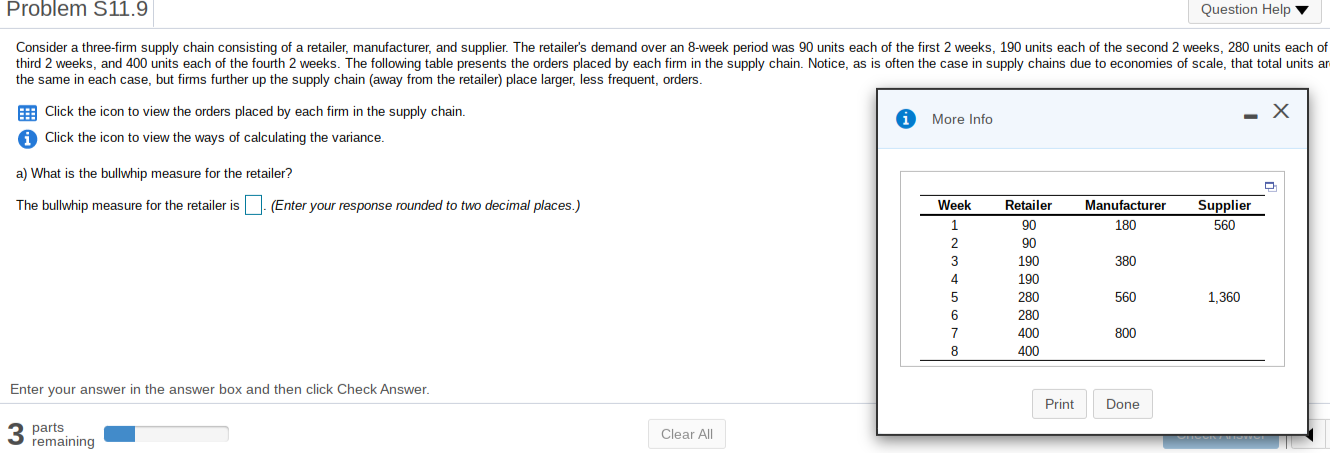

Problem S11.9 Question Help Consider a three-firm supply chain consisting of a retailer, manufacturer, and supplier. The retailer's demand over an 8-week period was 90 units each of the first 2 weeks, 190 units each of the second 2 weeks, 280 units each of third 2 weeks, and 400 units each of the fourth 2 weeks. The following table presents the orders placed by each firm in the supply chain. Notice, as is often the case in supply chains due to economies of scale, that total units ar the same in each case, but firms further up the supply chain (away from the retailer) place larger, less frequent, orders. Click the icon to view the orders placed by each firm in the supply chain. More Info Click the icon to view the ways of calculating the variance. a) What is the bullwhip measure for the retailer? The bullwhip measure for the retailer is. (Enter your response rounded to two decimal places.) Manufacturer 180 Supplier 560 380 Week 1 2 3 4 5 6 7 8 Retailer 90 90 190 190 280 280 400 560 1,360 800 400 Enter your answer in the answer box and then click Check Answer. Print Done parts remaining Clear All a. What is the bullwhip measure for the retailer? b. What is the bullwhip measure for the manufacturer? c. What is the bullwhip measure for the supplier? d. What conclusions can you draw regarding the impact that economies of scale may have on the bullwhip effect? Problem S11.9 Question Help Consider a three-firm supply chain consisting of a retailer, manufacturer, and supplier. The retailer's demand over an 8-week period was 90 units each of the first 2 weeks, 190 units each of the second 2 weeks, 280 units each of third 2 weeks, and 400 units each of the fourth 2 weeks. The following table presents the orders placed by each firm in the supply chain. Notice, as is often the case in supply chains due to economies of scale, that total units ar the same in each case, but firms further up the supply chain (away from the retailer) place larger, less frequent, orders. Click the icon to view the orders placed by each firm in the supply chain. More Info Click the icon to view the ways of calculating the variance. a) What is the bullwhip measure for the retailer? The bullwhip measure for the retailer is. (Enter your response rounded to two decimal places.) Manufacturer 180 Supplier 560 380 Week 1 2 3 4 5 6 7 8 Retailer 90 90 190 190 280 280 400 560 1,360 800 400 Enter your answer in the answer box and then click Check Answer. Print Done parts remaining Clear All a. What is the bullwhip measure for the retailer? b. What is the bullwhip measure for the manufacturer? c. What is the bullwhip measure for the supplier? d. What conclusions can you draw regarding the impact that economies of scale may have on the bullwhip effect









 Study Help