







Question: Problem Set 1 Econ W3213 Intermediate Macroeconomics Spring 20 1 5 Due at the beginning of class Thursday February 5'l (or in mailbox 23 in
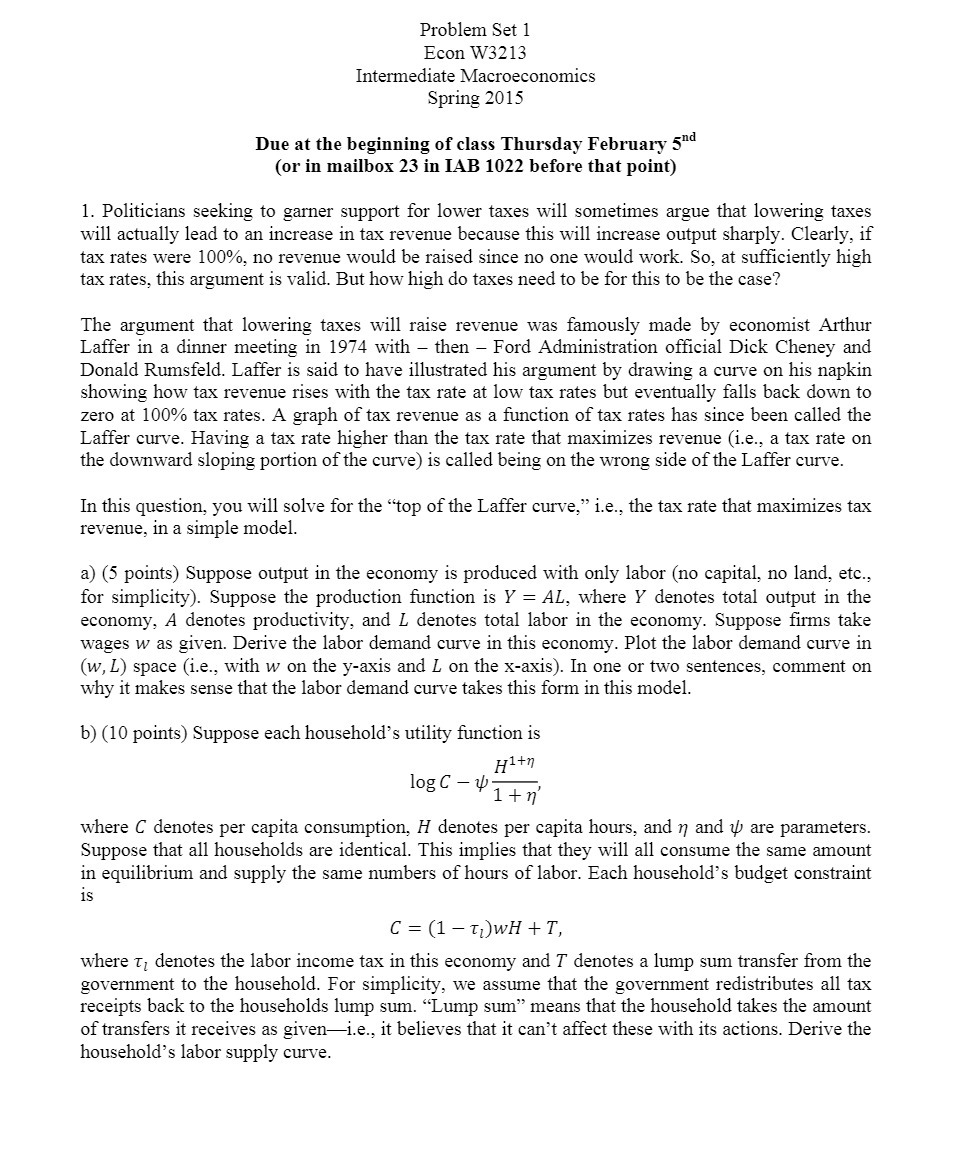
Problem Set 1 Econ W3213 Intermediate Macroeconomics Spring 20 1 5 Due at the beginning of class Thursday February 5'\"l (or in mailbox 23 in IAB 1022 before that point) I. Politicians seeking to garner support for lower taxes will sometimes argue that lowering taxes will actually lead to an increase in tax revenue because this will increase output sharply. Clearly, if tax rates were 100%, no revenue would he raised since no one would work. So, at sufciently high tax rates, this argmnent is valid. But how high do taxes need to be for this to be the case? The argument that lowering taxes will raise revenue was famously made by economist Arthur Laffer in a dinner meeting in 1974 with then Ford Administration ofcial Dick Cheney and Donald Rumsfeld. Laffer is said to have illustrated his argument by drawing a curve on his napkin showing how tax revenue rises with the tax rate at low tax rates but eventually falls back down to zero at 100% tax rates. A graph of tax revenue as a function of tax rates has since been called the La'er curve. Having a tax rate higher than the tax rate that maximizes revenue (i.e., a tax rate on the downward sloping portion of the curve) is called being on the wrong side of the Laffer curve. In this question, you will solve for the \"top of the Laffer curve,\" i.e., the tax rate that maximizes tax revenue, in a simple model. a) {5 points) Suppose output in the economy is produced with only labor (no capital, no land, etc., for simplicity). Suppose the production function is Y = AL, where Y denotes total output in the economy, A denotes productivity, and L denotes total labor in the economy. Suppose rms take wages w as given. Derive the labor demand curve in this economy. Plot the labor demand curve in (w, L) space (i.e., with w on the yaxis and L on the X-axis). In one or two sentences, comment on why it makes sense that the labor demand curve takes this form in this model. b) (10 points) Suppose each household's utility function is H1+ 1 + n' where C denotes per capita consumption, H denotes per capita hours, and I} and at: are parameters. Suppose that all households are identical. This implies that they will all consume the same amount in equilibrium and supply the same numbers of hours of labor. Each household's budget constraint is logCy C = (1 I)WH + T, where I; denotes the labor income tax in this economy and T denotes a lump sum transfer 'om the government to the household. For simplicity, we assume that the government redistributes all tax receipts back to the households lump sum. \"Lump sum" means that the household takes the amount of transfers it receives as givenLe, it believes that it can't affect these with its actions. Derive the household's labor supply curve
Step by Step Solution
There are 3 Steps involved in it

Get step-by-step solutions from verified subject matter experts
 Study Help