







Question: Problem Set 1 Problem Set 2 At a temperature of T=500K, an irreversible first-order reaction, A B, occurs in a spherical catalyst pellet with a
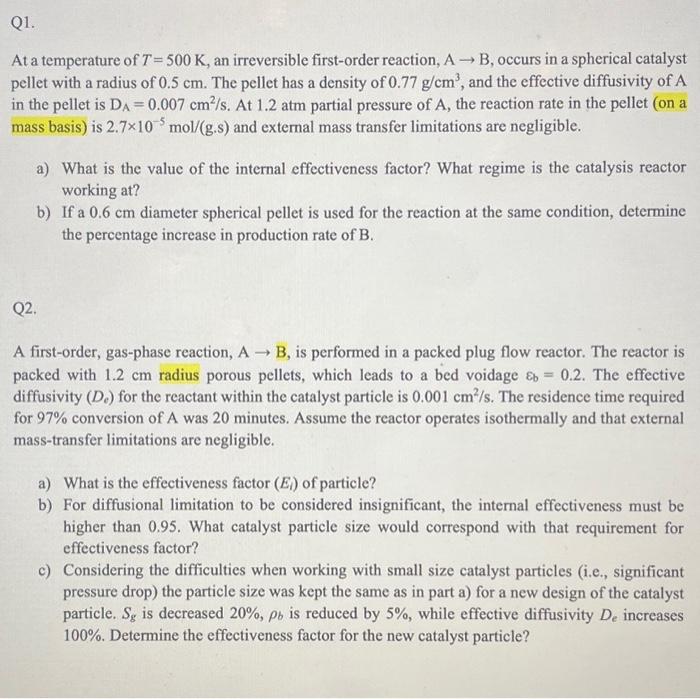
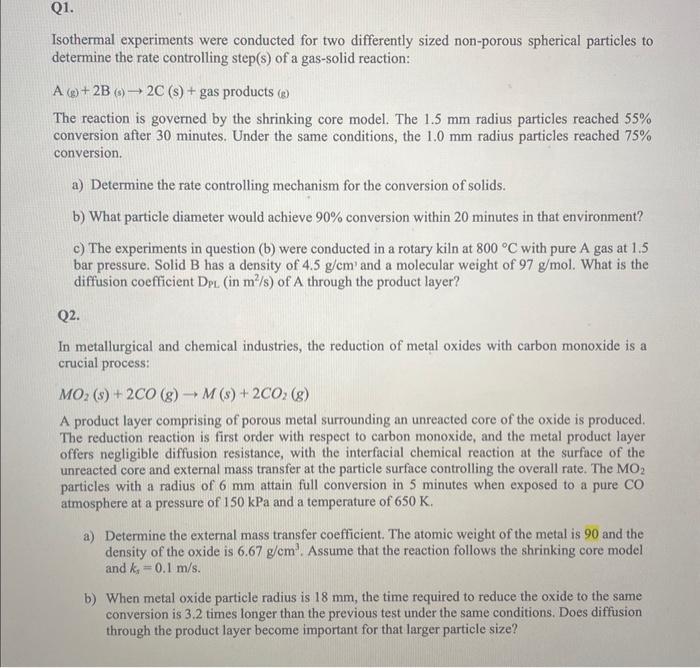
At a temperature of T=500K, an irreversible first-order reaction, A B, occurs in a spherical catalyst pellet with a radius of 0.5cm. The pellet has a density of 0.77g/cm3, and the effective diffusivity of A in the pellet is DA=0.007cm2/s. At 1.2atm partial pressure of A, the reaction rate in the pellet (on a mass basis) is 2.7105mol/g.s) and external mass transfer limitations are negligible. a) What is the value of the internal effectiveness factor? What regime is the catalysis reactor working at? b) If a 0.6cm diameter spherical pellet is used for the reaction at the same condition, determine the percentage increase in production rate of B. Q2. A first-order, gas-phase reaction, AB, is performed in a packed plug flow reactor. The reactor is packed with 1.2cm radius porous pellets, which leads to a bed voidage b=0.2. The effective diffusivity (De) for the reactant within the catalyst particle is 0.001cm2/s. The residence time required for 97% conversion of A was 20 minutes. Assume the reactor operates isothermally and that external mass-transfer limitations are negligible. a) What is the effectiveness factor (Ei) of particle? b) For diffusional limitation to be considered insignificant, the internal effectiveness must be higher than 0.95 . What catalyst particle size would correspond with that requirement for effectiveness factor? c) Considering the difficulties when working with small size catalyst particles (i.e., significant pressure drop) the particle size was kept the same as in part a) for a new design of the catalyst particle. Sg is decreased 20%,b is reduced by 5%, while effective diffusivity De increases 100%. Determine the effectiveness factor for the new catalyst particle? Isothermal experiments were conducted for two differently sized non-porous spherical particles to determine the rate controlling step(s) of a gas-solid reaction: A(g)+2B(s)2C(s)+ gas products (g) The reaction is governed by the shrinking core model. The 1.5mm radius particles reached 55% conversion after 30 minutes. Under the same conditions, the 1.0mm radius particles reached 75% conversion. a) Determine the rate controlling mechanism for the conversion of solids. b) What particle diameter would achieve 90% conversion within 20 minutes in that environment? c) The experiments in question (b) were conducted in a rotary kiln at 800C with pure A gas at 1.5 bar pressure. Solid B has a density of 4.5g/cm and a molecular weight of 97g/mol. What is the diffusion coefficient DPL (in m2/s ) of A through the product layer? Q2. In metallurgical and chemical industries, the reduction of metal oxides with carbon monoxide is a crucial process: MO2(s)+2CO(g)M(s)+2CO2(g) A product layer comprising of porous metal surrounding an unreacted core of the oxide is produced. The reduction reaction is first order with respect to carbon monoxide, and the metal product layer offers negligible diffusion resistance, with the interfacial chemical reaction at the surface of the unreacted core and external mass transfer at the particle surface controlling the overall rate. The MO2 particles with a radius of 6mm attain full conversion in 5 minutes when exposed to a pure CO atmosphere at a pressure of 150kPa and a temperature of 650K. a) Determine the external mass transfer coefficient. The atomic weight of the metal is 90 and the density of the oxide is 6.67g/cm3. Assume that the reaction follows the shrinking core model and kr=0.1m/s. b) When metal oxide particle radius is 18mm, the time required to reduce the oxide to the same conversion is 3.2 times longer than the previous test under the same conditions. Does diffusion through the product layer become important for that larger particle size
Step by Step Solution
There are 3 Steps involved in it

Get step-by-step solutions from verified subject matter experts
 Study Help