Question: Problem Set 1 Question 1 - Short Selling You short sell 20 shares of a stock which is currently traded for 100 dollars. The maintenance
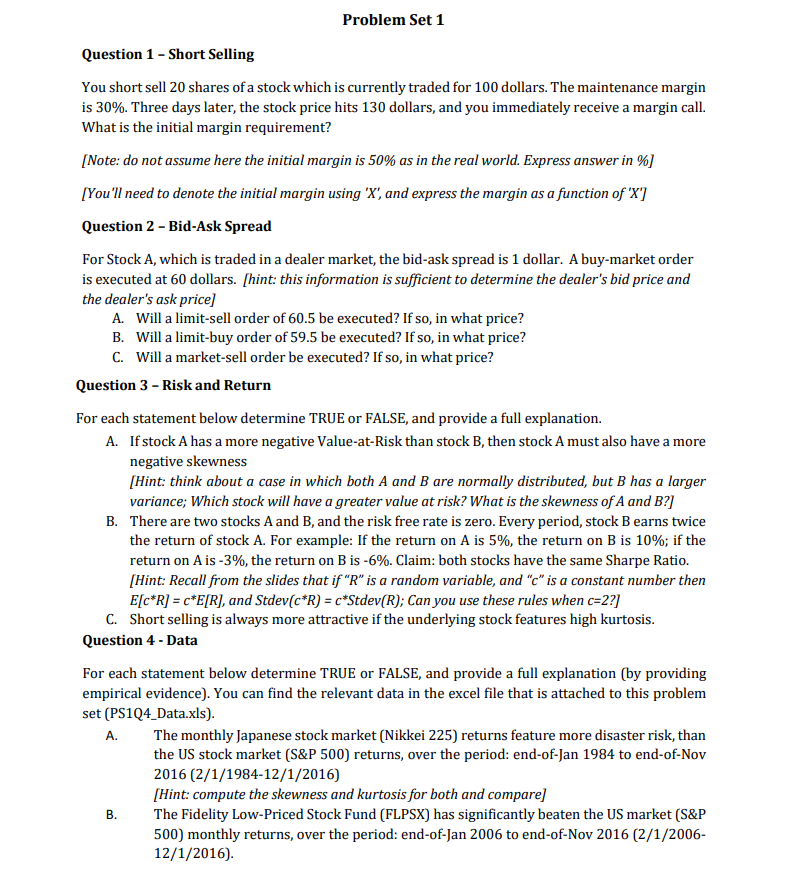
Problem Set 1 Question 1 - Short Selling You short sell 20 shares of a stock which is currently traded for 100 dollars. The maintenance margin is 30%. Three days later, the stock price hits 130 dollars, and you immediately receive a margin call. What is the initial margin requirement? [Note: do not assume here the initial margin is 50% as in the real world. Express answer in %] [You'll need to denote the initial margin using 'X", and express the margin as a function of "X"] Question 2 - Bid-Ask Spread For Stock A, which is traded in a dealer market, the bid-ask spread is 1 dollar. A buy-market order is executed at 60 dollars. (hint: this information is sufficient to determine the dealer's bid price and the dealer's ask price] A. Will a limit-sell order of 60.5 be executed? If so, in what price? B. Will a limit-buy order of 59.5 be executed? If so, in what price? C. Will a market-sell order be executed? If so, in what price? Question 3 - Risk and Return For each statement below determine TRUE or FALSE, and provide a full explanation. A. If stock A has a more negative Value-at-Risk than stock B, then stock A must also have a more negative skewness [Hint: think about a case in which both A and B are normally distributed, but B has a larger variance; Which stock will have a greater value at risk? What is the skewness of A and B?] B. There are two stocks A and B, and the risk free rate is zero. Every period, stock B earns twice the return of stock A. For example: If the return on A is 5%, the return on B is 10%; if the return on A is -3%, the return on B is -6%. Claim: both stocks have the same Sharpe Ratio. (Hint: Recall from the slides that if "R" is a random variable, and "c" is a constant number then E[c*R] = c*E[R], and Stdev(c*R) = c*Stdev(R); Can you use these rules when c=2?] C. Short selling is always more attractive if the underlying stock features high kurtosis. Question 4 - Data For each statement below determine TRUE or FALSE, and provide a full explanation (by providing empirical evidence). You can find the relevant data in the excel file that is attached to this problem set (PS1Q4_Data.xls). A. The monthly Japanese stock market (Nikkei 225) returns feature more disaster risk, than the US stock market (S&P 500) returns, over the period: end-of-Jan 1984 to end-of-Nov 2016 (2/1/1984-12/1/2016) [Hint: compute the skewness and kurtosis for both and compare] B. The Fidelity Low-Priced Stock Fund (FLPSX) has significantly beaten the US market (S&P 500) monthly returns, over the period: end-of-Jan 2006 to end-of-Nov 2016 (2/1/2006- 12/1/2016)
Step by Step Solution
There are 3 Steps involved in it
1 Expert Approved Answer
Step: 1 Unlock
Question Has Been Solved by an Expert!
Get step-by-step solutions from verified subject matter experts
Step: 2 Unlock
Step: 3 Unlock
Students Have Also Explored These Related Accounting Questions!









 Study Help