







Question: Problem Set #15 - Electric Generators l| Use Faraday's Law, the Generator rpm equation, and Ohm's Law to answer the following questions: 1) An AC
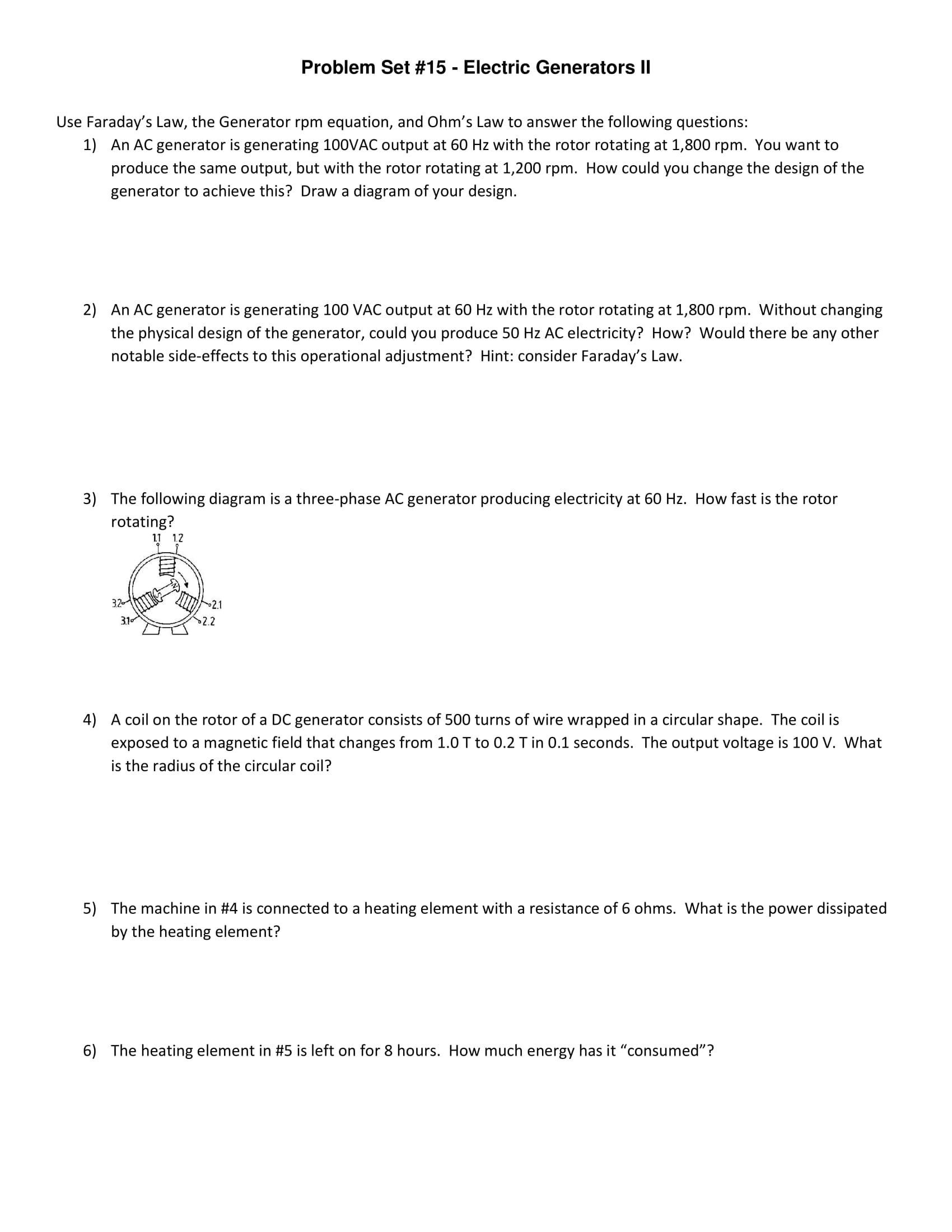
Problem Set #15 - Electric Generators l| Use Faraday's Law, the Generator rpm equation, and Ohm's Law to answer the following questions: 1) An AC generator is generating 100VAC output at 60 Hz with the rotor rotating at 1,800 rpm. You want to produce the same output, but with the rotor rotating at 1,200 rpm. How could you change the design of the generator to achieve this? Draw a diagram of your design. 2) An AC generator is generating 100 VAC output at 60 Hz with the rotor rotating at 1,800 rpm. Without changing the physical design of the generator, could you produce 50 Hz AC electricity? How? Would there be any other notable side-effects to this operational adjustment? Hint: consider Faraday's Law. 3) The following diagram is a three-phase AC generator producing electricity at 60 Hz. How fast is the rotor rotating? 4) A coil on the rotor of a DC generator consists of 500 turns of wire wrapped in a circular shape. The coil is exposed to a magnetic field that changes from 1.0 T to 0.2 T in 0.1 seconds. The output voltage is 100 V. What is the radius of the circular coil? 5) The machine in #4 is connected to a heating element with a resistance of 6 ohms. What is the power dissipated by the heating element? 6) The heating element in #5 is left on for 8 hours. How much energy has it \"consumed"
Step by Step Solution
There are 3 Steps involved in it

Get step-by-step solutions from verified subject matter experts
 Study Help