







Question: PROBLEM SET 3: EQUILIBRIUM PROBLEMS 1. Write the expression for the equilbrium constant for this reaction. 2N2O3(g)ccmm>4NO2(p)+O2(p) 2. Calculate the equilibrium constant for the reaction
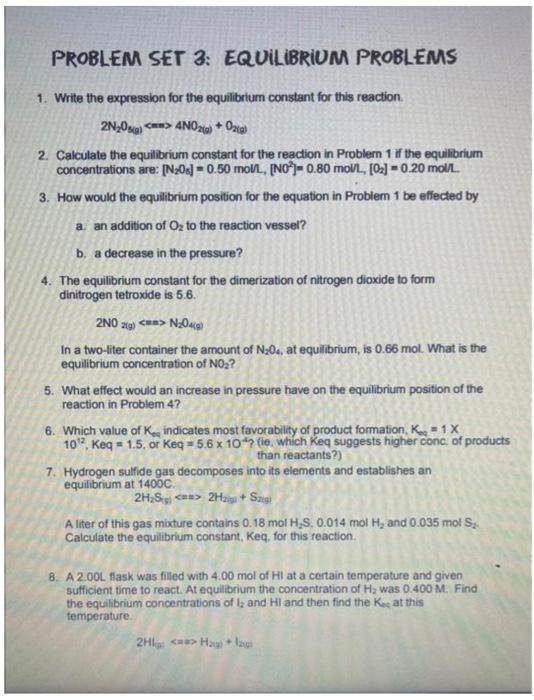
PROBLEM SET 3: EQUILIBRIUM PROBLEMS 1. Write the expression for the equilbrium constant for this reaction. 2N2O3(g)ccmm>4NO2(p)+O2(p) 2. Calculate the equilibrium constant for the reaction in Problern 1 if the equilibrium concentrations are: [N20s]=0.50mol, [NO2]=0.80molL,[O2]=0.20molL 3. How would the equilibrium position for the equation in Problem 1 be effected by a. an addition of O2 to the reaction vessel? b. a decrease in the pressure? 4. The equilibrium constant for the dimerization of nitrogen dioxide to form dinitrogen tetroxide is 5.6. 2NO2(g)mm>N2O4(g) In a two-liter container the amount of N2O4, at equilibrium, is 0.66 mol. What is the equilibrium concentration of NO2 ? 5. What effect would an increase in pressure have on the equilibrium position of the reaction in Problem 4 ? 6. Which value of Keq indicates most favorability of product formation, Kn=1X 10¹²,Keq=1.5, or Keq=5.6104? (ie, which Keq suggests higher conc. of products than reactants?) 7. Hydrogen sulfide gas decomposes into its elements and establishes an equilibrium at 1400C. 2H2Sis)cews2H2igi+Szigi A liter of this gas mixture contains 0.18 mol 2S,0.014 mol H2 and 0.035 mol S2. Calculate the equilibrium constant, Keq, for this reaction. 8. A 2.00L. flask was filled with 4.00 mol of Hl at a certain temperature and given sutficient time to react. At equilibrium the concentration of H2 was 0.400M. Find the equilibrium concentrations of I2 and HI and then find the Kpe at this temperature. 2H1Ha
Step by Step Solution
There are 3 Steps involved in it

Get step-by-step solutions from verified subject matter experts
 Study Help