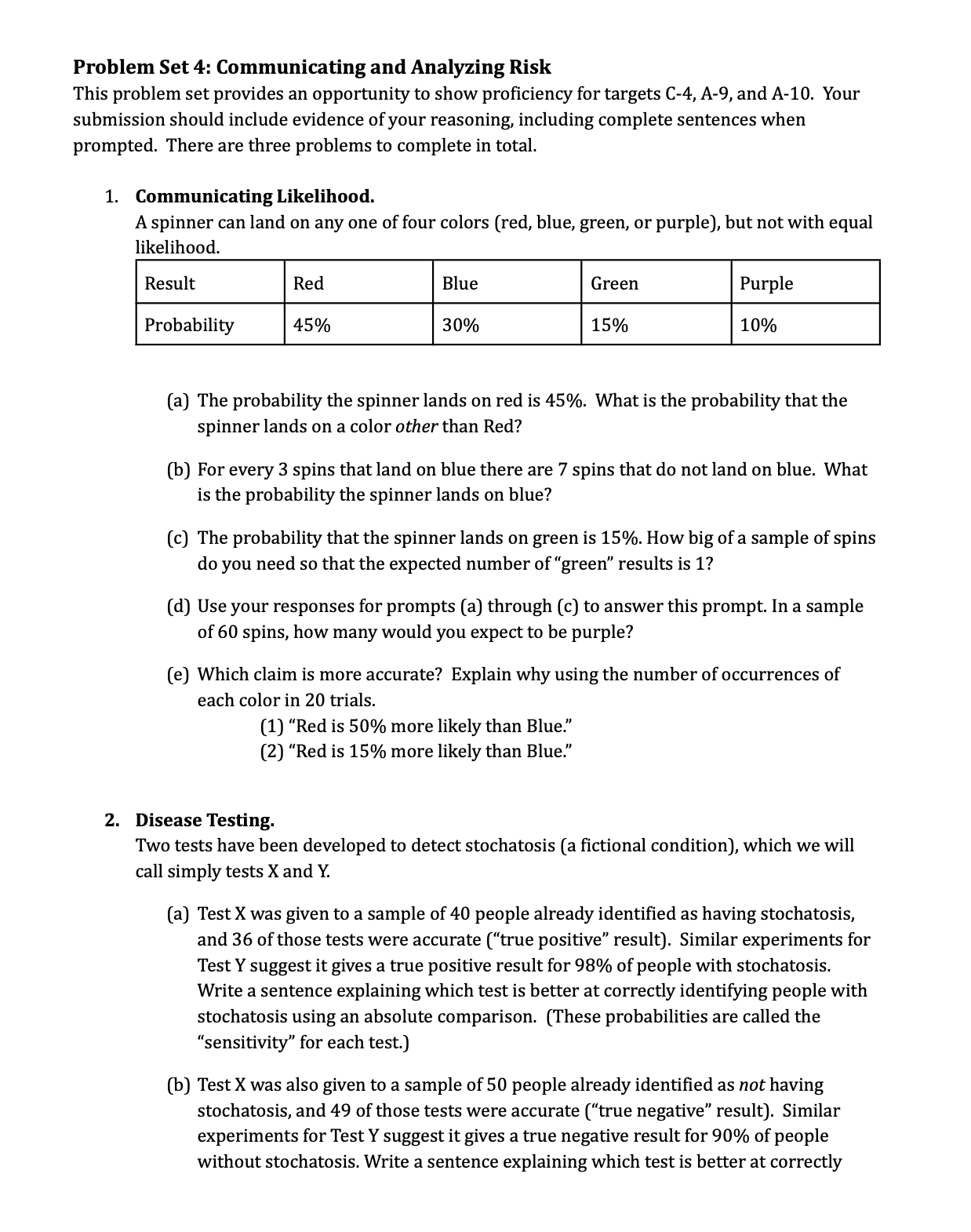
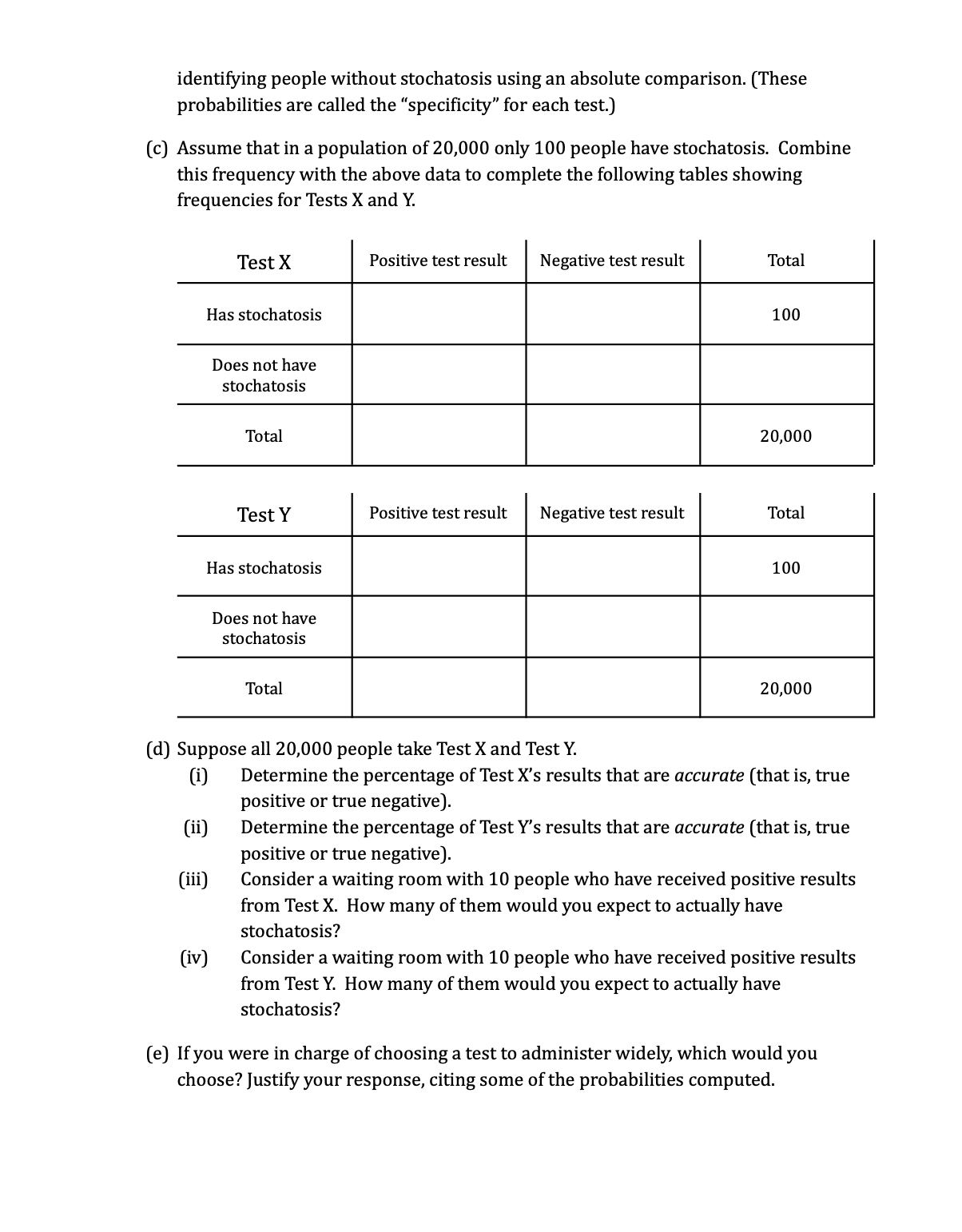
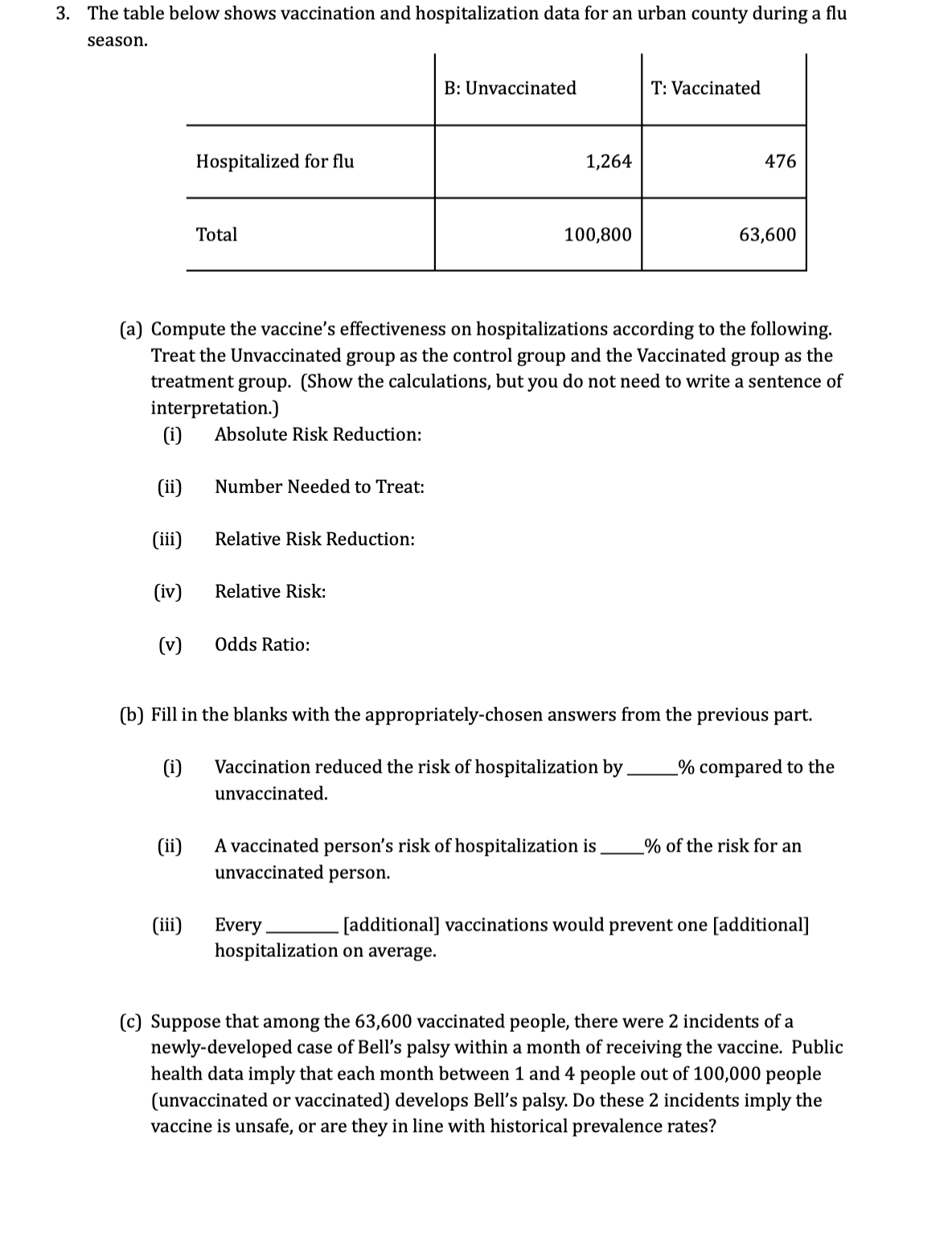
Question: Problem Set 4: Communicating and Analyzing Risk This problem set provides an opportunity to show proficiency for targets C-4, A-9, and A-10. Your submission should
Problem Set 4: Communicating and Analyzing Risk This problem set provides an opportunity to show proficiency for targets C-4, A-9, and A-10. Your submission should include evidence of your reasoning, including complete sentences when prompted. There are three problems to complete in total. 1. Communicating Likelihood. A spinner can land on any one of four colors (red, blue, green, or purple), but not with equal likelihood. o ot o o o (a) The probability the spinner lands on red is 45%. What is the probability that the spinner lands on a color other than Red? (b) For every 3 spins that land on blue there are 7 spins that do not land on blue. What is the probability the spinner lands on blue? (c) The probability that the spinner lands on green is 15%. How big of a sample of spins do you need so that the expected number of \"green\" results is 1? (d) Use your responses for prompts (a) through (c) to answer this prompt. In a sample of 60 spins, how many would you expect to be purple? (e) Which claim is more accurate? Explain why using the number of occurrences of each color in 20 trials. (1) \"Red is 50% more likely than Blue.\" (2) \"Red is 15% more likely than Blue.\" 2. Disease Testing. Two tests have been developed to detect stochatosis (a fictional condition), which we will call simply tests X and Y. (a) Test X was given to a sample of 40 people already identified as having stochatosis, and 36 of those tests were accurate (\"true positive\" result). Similar experiments for Test Y suggest it gives a true positive result for 98% of people with stochatosis. Write a sentence explaining which test is better at correctly identifying people with stochatosis using an absolute comparison. (These probabilities are called the \"sensitivity\" for each test.) (b) Test X was also given to a sample of 50 people already identified as not having stochatosis, and 49 of those tests were accurate (\"true negative\" result). Similar experiments for Test Y suggest it gives a true negative result for 90% of people without stochatosis. Write a sentence explaining which test is better at correctly identifying people without stochatosis using an absolute comparison. (These probabilities are called the \"specificity\" for each test.) (c) Assume that in a population of 20,000 only 100 people have stochatosis. Combine this frequency with the above data to complete the following tables showing frequencies for Tests X and Y. Test X Has stochatosis Does not have stochatosis Total TestY Has stochatosis Does not have stochatosis Total (d) Suppose all 20,000 people take Test X and Test Y. (i) Determine the percentage of Test X's results that are accurate (that is, true positive or true negative). (i) Determine the percentage of Test Y's results that are accurate (that is, true positive or true negative). (iii) Consider a waiting room with 10 people who have received positive results from Test X. How many of them would you expect to actually have stochatosis? (iv) Consider a waiting room with 10 people who have received positive results from Test Y. How many of them would you expect to actually have stochatosis? (e) If you were in charge of choosing a test to administer widely, which would you choose? Justify your response, citing some of the probabilities computed. 3. The table below shows vaccination and hospitalization data for an urban county during a flu season. B: Unvaccinated T: Vaccinated Hospitalized for flu 1,264 Total 100,800 63,600 (a) Compute the vaccine's effectiveness on hospitalizations according to the following,. Treat the Unvaccinated group as the control group and the Vaccinated group as the treatment group. (Show the calculations, but you do not need to write a sentence of interpretation.) (i) Absolute Risk Reduction: (ii) Number Needed to Treat: (iii) Relative Risk Reduction: (iv) Relative Risk: (v) 0Odds Ratio: (b) Fill in the blanks with the appropriately-chosen answers from the previous part. (i) Vaccination reduced the risk of hospitalization by % compared to the unvaccinated. (i) Avaccinated person's risk of hospitalization is % of the risk for an unvaccinated person. (iii) Every [additional] vaccinations would prevent one [additional] hospitalization on average. (c) Suppose that among the 63,600 vaccinated people, there were 2 incidents of a newly-developed case of Bell's palsy within a month of receiving the vaccine. Public health data imply that each month between 1 and 4 people out of 100,000 people (unvaccinated or vaccinated) develops Bell's palsy. Do these 2 incidents imply the vaccine is unsafe, or are they in line with historical prevalence rates
Step by Step Solution
There are 3 Steps involved in it
1 Expert Approved Answer
Step: 1 Unlock
Question Has Been Solved by an Expert!
Get step-by-step solutions from verified subject matter experts
Step: 2 Unlock
Step: 3 Unlock
Students Have Also Explored These Related Law Questions!









 Study Help