







Question: Problem Set - The Ricardian model 1. B. b. Consider the following unit labour requirements: Portugal 10 20 Given that English productivity is higher in
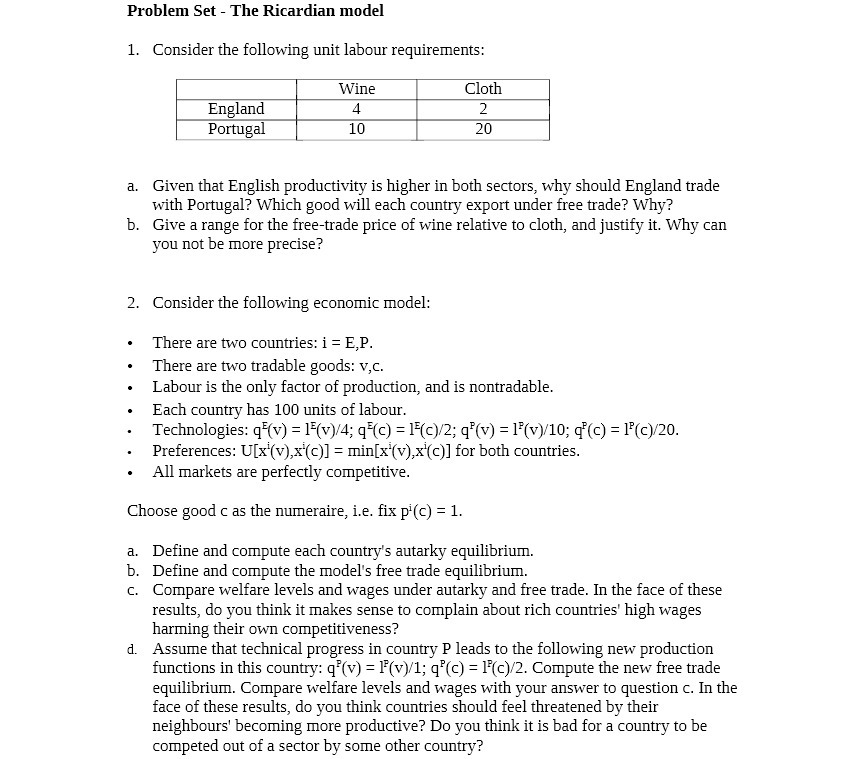
Problem Set - The Ricardian model 1. B. b. Consider the following unit labour requirements: Portugal 10 20 Given that English productivity is higher in both sectors, why should England trade with Portugal? Which good will each country export under free trade? \"Thy? Give a range for the freetrade price of wine relative to cloth, and justify it. Why can you not be more precise? Consider the following economic model: There are two countries: 1 = E,P. There are two tradable goods: v,c. Labour is the only factor of production; and is nonrradable. Each country has 100 units of labour. Technologies: quv) = 1330M; q'(c) = 1E(c)t2; qP(v] = lP(v).n'1CI; :c) = iP(c)f2. Preferences: U[xi{v),xi{c]] = n1in[xi(v),xi(c)] for both countries. All markets are perfectly competitive. Choose good c as the numeraire, i.e. fix pi[c] = l. PP'FJ Dene and compute each country's autarky equilibrium. Dene and compute the model's free trade equilibrium. Compare welfare levels and wages under autarky and free trade. In the face of these results, do you think it makes sense to complain about rich countries' high wages harming their own competitiveness? Assume that technical progress in country P leads to the following new production functions in this country: q'Iv) = lr{v]a'1; qP(c) = 1P(c}i2. Compute the new free trade equilibrium. lCompare welfare levels and wages with your answer to question c. In the face of these results, do you think countries should feel threatened by their neighbours' becoming more productive? Do you think it is bad for a country to be competed out of a sector by some other country
Step by Step Solution
There are 3 Steps involved in it

Get step-by-step solutions from verified subject matter experts
 Study Help