





Question: Problem Situation 6: Equidecomposability Tangrams (fig. 1.7) are a collection of polygonally shaped regions that can be assembled to make a variety of different polygonal
Problem Situation 6: Equidecomposability TangramsProblem Situation 6: Equidecomposability TangramsProblem Situation 6: Equidecomposability Tangrams
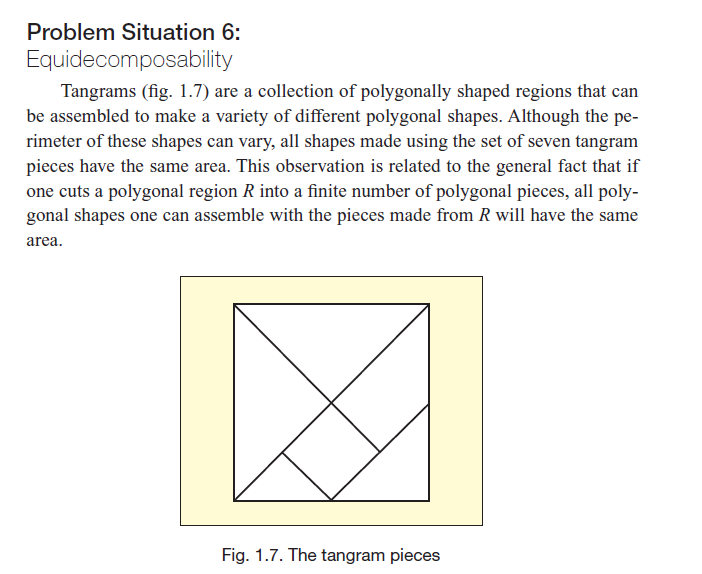
Problem Situation 6: Equidecomposability Tangrams (fig. 1.7) are a collection of polygonally shaped regions that can be assembled to make a variety of different polygonal shapes. Although the pe- rimeter of these shapes can vary, all shapes made using the set of seven tangram pieces have the same area. This observation is related to the general fact that if one cuts a polygonal region R into a finite number of polygonal pieces, all poly- gonal shapes one can assemble with the pieces made from R will have the same area. Fig. 1.7. The tangram piecesHowever, what about the converse? Given any two polygons P! and P2 with the same area, is it possible to cut P! into a nite number of pieces and assemble these pieces in the style of a jigsaw puzzle to form P2? Two polygons that hate this property are said to be eqafdecomposabie. Remarkably, the answer to this question is yes. To see that the problem in- 1rolyes some not totally transparent issues, we might consider the question of What Is Geometry? 9 whether a rectangle whose sides have length a\"? and J3 can be cut into a nite number of pieces and reassembled to form a square of side 2. One approach to the general case is to show that any polygon can be subdi- yided into triangles, and each ofthese triangles can be shown to be decomposable into pieces that can be assembled into a rectangle with one of its sides haying length l. The rectangles formed from each of the triangles can then be glued together along the sides of length l to form a longer rectangle also with a side of length 1. Because P} and P2 have the same area, they are both decomposable What Is Geometry? 9 whether a rectangle whose sides have length of and \"/3 can be cut into a nite number of pieces and reassembled to form a square of side 2. One approach to the general case is to show that any polygon can be subdi- vided into triangles, and each of these triangles can be shown to be decomposable into pieces that can be assembled into a rectangle with one of its sides having length l. The rectangles formed from each of the triangles can then be glued together along the sides of length l to form a longer rectangle also with a side of length 1. Because Pi and P2 have the same area, they are both decomposable to the same rectangle with a side of length 1. When two polygons are each equi- decomposable to a third polygon, they are equidecomposable to each other. The analogous question in three dimensionsCan one decompose a three- dimensional polyhedron Q! into a nite number of polyhedral pieces to form a polyhedron Q2 of the same volume?is not universally true! For example, one cannot decompose a regular tetrahedron of volume 1 into a cube of volume 1. However, in the twentieth century the discovery was made that a ball {sphere together with its interior) can be decomposed into a nite number of disjoint parts and reassembled to form two spheres identical with the original one, a phe- nomenon known as the Banach-Tarski paradox
Step by Step Solution

There are 3 Steps involved in it

1 Expert Approved Answer
Step: 1 Unlock blur-text-image

Question Has Been Solved by an Expert!

Get step-by-step solutions from verified subject matter experts

Step: 2 Unlock
Step: 3 Unlock

Students Have Also Explored These Related Mathematics Questions!