







Question: problem solving class the question is in the last picture In the late 1990s, Nokia Corporation presented wireless carriers and invester Overcoming Fear of Failure:
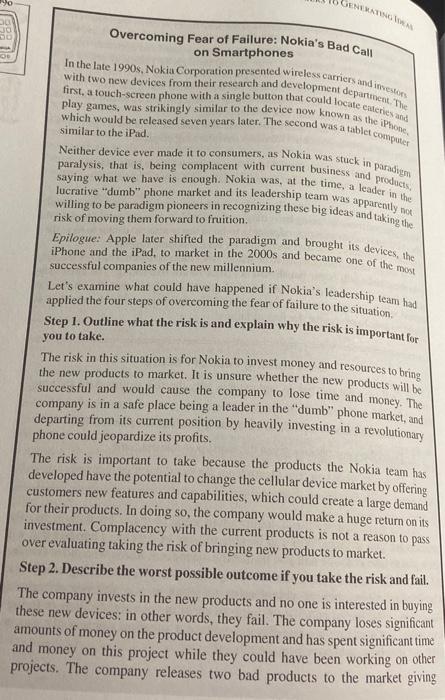
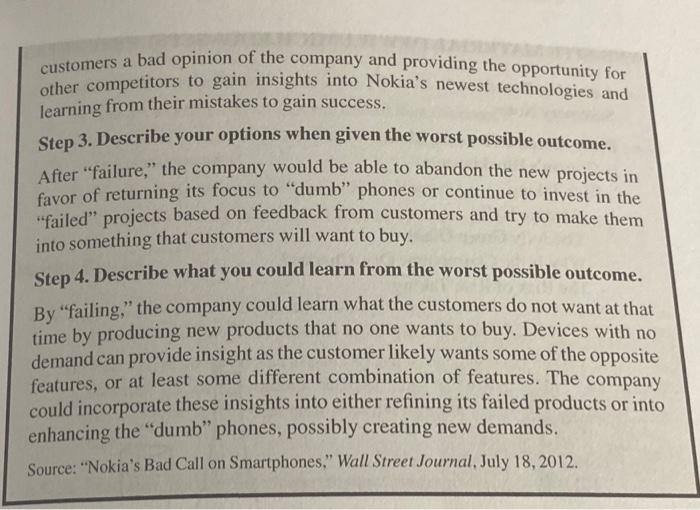

In the late 1990s, Nokia Corporation presented wireless carriers and invester Overcoming Fear of Failure: Nokia's Bad Call on Smartphones paralysis, that is, being complacent with current business and produch, saying what we have is enough. Nokia was, at the time, a leader inct, the lucrative "dumb" phone market and its leadership team was apparently not willing to be paradigm pioneers in recognizing these big ideas and taking the risk of moving them forward to fruition. Epilogue: Apple later shifted the paradigm and brought its devices, the iPhone and the iPad, to market in the 2000 s and became one of the most successful companies of the new millennium. Let's examine what could have happened if Nokia's leadership team had applied the four steps of overcoming the fear of failure to the situation. Step 1. Outline what the risk is and explain why the risk is important for you to take. The risk in this situation is for Nokia to invest money and resources to bring the new products to market. It is unsure whether the new products will be successful and would cause the company to lose time and money. The company is in a safe place being a leader in the "dumb" phone market, and departing from its current position by heavily investing in a revolutionary phone could jeopardize its profits. The risk is important to take because the products the Nokia team has developed have the potential to change the cellular device market by offering customers new features and capabilities, which could create a large demand for their products. In doing so, the company would make a huge return on its investment. Complacency with the current products is not a reason to pass over evaluating taking the risk of bringing new products to market. Step 2. Describe the worst possible outcome if you take the risk and fail. The company invests in the new products and no one is interested in buying these new devices: in other words, they fail. The company loses significant amounts of money on the product development and has spent significant time and money on this project while they could have been working on other projects. The company releases two bad products to the market giving customers a bad opinion of the company and providing the opportunity for other competitors to gain insights into Nokia's newest technologies and learning from their mistakes to gain success. Step 3. Describe your options when given the worst possible outcome. After "failure," the company would be able to abandon the new projects in favor of returning its focus to "dumb" phones or continue to invest in the "failed" projects based on feedback from customers and try to make them into something that customers will want to buy. Step 4. Describe what you could learn from the worst possible outcome. By "failing," the company could learn what the customers do not want at that time by producing new products that no one wants to buy. Devices with no demand can provide insight as the customer likely wants some of the opposite features, or at least some different combination of features. The company could incorporate these insights into either refining its failed products or into enhancing the "dumb" phones, possibly creating new demands. Source: "Nokia's Bad Call on Smartphones," Wall Street Journal, July 18, 2012. 6.14. What lesson can you take away from the example of the Nokia smartphone and tablet
Step by Step Solution
There are 3 Steps involved in it

Get step-by-step solutions from verified subject matter experts
 Study Help