







Question: Problem Solving Question 1 Note: please draw a separate graph for each subpart of the problem below. The demand and supply for bicycles is given
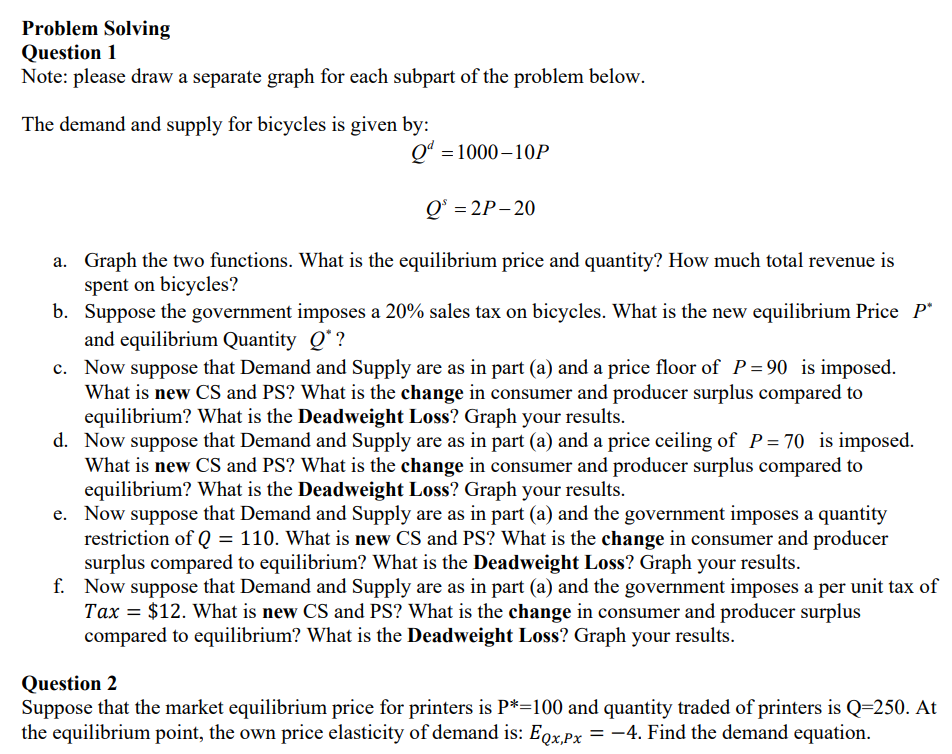
Problem Solving Question 1 Note: please draw a separate graph for each subpart of the problem below. The demand and supply for bicycles is given by: Q'leOOIOP Q'zZPZO a. Graph the two functions. What is the equilibrium price and quantity? How much total revenue is spent on bicycles? b. Suppose the government imposes a 20% sales tax on bicycles. What is the new equilibrium Price P' and equilibrium Quantity Q' ? c. Now suppose that Demand and Supply are as in part (a) and a price oor of P = 90 is imposed. What is new CS and PS? What is the change in consumer and producer surplus compared to equilibrium? What is the Deadweight Loss? Graph your results. d. Now suppose that Demand and Supply are as in part (a) and a price ceiling of P = ?0 is imposed. What is new CS and PS? What is the change in consumer and producer surplus compared to equilibrium? What is the Deadweight Loss? Graph your results. e. Now suppose that Demand and Supply are as in part (a) and the government imposes a quantity restriction of Q = 110. What is new CS and PS? What is the change in consumer and producer surplus compared to equilibrium? What is the Deadweight Loss? Graph your results. f. Now suppose that Demand and Supply are as in part (a) and the government imposes a per unit tax of Tax = $12. What is new CS and PS? What is the change in consumer and producer surplus compared to equilibrium? What is the Deadweight Loss? Graph your results. Question 2 Suppose that the market equilibrium price for printers is P*=100 and quantity traded of printers is Q=250. At the equilibrium point, the own price elasticity of demand is: EQx,Px = 4. Find the demand equation
Step by Step Solution
There are 3 Steps involved in it

Get step-by-step solutions from verified subject matter experts
 Study Help