







Question: Problem Solving Sample Problem The pitcher threw the ball horizontally from 5.5m with an initial speed of 25 m/s. a) How long will it take
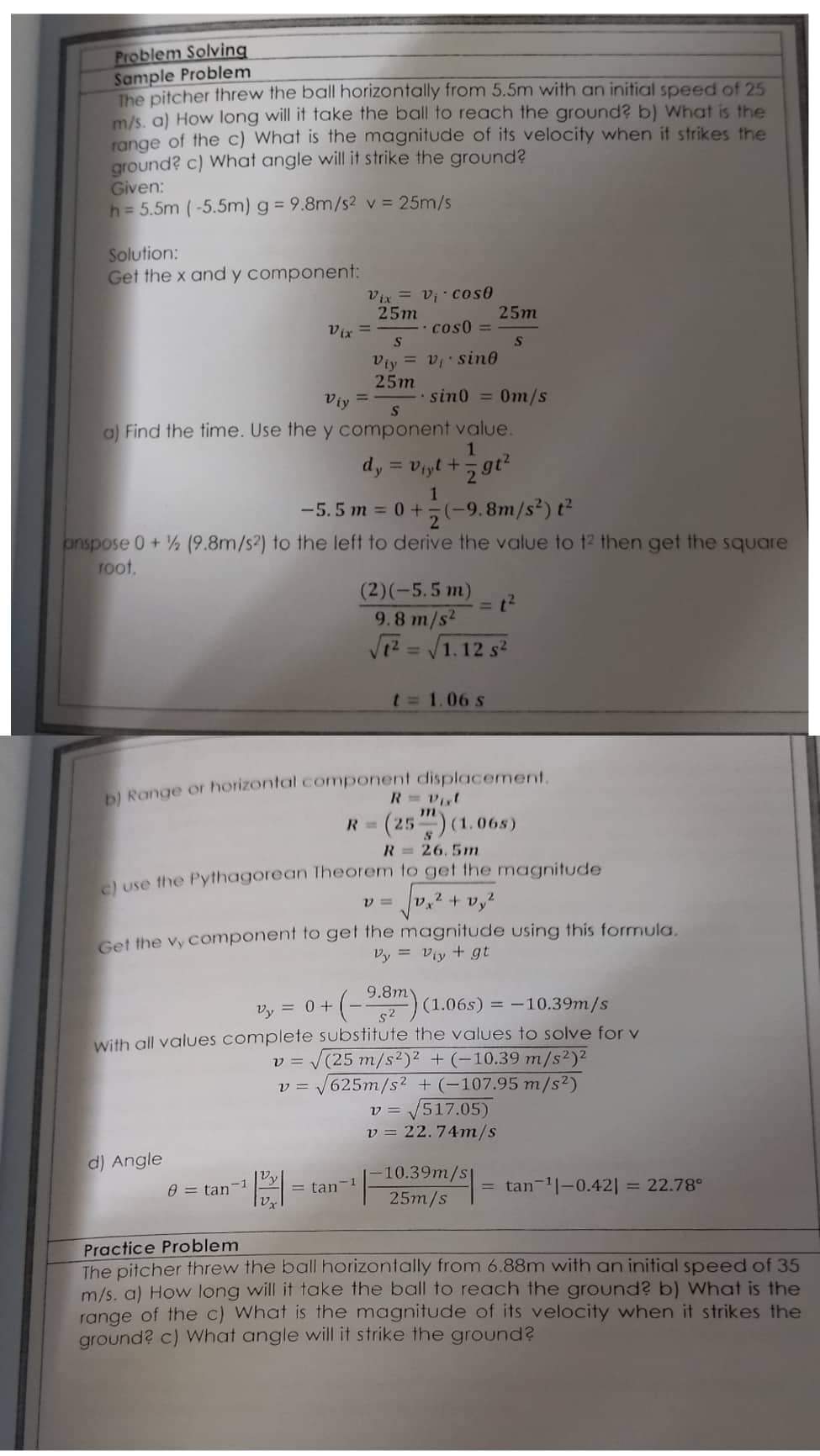
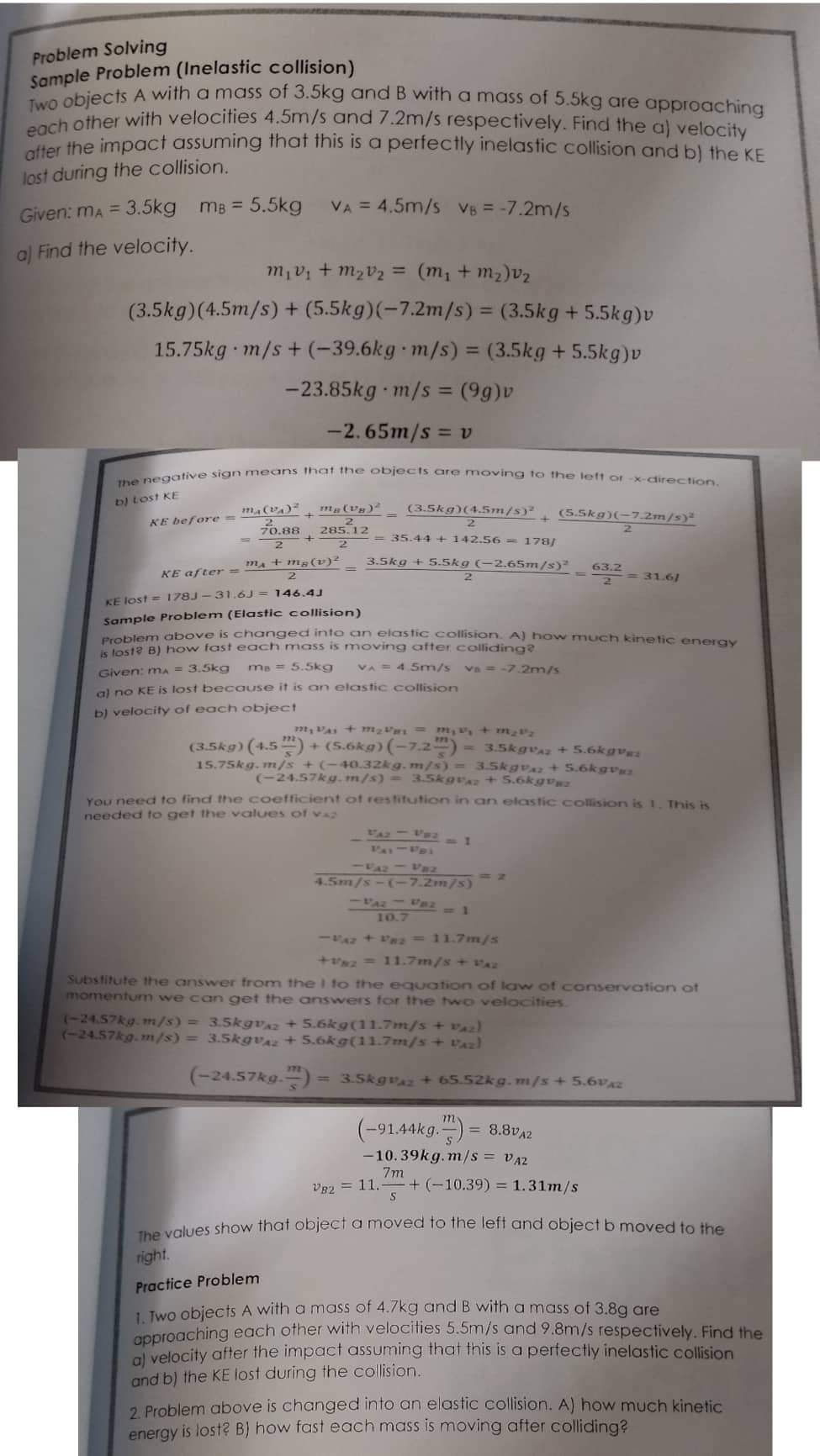
Problem Solving Sample Problem The pitcher threw the ball horizontally from 5.5m with an initial speed of 25 m/s. a) How long will it take the ball to reach the ground? b) What is the range of the c) What is the magnitude of its velocity when it strikes the ground? c) What angle will it strike the ground? Given: h = 5.5m (-5.5m) g = 9.8m/s2 v = 25m/s Solution: Get the x and y component: Vix = Vi . COSO 25m 25m Vix = -. COSO = S Vly = v . sine 25m Viy . sin0 = 0m/s S a) Find the time. Use the y component value. dy = vnit+-gt2 1 -5.5 m = 0+ = (-9.8m/s2) t2 anspose 0 + 1/2 (9.8m/s?) to the left to derive the value to 12 then get the square root. (2) (-5.5 m) 9.8 m/s2 V12 = V1. 12 52 1 = 1.06 s b) Range or horizontal component displacement. R = vil R = (25 %) (1. 065) R = 26. 5m c) use the Pythagorean Theorem to get the magnitude v = v, 2 + vy Get the vy component to get the magnitude using this formula. Vy = Viy + gt Vy = 0+ ( - - 9.8my $2 (1.065) = -10.39m/s with all values complete substitute the values to solve for v v = V (25 m/s2)2 + (-10.39 m/s2)2 v = V625m/s2 + (-107.95 m/s2) v = V517.05) v = 22. 74m/s d) Angle 0 = tan -1 = tan -1 25m/ s 1-10.39m/S = tan '|-0.421 = 22.78 Practice Problem The pitcher threw the ball horizontally from 6.88m with an initial speed of 35 m/s. a) How long will it take the ball to reach the ground? b) What is the range of the c) What is the magnitude of its velocity when it strikes the ground? c) What angle will it strike the ground?Problem Solving Sample Problem (Inelastic collision) Two objects A with a mass of 3.5kg and B with a mass of 5.5kg are approaching each other with velocities 4.5m/s and 7.2m/s respectively. Find the a) velocity after the impact assuming that this is a perfectly inelastic collision and b) the KE lost during the collision. Given: mA = 3.5kg ms = 5.5kg VA = 4.5m/s VB = -7.2m/s a) Find the velocity. mv, + m2v2 = (m, + mz)V2 (3.5kg)(4.5m/s) + (5.5kg)(-7.2m/s) = (3.5kg + 5.5kg)v 15.75kg . m/s + (-39.6kg . m/s) = (3.5kg + 5.5kg)v -23.85kg . m/s = (99)v -2. 65m/s = v the negative sign means that the objects are moving to the left or -x-direction. DJ LOST KE KE before = ma(vA) , ma(vs) (3.5kg)(4.5m/s) (5.5kg)(-7.2m/s) 70.88 285.12 2 = 35.44 + 142.56 = 178/ KE after = ma + is(v) 3.5kg + 5.5kg (-2.65m/s) 63.2 2 2 = =31.61 KE lost = 1781 - 31.6J = 146.4J Sample Problem (Elastic collision) Problem above is changed into an elastic collision. A) how much kinetic energy is lost? B) how fast each mass is moving after, colliding? Given: mA = 3.5kg ms = 5.5kg VA = 4 5m/s vn = -7.2m/s al no KE is lost because it is an elastic collision b) velocity of each object (3.5kg) (4.5 ) + (5.6kg) (-7.2-") = 3.5kgvaz + 5.6kgvg: 15.75kg. m/s + (-40.32kg. m/s) = 35kgve + 5.6kgvps (-24.57ky.m/$) = 3 5kgv.2 + 5.6kgVN You need to find the coefficient of restitution in an elastic collision is 1, This is needed to get the values of vaz 4.5m/s -(-7.2m/s) 10.7 -142 + Una = 11.7m/s +ing = 11.7m/8 + VAZ Substitute the answer from the I to the equation of law of conservation of momentum we can get the answers for the two velocities (-24.57kg.m/s) = 3.5kgv2 + 5.6kg(11.7m/s + VA2) (-24.57kg.m/s) = 3.5kgvaz + 5.6kg(11.7m/s+ VA2) (-24.57kg.") = 3.5kgvx2 + 65.52kg. m/s + 5.6VAZ (-91.44kg. " ) = 8.8VAZ -10.39kg. m/s = VAZ VB2 = 11. 7m "+ (-10.39) = 1.31m/s The values show that object a moved to the left and object b moved to the right Practice Problem 1. Two objects A with a mass of 4.7kg and B with a mass of 3.8g are approaching each other with velocities 5.5m/s and 9.8m/s respectively. Find the a) velocity after the impact assuming that this is a perfectly inelastic collision and b) the KE lost during the collision. 2. Problem above is changed into an elastic collision. A) how much kinetic energy is lost? B) how fast each mass is moving after colliding
Step by Step Solution
There are 3 Steps involved in it

Get step-by-step solutions from verified subject matter experts
 Study Help