







Question: PROBLEM - SOLVING STRATEGY 1 6 . 1 Standing waves We can use the same general strategy for any standing wave. PREPARE For sound waves,
PROBLEMSOLVING STRATEGY Standing waves
We can use the same general strategy for any standing wave.
PREPARE
For sound waves, determine what sort of pipe or tube you have: openopen, closedclosed, or openclosed.
For string or light waves, the ends will be fixed points.
For other types of standing waves, such as electromagnetic or water waves, the mode diagram will be similar to one of the cases outlined in Synthesis Page You can then work by analogy with waves on strings or sound waves in tubes.
Determine known values: length of the tube or string, frequency, wavelength, and positions of nodes or antinodes.
Sketch a visual overview, including a picture of the relevant mode.
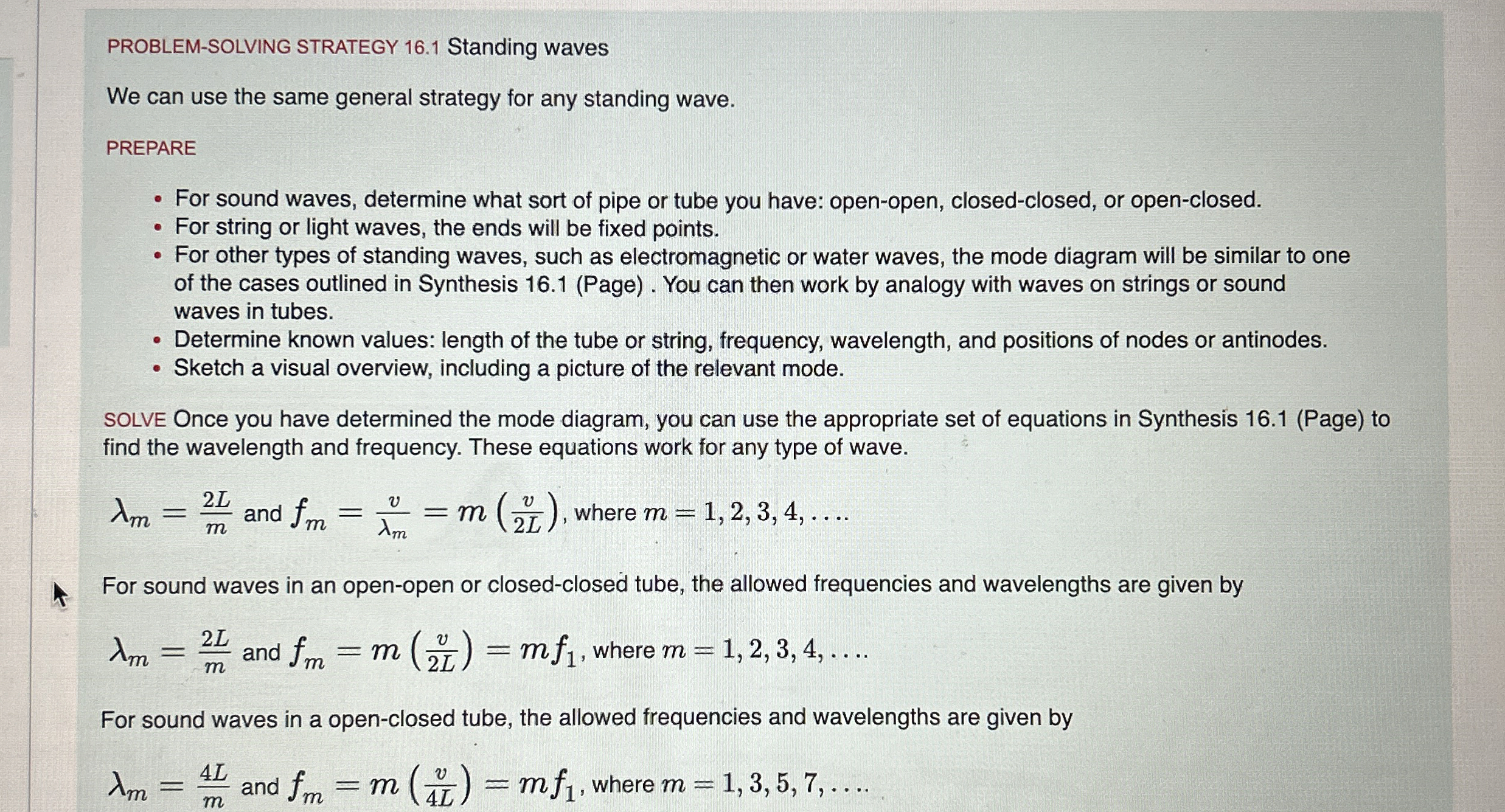
SOLVE Once you have determined the mode diagram, you can use the appropriate set of equations in Synthesis Page to find the wavelength and frequency. These equations work for any type of wave.
and where dots
For sound waves in an openopen or closedclosed tube, the allowed frequencies and wavelengths are given by
and where dots
For sound waves in a openclosed tube, the allowed frequencies and wavelengths are given by
and where What is the length L of the pipe? Express your answer in centimeters
Step by Step Solution
There are 3 Steps involved in it
1 Expert Approved Answer
Step: 1 Unlock

Question Has Been Solved by an Expert!
Get step-by-step solutions from verified subject matter experts
Step: 2 Unlock
Step: 3 Unlock
 Study Help