







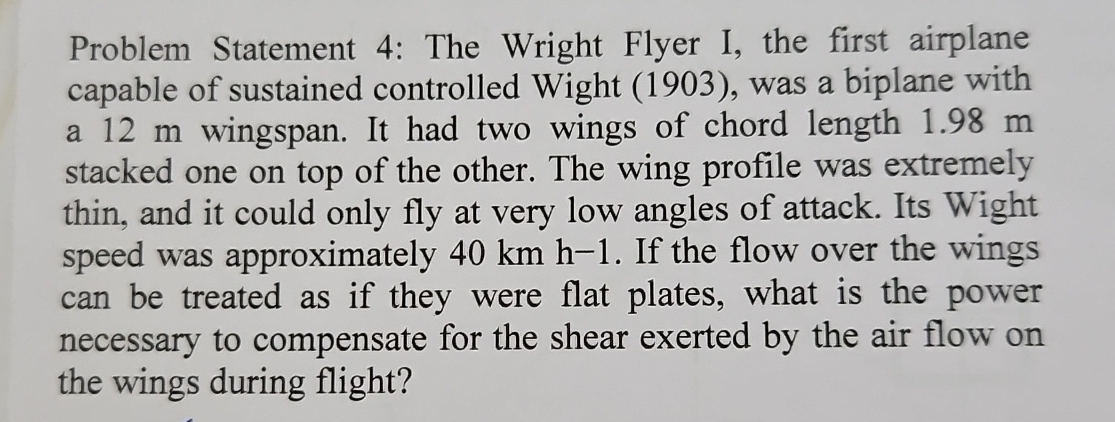
Question: Problem Statement 4 : The Wright Flyer I, the first airplane capable of sustained controlled Wight ( 1 9 0 3 ) , was a
Problem Statement : The Wright Flyer I, the first airplane capable of sustained controlled Wight was a biplane with a m wingspan. It had two wings of chord length m stacked one on top of the other. The wing profile was extremely thin, and it could only fly at very low angles of attack. Its Wight speed was approximately If the flow over the wings can be treated as if they were flat plates, what is the power necessary to compensate for the shear exerted by the air flow on the wings during flight?
Step by Step Solution
There are 3 Steps involved in it
1 Expert Approved Answer
Step: 1 Unlock

Question Has Been Solved by an Expert!
Get step-by-step solutions from verified subject matter experts
Step: 2 Unlock
Step: 3 Unlock
 Study Help