







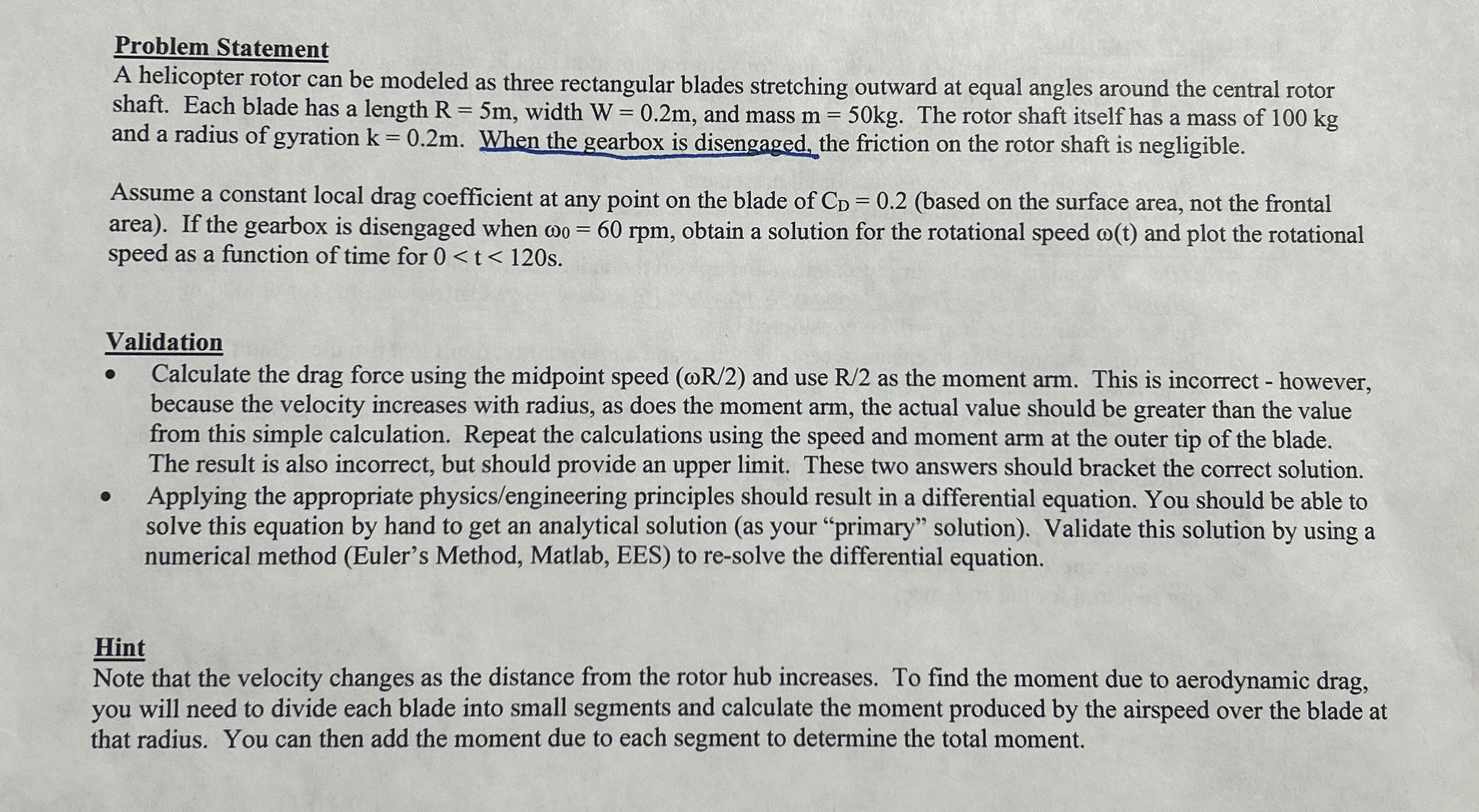
Question: Problem Statement A helicopter rotor can be modeled as three rectangular blades stretching outward at equal angles around the central rotor shaft. Each blade has
Problem Statement
A helicopter rotor can be modeled as three rectangular blades stretching outward at equal angles around the central rotor
shaft. Each blade has a length width and mass The rotor shaft itself has a mass of kg
and a radius of gyration When the gearbox is disengaged, the friction on the rotor shaft is negligible.
Assume a constant local drag coefficient at any point on the blade of based on the surface area, not the frontal
area If the gearbox is disengaged when obtain a solution for the rotational speed and plot the rotational
speed as a function of time for
Validation
Calculate the drag force using the midpoint speed and use the moment arm. This incorrect however,
because the velocity increases with radius, does the moment arm, the actual value should greater than the value
from this simple calculation. Repeat the calculations using the speed and moment arm the outer tip the blade.
The result also incorrect, but should provide upper These two answers should bracket the correct solution.
Applying the appropriate physicngineering principles should result a differential equation. You should able
solve this equation hand get analytical solution your "primary" solution Validate this solution using
numerical method Method, Matlab, EESsolve the differential equation.
Hint
Note that the velocity changes the distance from the rotor hub increases. find the moment due aerodynamic drag,
you will need divide each blade into small segments and calculate the moment produced the airspeed over the blade
that radius. You can then add the moment due each segment determine the total moment.
Step by Step Solution
There are 3 Steps involved in it
1 Expert Approved Answer
Step: 1 Unlock

Question Has Been Solved by an Expert!
Get step-by-step solutions from verified subject matter experts
Step: 2 Unlock
Step: 3 Unlock
 Study Help