







Question: Problem Statement A large sailboat has a centerboard extending 1 . 5 meters below its keel. The centerboard is essentially a thin, smooth plate with
Problem Statement
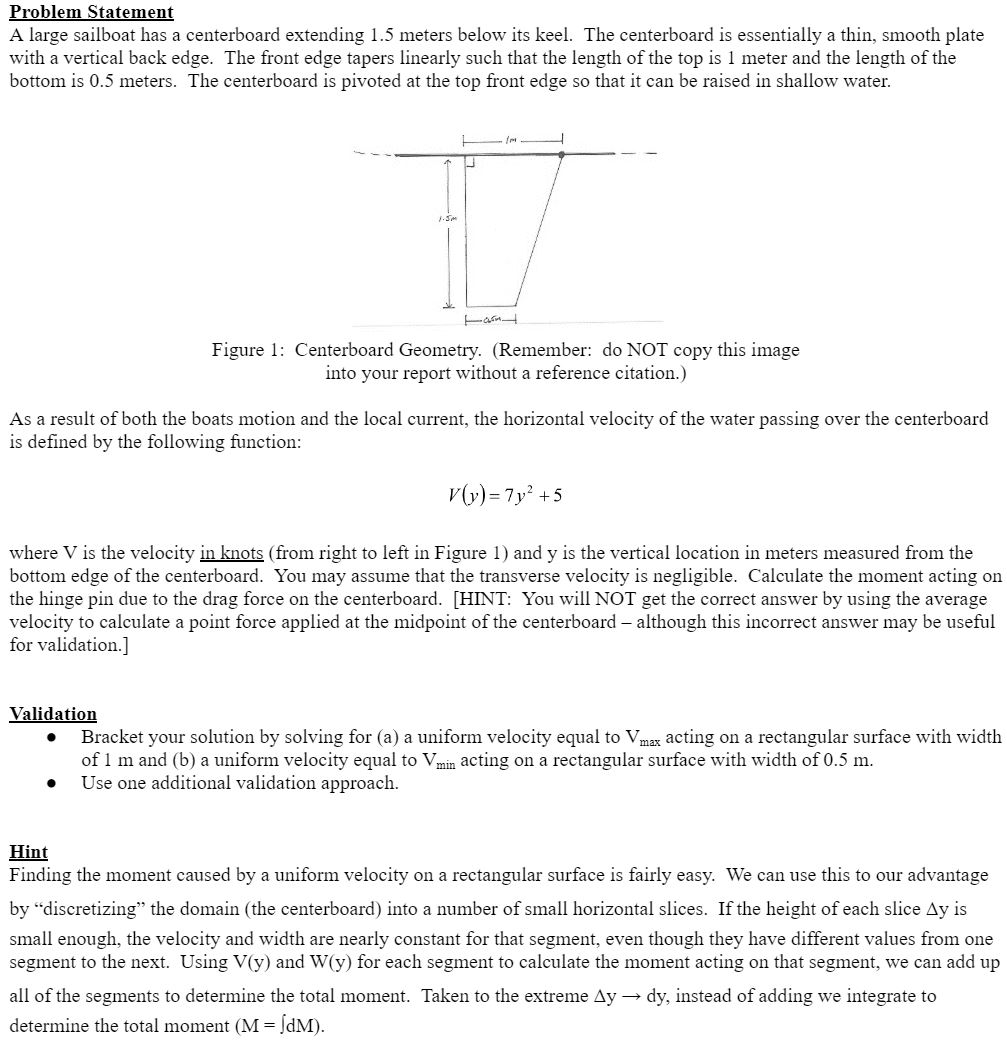
A large sailboat has a centerboard extending meters below its keel. The centerboard is essentially a thin, smooth plate
with a vertical back edge. The front edge tapers linearly such that the length of the top is meter and the length of the
bottom is meters. The centerboard is pivoted at the top front edge so that it can be raised in shallow water.
Figure : Centerboard Geometry. Remember: do NOT copy this image
into your report without a reference citation.
As a result of both the boats motion and the local current, the horizontal velocity of the water passing over the centerboard
is defined by the following function:
where V is the velocity in knots from right to left in Figure and y is the vertical location in meters measured from the
bottom edge of the centerboard. You may assume that the transverse velocity is negligible. Calculate the moment acting on
the hinge pin due to the drag force on the centerboard. HINT: You will NOT get the correct answer by using the average
velocity to calculate a point force applied at the midpoint of the centerboard although this incorrect answer may be useful
for validation.
Validation
Bracket your solution by solving for a a uniform velocity equal to acting on a rectangular surface with width
of m and b a uniform velocity equal to acting on a rectangular surface with width of m
Use one additional validation approach.
Hint
Finding the moment caused by a uniform velocity on a rectangular surface is fairly easy. We can use this to our advantage
by "discretizing" the domain the centerboard into a number of small horizontal slices. If the height of each slice is
small enough, the velocity and width are nearly constant for that segment, even though they have different values from one
segment to the next. Using and for each segment to calculate the moment acting on that segment, we can add up
all of the segments to determine the total moment. Taken to the extreme instead of adding we integrate to
determine the total moment
Step by Step Solution
There are 3 Steps involved in it
1 Expert Approved Answer
Step: 1 Unlock

Question Has Been Solved by an Expert!
Get step-by-step solutions from verified subject matter experts
Step: 2 Unlock
Step: 3 Unlock
 Study Help