







Question: Problem Statement: A pipeline system is constructed to take water ( left ( - 3 0 ^ { circ } mathrm
Problem Statement:
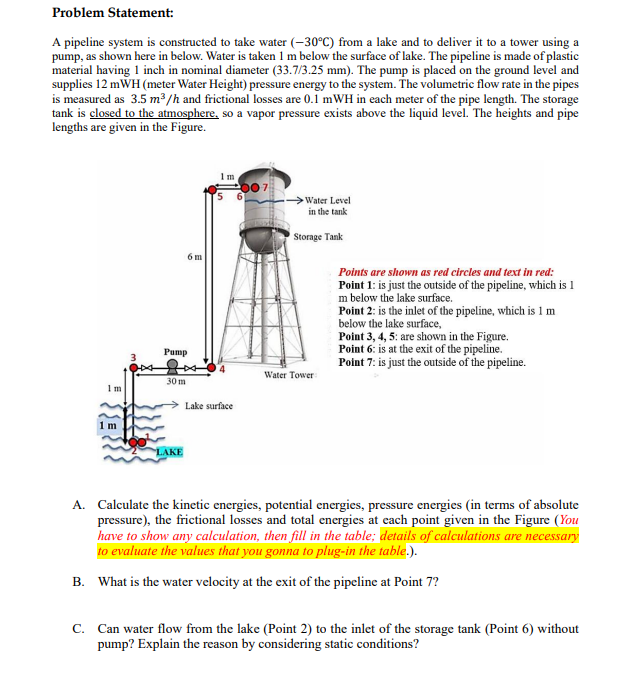
A pipeline system is constructed to take water leftcircmathrmCright from a lake and to deliver it to a tower using a pump, as shown here in below. Water is taken m below the surface of lake. The pipeline is made of plastic material having inch in nominal diameter mathrm~mm The pump is placed on the ground level and supplies mWH meter Water Height pressure energy to the system. The volumetric flow rate in the pipes is measured as mathrm~mmathrmh and frictional losses are mWH in each meter of the pipe length. The storage tank is closed to the atmosphere, so a vapor pressure exists above the liquid level. The heights and pipe lengths are given in the Figure.
rel
:
Points are shown as red circles and text in red:
Point : is just the outside of the pipeline, which is n below the lake surface.
Point : is the inlet of the pipeline, which is m elow the lake surface,
Point : are shown in the Figure.
Point : is at the exit of the pipeline.
Point : is just the outside of the pipeline.
A Calculate the kinetic energies, potential energies, pressure energies in terms of absolute pressure the frictional losses and total energies at each point given in the Figure You have to show any calculation, then fill in the table; details of calculations are necessary to evaluate the values that you gonna to plugin the table.
B What is the water velocity at the exit of the pipeline at Point
C Can water flow from the lake Point to the inlet of the storage tank Point without pump? Explain the reason by considering static conditions?
Step by Step Solution
There are 3 Steps involved in it
1 Expert Approved Answer
Step: 1 Unlock

Question Has Been Solved by an Expert!
Get step-by-step solutions from verified subject matter experts
Step: 2 Unlock
Step: 3 Unlock
 Study Help