







Question: Problem Statement Assignment 1. Description of the Situation: - Start with a clear and concise description of the situation or context in which the problem
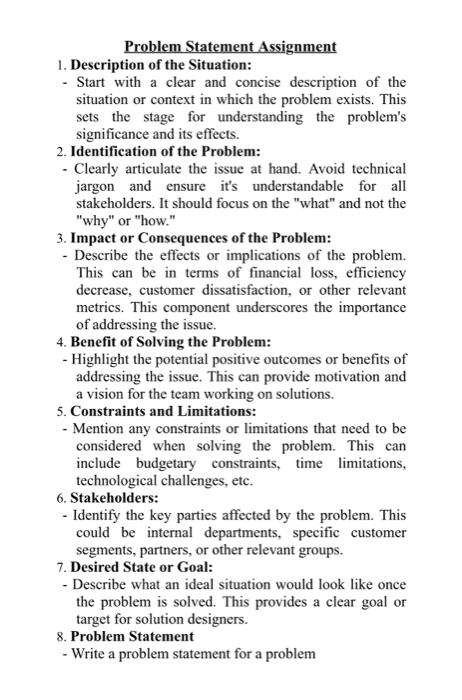
Problem Statement Assignment 1. Description of the Situation: - Start with a clear and concise description of the situation or context in which the problem exists. This sets the stage for understanding the problem's significance and its effects. 2. Identification of the Problem: - Clearly articulate the issue at hand. Avoid technical jargon and ensure it's understandable for all stakeholders. It should focus on the "what" and not the "why" or "how." 3. Impact or Consequences of the Problem: - Describe the effects or implications of the problem. This can be in terms of financial loss, efficiency decrease, customer dissatisfaction, or other relevant metrics. This component underscores the importance of addressing the issue. 4. Benefit of Solving the Problem: - Highlight the potential positive outcomes or benefits of addressing the issue. This can provide motivation and a vision for the team working on solutions. 5. Constraints and Limitations: - Mention any constraints or limitations that need to be considered when solving the problem. This can include budgetary constraints, time limitations, technological challenges, etc. 6. Stakeholders: - Identify the key parties affected by the problem. This could be internal departments, specific customer segments, partners, or other relevant groups. 7. Desired State or Goal: - Describe what an ideal situation would look like once the problem is solved. This provides a clear goal or target for solution designers. 8. Problem Statement - Write a problem statement for a
Step by Step Solution
There are 3 Steps involved in it

Get step-by-step solutions from verified subject matter experts
 Study Help