







Question: Problem statement: I was impressed with your response to my last question, so I have a new one for you. I have a thin washer
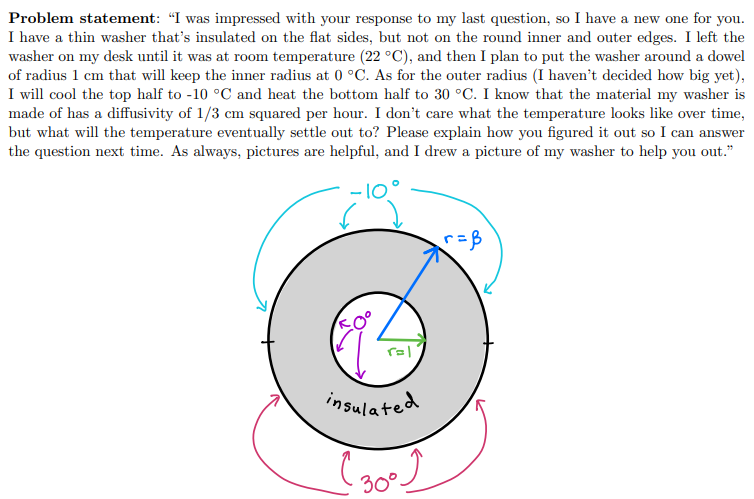
Problem statement: "I was impressed with your response to my last question, so I have a new one for you. I have a thin washer that's insulated on the flat sides, but not on the round inner and outer edges. I left the washer on my desk until it was at room temperature and then I plan to put the washer around a dowel of radius that will keep the inner radius at As for the outer radius I haven't decided how big yetI will cool the top half to and heat the bottom half to I know that the material my washer is made of has a diffusivity of squared per hour. I don't care what the temperature looks like over time, but what will the temperature eventually settle out to Please explain how you figured it out so I can answer
the question next time. As always, pictures are helpful, and I drew a picture of my washer to help you out."Problem statement: I was impressed with your response to my last question, so I have a new one for you.
I have a thin washer thats insulated on the flat sides, but not on the round inner and outer edges. I left the
washer on my desk until it was at room temperature C and then I plan to put the washer around a dowel
of radius cm that will keep the inner radius at C As for the outer radius I havent decided how big yet
I will cool the top half to C and heat the bottom half to C I know that the material my washer is
made of has a diffusivity of cm squared per hour. I dont care what the temperature looks like over time, but what will the temperature eventually settle out to
Can someone please help me solve this question?
Step by Step Solution
There are 3 Steps involved in it
1 Expert Approved Answer
Step: 1 Unlock

Question Has Been Solved by an Expert!
Get step-by-step solutions from verified subject matter experts
Step: 2 Unlock
Step: 3 Unlock
 Study Help