







Question: Problem Statement | In order to familiarize yourself with the format of the nal exam, this week's Quizbit will be a series of multiple select
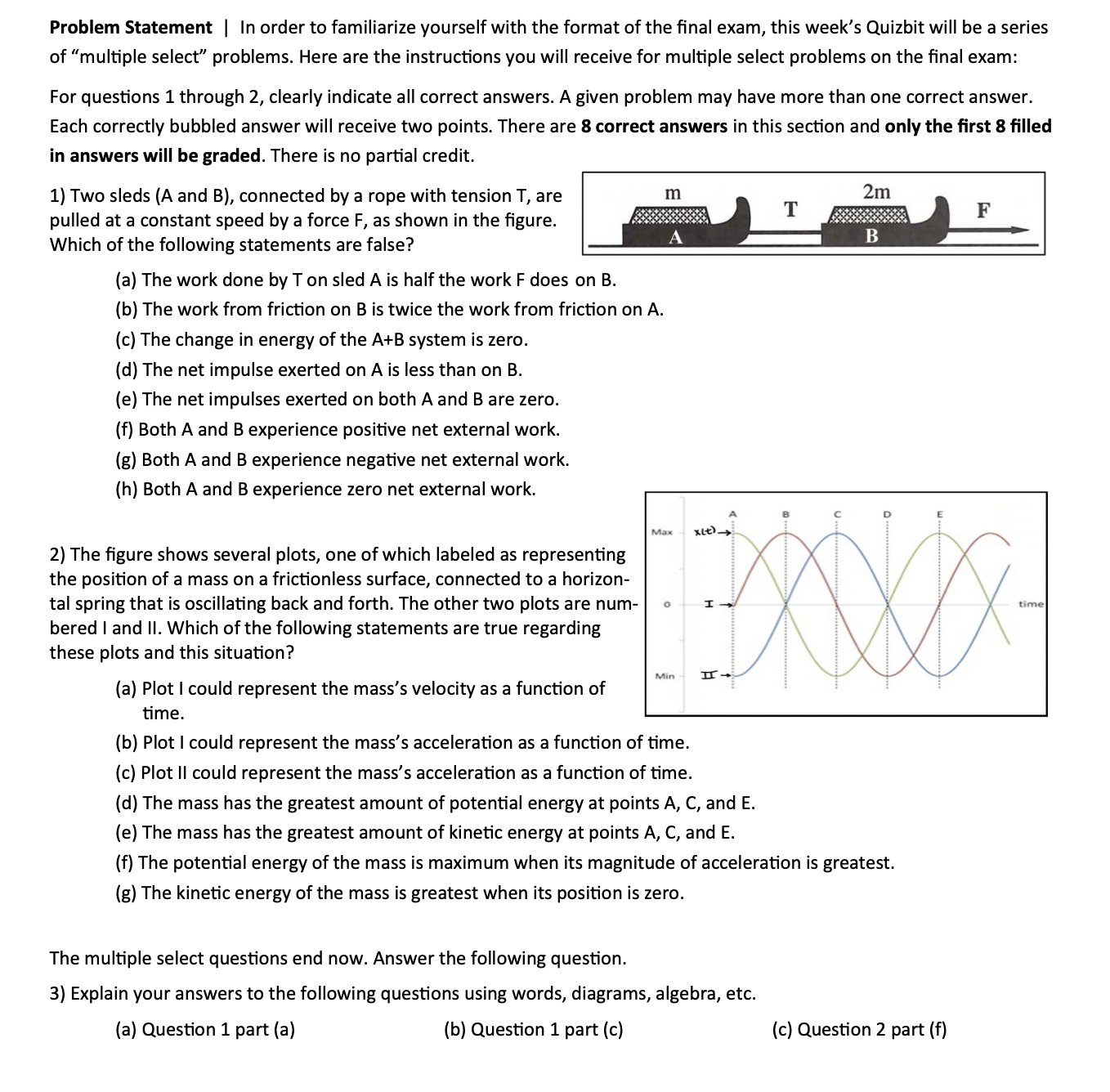
Problem Statement | In order to familiarize yourself with the format of the nal exam, this week's Quizbit will be a series of "multiple select\" problems. Here are the instructions you will receive for multiple select problems on the nal exam: For questions 1 through 2, clearly indicate all correct answers. A given problem may have more than one correct answer. Each correctly bubbled answer will receive two points. There are 8 correct answers in this section and only the rst 8 lled in answers will be graded. There is no partial credit. 1) Two sleds {A and B}, connected by a rope with tension T, are pulled at a constant speed by a force F, as shown in the gure. Which of the following statements are false? (a) The work done by T on sled A is half the work F does on B. {b} The work from friction on B is twice the work from friction on A. (c) The change in energy of the A+B system is zero. id} The net impulse exerted on A is less than on B. (e) The net impulses exerted on both A and B are zero. if} Both A and B experience positive net external work. (g) Both A and B experience negative net external work. {h} Both A and B experience zero net external work. 2} The gure shows several plots, one of which labeled as representing the position of a mass on a frictionless surface, connected to a horizon- tal spring that is oscillating back and forth. The other two plots are num- bered | and II. Which of the following statements are true regarding these plots and this situation? (a) Plot I could represent the mass's velocity as a function of time. (bl Plot I could represent the mass's acceleration as a function of time. (c) Plot N could represent the mass's acceleration as a function of time. (d) The mass has the greatest amount of potential energy at points A, C, and E. (e) The mass has the greatest amount of kinetic energy at points A, C, and E. {f} The potential energy of the mass is maximum when its magnitude of acceleration is greatest. (g) The kinetic energy of the mass is greatest when its position is zero. The multiple select questions end now. Answer the following question. 3) Explain your answers to the following questions using words, diagrams, algebra, etc. (a) Question 1 part (a) (b) Question 1 part (cl (c) Question 2 part (f)
Step by Step Solution
There are 3 Steps involved in it

Get step-by-step solutions from verified subject matter experts
 Study Help